
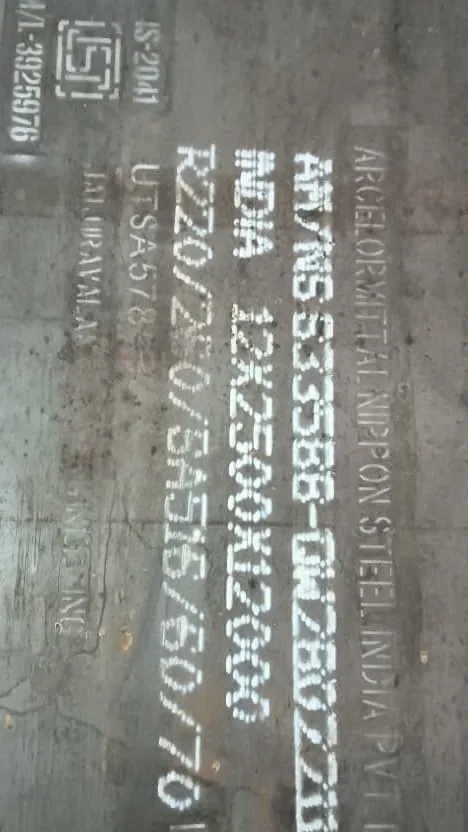
Key takeaways: SA516 Gr 70 HIC plate at a glance
- PVQ carbon steel to ASTM A516 / ASME SA-516 with ASTM A20 general requirements, the same 70-ksi pressure-vessel grade as standard A516 Gr 70 plate, qualified for sour duty.
- HIC-tested to NACE TM0284 in NACE Solution A against crack length, thickness and sensitivity ratios (CLR / CTR / CSR).
- Sour-service compliant to NACE MR0175 / ISO 15156, base-metal hardness capped and condition controlled for wet-H2S environments.
- Clean steel practice, killed, fine-grain, with very low sulfur and calcium treatment for sulfide shape control.
- Normalized for low-temperature Charpy toughness. Every order ships with a NACE TM0284 HIC report and an EN 10204 3.1/3.2 mill test certificate.
What is SA516 Gr 70 NACE-HIC plate?
SA516 Gr 70 NACE-HIC plate is the compliance-qualified version of standard PVQ pressure-vessel steel carbon plate. It's the same 70-ksi steel defined by ASME SA-516 / ASTM A516, but it's made to a tighter, cleaner chemistry. A hydrogen-induced-cracking test then proves it out for sour, wet-H2S service.
In plain terms, the grade carries two layers of specification. The base layer is A516 Gr 70 itself, a killed, fine-grain carbon-manganese steel built for moderate- and lower-temperature pressure vessels. The sour-service layer adds low-sulfur, calcium-treated melting for inclusion shape control. It also usually calls for a normalizing heat treatment, a NACE TM0284 HIC test, and conformance to the materials limits of NACE MR0175 / ISO 15156. If you're specifying a sour vessel, call out the HIC-tested variant by name. Plain Gr 70 won't give you the test evidence a project audit demands.
Why sour service needs HIC plate: wet H2S & hydrogen damage
When a carbon-steel vessel holds water alongside hydrogen sulfide (H2S), the H2S pushes atomic hydrogen into the steel rather than letting it recombine into harmless gas at the surface. That hydrogen gathers at internal flaws, usually elongated manganese-sulfide inclusions, and the pressure builds until the metal cracks from within. A516 Gr 70 in its base form is vulnerable to this kind of sour-service cracking. The HIC variant was developed specifically to stand up to it. That's why sour service (wet H2S) falls under dedicated materials standards instead of ordinary code chemistry.
Hydrogen-induced cracking (HIC) & stepwise cracking
Hydrogen-induced cracking produces flat, blister-like cracks running parallel to the plate surface, and no external stress is needed to form them. When cracks on neighboring planes link up through the thickness, the result is the classic "stepwise" pattern. The cracks nucleate at inclusions, so resistance to HIC is really won back in the steelmaking ladle, by keeping sulfur very low and shaping what sulfides remain through calcium treatment, long before the plate ever reaches the vessel.
How it differs from SSC and SOHIC
HIC comes from hydrogen pressure building up at inclusions, and it needs no applied load to occur. Sulfide stress cracking, by contrast, does require tensile stress plus a hard microstructure, which is exactly why hardness limits on base metal, weld and HAZ are the way it's controlled. Stress-oriented HIC sits somewhere in between: stacked HIC cracks that line up and grow under applied or residual stress, usually near welds. HIC testing targets the inclusion-driven mechanism. MR0175 hardness control, on the other hand, targets the ones driven by stress.
When HIC testing is required
HIC-tested plate gets called out when a carbon-steel component will sit in contact with a wet phase carrying H2S above the threshold set by the project's sour-service assessment. In practice, the owner's materials or corrosion engineer writes the requirement into the material requisition against MR0175 / ISO 15156, naming NACE TM0284 along with the acceptance ratios to apply. Once the wet-H2S exposure clears that limit, specify HIC plate instead of standard Gr 70.
HIC testing & acceptance: NACE TM0284 (CLR/CTR/CSR)
NACE TM0284 is the standard lab test for resistance to hydrogen-induced cracking. Specimens cut from the plate go into an acidified, H2S-saturated aqueous test environment (commonly NACE Solution A) for a fixed exposure. They're then sectioned and checked for cracks. The result comes out as three ratios, each averaged over the specimen sections and measured against an agreed acceptance limit.
| Parameter | Definition | Typical acceptance limit* |
|---|---|---|
| CLR, Crack Length Ratio | Sum of crack lengths ÷ section width | ≤ 15% |
| CTR, Crack Thickness Ratio | Sum of crack thicknesses ÷ section thickness | ≤ 5% |
| CSR, Crack Sensitivity Ratio | Sum of (crack length × thickness) ÷ (section area) | ≤ 2% |
*Typical / project-specified values. The exact CLR/CTR/CSR limits and test solution are set by the purchaser's specification; confirm the figures required for your vessel on the RFQ and they are certified against the mill HIC report.
Sour-service metallurgy: low sulfur + calcium treatment
HIC resistance comes down to cleanliness. Cracks start at elongated sulfide inclusions, so the plate gets melted to very low sulfur, well below the base-spec ceiling, then treated with calcium so the leftover sulfides solidify as small, globular particles instead of long stringers. That inclusion shape control, paired with killed, fine-grain practice and a controlled carbon equivalent, is what lets the plate pass TM0284 where ordinary Gr 70 would fail.
NACE MR0175 / ISO 15156 compliance: hardness & condition
NACE MR0175 / ISO 15156 lays out materials requirements for metals used in H2S-containing oil-and-gas service. For carbon steel, it works mainly through hardness and supply condition, because hard microstructures are prone to sulfide stress cracking. The plate gets supplied in a prescribed heat-treated condition. For HIC Gr 70, that's normally the normalized condition. Hardness is kept under the specified cap.
| Requirement | Typical basis* |
|---|---|
| Base-metal hardness | ≤ 200 HBW (carbon steel, typical) |
| Weld & HAZ hardness | ≤ 248 HV10 / 22 HRC, as specified |
| Supply condition | Normalized (as required for sour duty) |
| PWHT | As required by code / to control weld-zone hardness |
*Typical or as-specified limits per MR0175 and ISO 15156 and the project specification; confirm the hardness cap your order has to certify to on the RFQ.
Chemical composition
The table shows SA-516 Gr 70 chemistry as restricted for HIC service. The specification ranges follow ASTM A516 / A20; the HIC columns call for tighter sulfur and phosphorus, the kind typically required for sour duty, along with calcium treatment. Carbon and manganese limits shift with plate thickness, per the specification.
| Element | SA-516 Gr 70 (spec, wt%) | HIC-restricted (typical, wt%) |
|---|---|---|
| Carbon (C) | ≤ 0.27 (thickness-dependent) | ≤ 0.22, low carbon equivalent |
| Manganese (Mn) | 0.85–1.20 | 0.85–1.20 |
| Phosphorus (P) | ≤ 0.025 | ≤ 0.015 |
| Sulfur (S) | ≤ 0.025 | ≤ 0.002 |
| Silicon (Si) | 0.15–0.40 | 0.15–0.40 |
| Calcium (Ca) | – | Ca-treated (sulfide shape control) |
HIC-restricted figures are typical house or project values, not a guaranteed absolute. The exact limits get agreed per order against your specification. Steel is supplied killed and fine-grain.
Killed, fine-grain practice & inclusion shape control
A516 Gr 70 is fully killed steel made to fine austenitic grain-size practice, and that gives the matrix the uniform, deoxidized quality a pressure vessel needs. For HIC plate, that base practice gets extended with low sulfur content and calcium treatment, so the sulfide inclusions stay small and rounded rather than elongated. Those inclusions are where hydrogen cracks start. Shape control of inclusions is the metallurgical core of a sour-service plate.
Mechanical properties
SA-516 Gr 70 hits the 70-ksi minimum tensile that gives the grade its number. HIC restriction and normalizing don't touch those code minima. What they add is cleanliness and toughness on top.
| Property | SA-516 Gr 70 requirement |
|---|---|
| Tensile strength | 485–620 MPa (70–90 ksi) |
| Yield strength (0.2%) | ≥ 260 MPa (38 ksi) |
| Elongation (in 200 mm) | ≥ 17% |
| Elongation (in 50 mm) | ≥ 21% |
Impact toughness: Charpy & normalizing
Sour-service vessels usually run cold, so Charpy V-notch (CVN) impact testing at the design minimum temperature isn't an afterthought, it's a core requirement. That's why HIC Gr 70 plate is almost always supplied normalized. The normalizing heat treatment refines the grain structure and pushes low-temperature toughness well above what as-rolled plate can deliver. A typical requirement calls for a minimum average absorbed energy (for example, ≥ 27 J / 20 ft·lb) at a specified low temperature; the exact energy and test temperature depend on the vessel design. For the toughness-only heat-treat case without the HIC requirement, see normalized A516 Gr 70 plate.
Physical properties
| Property | Value (approx.) |
|---|---|
| Density | 7.85 g/cm³ |
| Elastic modulus | ~200 GPa |
| Thermal conductivity | ~52 W/m·K |
| Mean CTE | ~12 µm/m·°C |
| Magnetic response | Ferromagnetic |
Equivalent grades & designations
ASTM A516 Gr 70 and ASME SA-516 Gr 70 are the same steel. The chemistry and the mechanical requirements match exactly; the ASME designation is simply the construction-code adoption of the ASTM specification. EN 10028-2 P355GH comes closest as a European pressure-vessel reference. It sits near the same strength class, but it isn't an identical grade.
| System | Designation | Note |
|---|---|---|
| ASTM | A516 Grade 70 | Base specification |
| ASME | SA-516 Grade 70 | Identical; code adoption of A516 |
| EN 10028-2 | P355GH | Nearest reference, not identical |
| General requirements | ASTM A20 / ASME SA-20 | Governs PVQ plate ordering |
SA516 Gr 70 HIC plate vs the alternatives: when to choose it
Choosing a sour-service plate comes down to two things: how bad the wet-H2S exposure is, and how much compliance paperwork the project needs. The ladder below starts at the standard grade and climbs up to clad construction.
| Option | When to choose it |
|---|---|
| SA516 Gr 70 HIC plate | Wet-H2S sour service needing proven HIC resistance and MR0175 compliance |
| Standard A516 Gr 70 plate | Non-sour pressure vessels with no wet-H2S exposure |
| A516 Gr 60 (HIC) | Lower strength class acceptable; thinner, lower-design-stress sour vessels |
| Clad / CRA-lined plate | Severe sour or corrosive service beyond carbon steel's limits |
vs standard (non-HIC) A516 Gr 70 plate
Standard A516 Gr 70 plate carries the same strength but is not melted to HIC-grade cleanliness and is not tested to TM0284. For any wet-H2S duty it is the wrong choice, the HIC variant exists precisely because plain Gr 70 is susceptible to sour-service cracking.
vs Gr 60 HIC
A516 Gr 60 in a HIC condition delivers the same sour-service qualification, just at a lower strength class: 60-ksi tensile. It fits thinner vessels, or ones with lower design stress, where you don't need the extra strength of Gr 70. Beyond that, the sour-service metallurgy is the same story.
vs A537 / clad (CRA-lined) plate for severe sour
Where carbon steel can't handle the environment at all, high H2S partial pressure plus chlorides or CO2, the answer is to move up to a higher-toughness quenched-and-tempered grade, or go with a corrosion-resistant-alloy-clad plate. HIC Gr 70 works fine up to that point. Past it, the vessel needs a CRA liner.
Forms, thickness ranges & plate sizes
A516 Gr 70 only comes as plate. That's the primary mill form, really the only one, coil isn't an option for this steel. HIC-grade plate, meaning low-sulfur and calcium-treated, is available across the usual pressure-vessel thickness range. Exact thickness, width and length depend on current stock and rolling position, so those get confirmed per inquiry.
Other A516 Gr 70 forms & variants
For the full grade family and its heat-treat and strength variants, check the A516 Gr 70 grade hub. Standard plate is covered at standard A516 Gr 70 plate, and the normalized version lives at normalized A516 Gr 70 plate. Its sibling, A516 Gr 60, rounds things out.
Plate weight & how to calculate
Carbon-steel plate weight comes straight from volume times density. Multiply the plate's dimensions by the density of steel, 7.85 g/cm³:
Weight (kg) = thickness (mm) × width (m) × length (m) × 7.85
For a 20 mm × 2.0 m × 6.0 m plate: 20 × 2.0 × 6.0 × 7.85 = 1,884 kg. Want a quick cross-check on a different size? Try the weight calculator, or walk through the method yourself with how to calculate steel plate weight.
Standards & specifications complied
- ASTM A516 / ASME SA-516, pressure-vessel plates, carbon steel, for moderate- and lower-temperature service.
- ASTM A20 / ASME SA-20, general requirements for steel plates for pressure vessels (ordering, testing, tolerances).
- NACE TM0284, laboratory test for resistance to hydrogen-induced cracking (CLR / CTR / CSR in NACE Solution A).
- NACE MR0175 / ISO 15156, materials for use in H2S-containing environments in oil-and-gas production (hardness, condition).
- EN 10204 3.2 mill test certificate, certification and traceability of the supplied plate.
Testing, inspection & certification
Each HIC plate order comes with the test package a sour-service audit needs. The NACE TM0284 HIC report documents the CLR/CTR/CSR results against the agreed acceptance limits. An MR0175 / ISO 15156 hardness survey confirms the base-metal hardness cap. Charpy V-notch impact testing is reported at the specified low temperature. Ultrasonic examination to SA-578 / A20 supplementary requirements screens the plate for internal laminations, a known rejection cause in HIC-grade material. Full material traceability links every plate to its heat, and an EN 10204 3.1/3.2 mill test certificate comes with every order. To see how the paperwork reads, check testing, MTC, NDT & PMI.
Applications of SA516 Gr 70 HIC plate by industry
HIC-tested Gr 70 plate is the workhorse carbon plate for wet-H2S pressure equipment. It's specified for:
- Sour oil & gas service, separators, knock-out drums, slug catchers and amine-contact vessels that handle sour hydrocarbon and produced water.
- Refining & petrochemical, amine regenerators, sour-water strippers and the drums tied to them, wherever wet H2S shows up.
- Pressure vessels & boilers, code-stamped vessels and storage units that fall under a sour-service material requisition.
Fabrication, welding & PWHT
The sour-service story doesn't end at the mill. Fabrication matters just as much: a HIC plate installed with hard weld zones can still fail by sulfide stress cracking. Welding procedures get qualified to keep weld-metal and heat-affected-zone hardness under the MR0175 cap. That usually means controlled heat input, low-hydrogen consumables that match the base metal, and post-weld heat treatment wherever the code or the hardness requirement demands it. PWHT does double duty here, since it also relieves the residual stress that would otherwise drive SOHIC. For the full workflow, from requisition to weld map, see how to specify A516 for a sour-service vessel.
Price & how we quote
We quote SA516 Gr 70 HIC plate on RFQ against live pricing. There's no fixed price table for it, because the number depends on thickness, size, HIC acceptance limits, impact requirements and quantity. Send us the thickness, dimensions, acceptance ratios and the MR0175 condition your vessel needs, and we'll get back to you with a current quotation and the test scope confirmed. All products are held ex-stock for immediate dispatch where the required HIC heat is available; for sizes outside stock, we roll to order.
FAQ
What is HIC testing in plate?
Is A516 Gr 70 suitable for sour service?
What are the CLR, CTR and CSR acceptance limits?
When is HIC testing required?
What's the difference between HIC and normalized A516 Gr 70 plate?
Do you provide the HIC report and mill test certificate?
Request a quote
Nandini Steel has held ISO 9001:2015 certification since it started in 2003, working as a stockist and supplier of PVQ carbon steel, stainless and nickel-alloy products. Over more than 20 years it has supplied 307+ projects, served 260+ clients and shipped to 36+ export countries. Send your SA516 Gr 70 HIC plate inquiry with thickness, dimensions, HIC acceptance limits and the MR0175 condition required. We'll respond with a current RFQ and confirmed test scope.
- Phone: +91 22 43404600 · +91 9920209184
- WhatsApp: +91 99202 09184
- Email: reachus@nandinisteel.com
- Address: 25, Dreamland Building, 601, 6th Floor, Mama Parmanand Marg, Charni Road, Opera House, Girgaon, Mumbai, Maharashtra 400004, India
- GSTIN: 27ADJPA7240C1Z0
Related grades to cross-shop
Part of our steel plate range.