
Why Austenitic Stainless Dominates Hygienic Processing
Food-contact equipment must be non-reactive, free of crevices that harbor bacteria, and able to withstand aggressive cleaning chemistry without releasing metal ions into product. Austenitic stainless steels deliver all three. Their chromium content forms a self-repairing passive oxide film that resists the organic acids, salts, and chlorinated sanitizers common in dairies, breweries, beverage lines, and commercial kitchens.
The two workhorse families are 304 and 304L for general duty and 316 and 316L where chlorides are present. The difference comes down to molybdenum: 316 carries 2 to 3 percent Mo, which lifts its pitting resistance well above 304. The most common buyer error is defaulting to 304 for chloride-adjacent duty, where it pits. Confirm the actual service chlorides before choosing 304 over 316, since stepping up is far cheaper than a failed tank.
The L-Grades and Welded Hygienic Fabrication
Tanks, vessels, and process piping are welded, and the heat-affected zone of a weld is exactly where corrosion starts if carbon is high. Holding a standard grade in the 425 to 815 °C range precipitates chromium carbides at grain boundaries, a condition called sensitization that strips the local chromium and leaves the weld prone to intergranular corrosion. The fix is the low-carbon L grade (C ≤ 0.03%), which avoids sensitization without post-weld annealing. For welded food and pharma work, specify 304L or 316L so the HAZ stays corrosion-resistant. See our guide on how to prevent sensitization and how to weld 316L.
Grade Selection by Product and Media
| Service / media | Recommended grade | Why |
|---|---|---|
| Dry goods, grain, bakery, low-chloride water | 304 / 304L | Cost-effective, fully hygienic, PREN ~18 |
| Dairy, milk, cheese whey | 304L / 316L | 316L where chloride sanitizers or brine are used |
| Brewing, wort, cleaning chemistry | 304L / 316L | 316L for high-temperature caustic and acid CIP |
| Soft drinks, juices, acidic beverages | 316 / 316L | Resists organic and citric acid attack |
| Brines, pickling, salted products, seafood | 316L | Molybdenum resists chloride pitting |
| Hot concentrated chlorides, severe duty | 904L and above | Super-austenitic PREN ~34 when 316L is outrun |
Buyers sometimes pay for 316 where dry, indoor, non-chloride 304 would serve, and occasionally under-spec 316 for hot concentrated chlorides where 904L or duplex is really needed. The 2 to 3 percent molybdenum is what you are buying, so match it to the real pitting risk. Our grade selector tool and the 304 vs 316 comparison help pin the choice.
Composition and Pitting Resistance
| Grade | UNS | Key chemistry | PREN (approx.) | Typical food use |
|---|---|---|---|---|
| 304 / 304L | S30400 / S30403 | 18% Cr, 8% Ni, C ≤ 0.03% (L) | ~18 | General, dry, low-chloride |
| 316 / 316L | S31600 / S31603 | 16% Cr, 10% Ni, 2–3% Mo | ~24 | Brine, acids, sanitizers |
| 904L | N08904 | ~25% Ni, ~4.5% Mo, ~1.5% Cu | ~34 | Severe chloride/acid duty |
PREN (Pitting Resistance Equivalent Number) ranks chloride resistance: 304 (~18) < 316 (~24) < 904L (~34). Read more on PREN and pitting resistance and 304L vs 316L.
Surface Finishes for Hygienic Design
Cleanability is a function of surface roughness. Smoother surfaces shed soil faster, drain fully, and give bacteria fewer places to colonize. Hygienic design standards typically call for a food-contact surface roughness at or below Ra 0.8 µm, which the standard mill finishes meet or can be polished to.
| Finish | Description | Typical food use |
|---|---|---|
| 2B | Cold-rolled, annealed, pickled, lightly skin-passed; smooth matte | Tanks, vessels, general process plate and sheet |
| BA (bright annealed) | Bright reflective, very low Ra | Dairy and pharma interiors, tube, high-cleanability vessels |
| No.4 | Brushed/directional ground | Worktops, benches, visible exterior panels |
The full breakdown is in our guide to 2B, BA and No.4 stainless finishes. We supply 316 sheet, 316L sheet, 304 sheet, 304L sheet, and 316L coil in these finishes ex-stock.
Passivation and the CIP Surface
Fabrication, welding, and grinding contaminate the surface with free iron and leave heat tint that is far less corrosion-resistant than the base metal. Passivation removes that free iron and restores a uniform chromium-rich oxide, which is what actually resists the acid and caustic cycles of clean-in-place. Weld areas should be pickled to strip heat tint, then passivated. See how to passivate stainless steel and the background on passivation of stainless steel.
Clean-in-Place (CIP) and Material Durability
CIP automates cleaning by circulating hot caustic, acid, and sanitizer through closed equipment. The sequence is punishing: alkaline wash near 80 °C, acid rinse, and chlorinated or peracetic sanitizers. Chloride-bearing sanitizers are the main reason brine-free lines still upgrade to 316L, because repeated chloride exposure at temperature drives pitting on 304. For hot, chloride-heavy CIP, 316L is the safe default, and genuinely severe duty moves to 904L.
Hygienic CIP design also depends on geometry: full drainage, no dead legs, crevice-free welds, and smooth internal finishes. The material choice and the finish work together, which is why grade, finish, and passivation are specified as one package.
Forms We Supply for Food and Beverage Plants
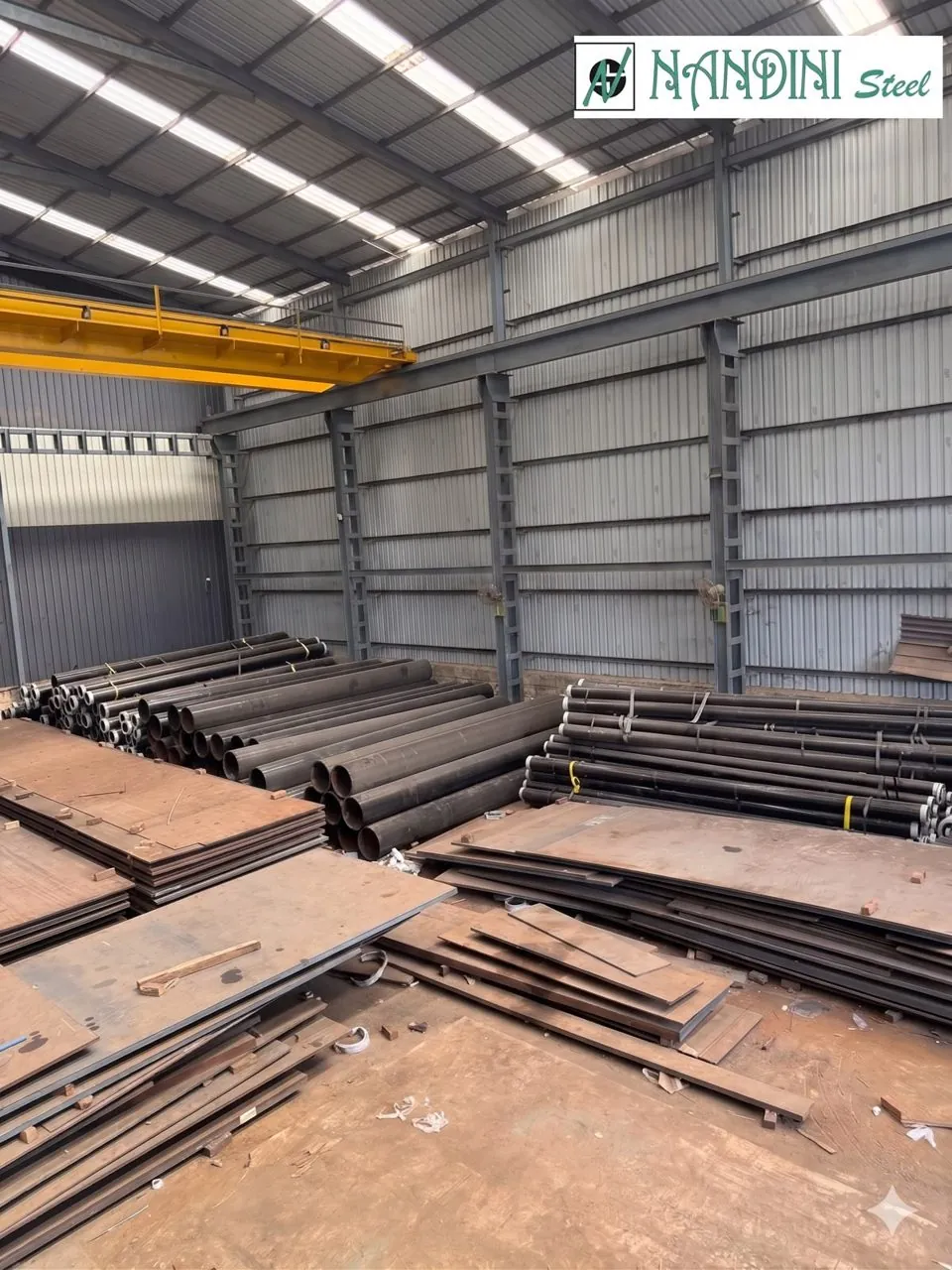
Nandini Steel stocks the full range for hygienic fabrication: stainless steel pipes, pipe fittings, flanges, and round bars, plus sheet, plate, and coil. Process piping typically conforms to ASTM A312; flat product for tanks and vessels conforms to ASTM A240 / ASME SA-240 with general requirements under ASTM A480. Every order ships with an EN 10204 3.1 or 3.2 mill test certificate for full traceability.
Established in 2003, Nandini Steel is an ISO 9001:2015-certified stockist and supplier (Cert No. 1283438, Unitas Certification Services, valid to 11 January 2028) serving 260+ clients across 36+ export countries on 307+ projects. All products are ex-stock for immediate dispatch.
Related reading: how to select a stainless grade, austenitic stainless steel, the food and dairy application page, and the pharmaceutical application page.
Frequently Asked Questions
Is 304 or 316 stainless steel better for food processing?
Why use L-grade stainless (304L/316L) for welded food equipment?
What surface finish is required for food-contact stainless?
Does stainless need passivation before food service?
Can 316L withstand clean-in-place (CIP) chemistry?
Do your food-grade stainless products come with test certificates?
Request a Quote
Tell us your product, media, chloride level, and finish, and the Nandini Steel team will match the grade and form from ex-stock. Call +91 22 43404600, WhatsApp +91 99202 09184, or email reachus@nandinisteel.com for live pricing and an EN 10204 3.1/3.2 certified quote.