
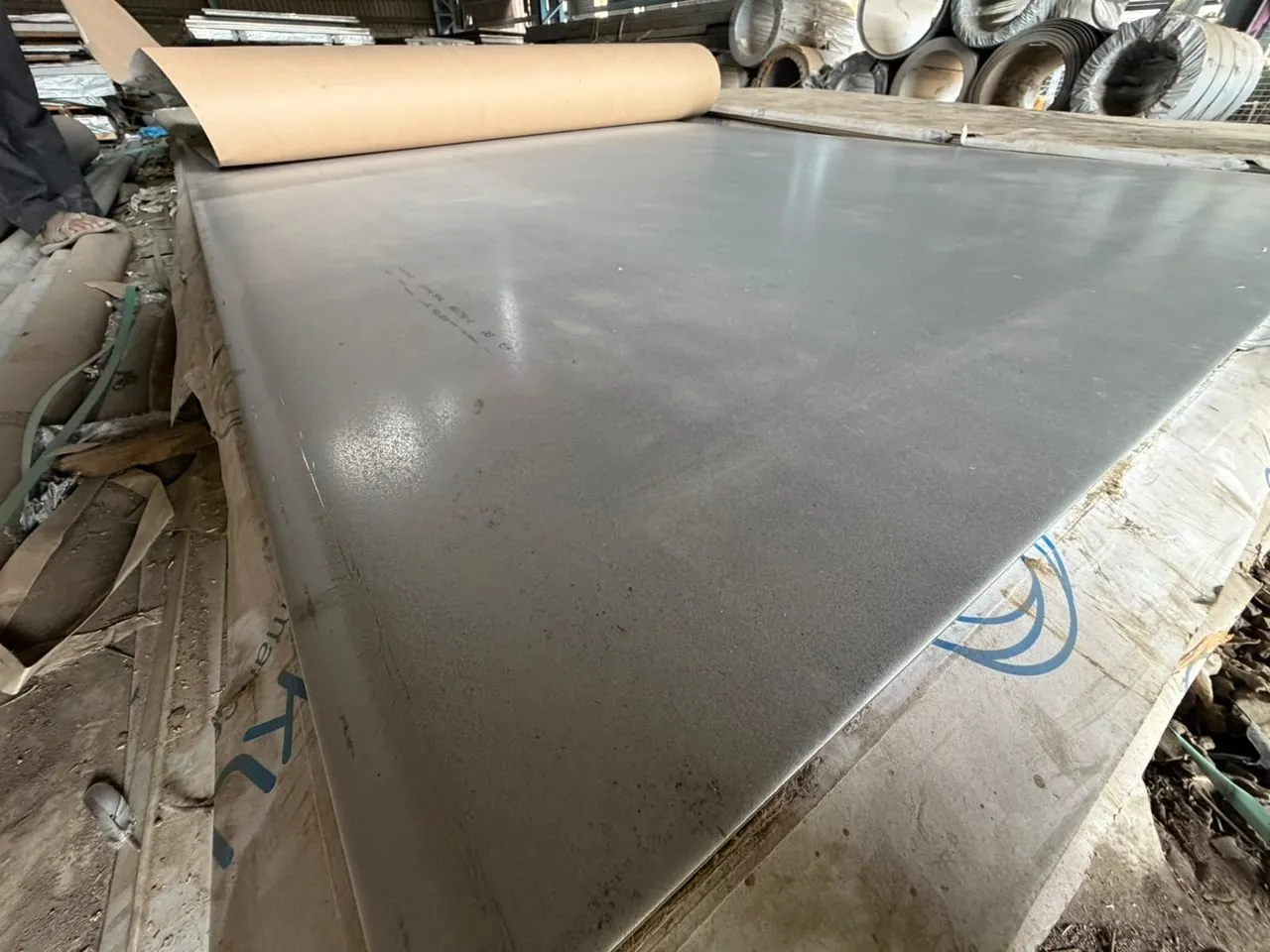
What you'll calculate and why plate weight matters
This guide computes theoretical weight for a flat rectangular plate using true, grade-specific density, the figure that drives costing, freight and lifting before you ever raise an RFQ. Corrosion-resistant and pressure-vessel plate gets sold per kilogram, so whatever weight you calculate becomes the quantity you pay for.
- Price: CRA and PVQ plate gets quoted per kg, so weight drives cost directly. Get the density wrong and the budget follows it.
- Freight & lifting: Container payload, crane capacity and nesting yield all hinge on an accurate mass per plate, not a round-number guess.
- Density is a grade property: Identical dimensions weigh different amounts across grades because nickel and molybdenum raise density. A generic "steel = 7.85" calculator will over- or under-state a 904L, Incoloy 825 or duplex order.
What you need before you start
Four things determine the answer. Three are dimensions, and the fourth, density, shifts with the grade. That's why a cross-grade stockist lists it per grade instead of just assuming carbon steel.
The grade: it sets the density
Fix the grade first, because the grade fixes the density. Austenitic stainless 304, 316 and 321 don't carry the same density as super-austenitic 904L, Ni-Fe-Cr Incoloy 825, duplex 2205 or PVQ carbon A516. Each one is different. Pull the correct value from the grade density chart below.
The three dimensions and a consistent unit system
You need length, width and thickness. Keep every dimension in one system: all metric (meters and millimeters) or all imperial (feet and inches). Mixing a metric length with an imperial thickness is the most common way to get a wrong result.
The density value
Density comes in grams per cubic centimeter (g/cm³), kilograms per cubic meter (kg/m³), or pounds per cubic inch (lb/in³). All three measure the same physical property, known as specific gravity. The chart below lists each grade in all three units, so whichever formula you're working with, the number drops straight in.
The tolerance standard that defines actual thickness
The calculated weight is only theoretical. Actual plate comes rolled to a thickness tolerance, almost always on the plus side, so the weighbridge reading tends to land a bit above that theoretical figure. For stainless flat product, thickness tolerance falls under ASTM A480, which sets the general requirements behind ASTM A240 plate. PVQ plate works much the same way, governed by ASTM A20, the general requirements standard behind ASTM A516. Both get accounted for during reconciliation.
The steel plate weight formula
Both systems express the same relationship: volume times density. Pick whichever matches your input units, and stick with that choice throughout.
| Case | Formula |
|---|---|
| Metric (rectangular) | weight (kg) = L (m) × W (m) × thickness (mm) × density (g/cm³) |
| Per square meter shortcut | kg/m² = thickness (mm) × density (g/cm³) |
| Imperial (rectangular) | weight (lb) = L (ft) × W (ft) × thickness (in) × density (lb/in³) × 144 |
| Circle / disc | weight (kg) = (π ÷ 4) × D (m)² × thickness (mm) × density (g/cm³) |
Metric
For a rectangular plate, weight (kg) equals L (m) times W (m) times thickness (mm) times density (g/cm³). That unit mix isn't an accident. Expressing thickness in millimeters and density in g/cm³ cancels out cleanly to kilograms, so you skip the hassle of converting the plate down to meters cubed by hand.
Per square meter shortcut
For a one-square-meter plate, length times width equals 1, which means kg/m² works out to thickness in millimeters times density in g/cm³. Multiply that figure by the plate's area in square meters and you've got the plate weight. That's the number shown in the quick-reference chart below.
Imperial
Work in feet, inches and pounds, and the formula comes out as: weight (lb) = L (ft) × W (ft) × thickness (in) × density (lb/in³) × 144. That 144 is there to turn square feet into square inches, so the lb/in³ density figure can be applied without any extra conversion. Want a per-square-foot rate instead? Use lb/ft² = thickness (in) × density (lb/in³) × 144.
Step-by-step: calculate the weight of a steel plate
- Identify the grade and look up its density. Confirm the UNS/grade on the order, then read its density from the chart below, for example 316 at 8.00 g/cm³, not a generic 7.85.
- Put all three dimensions in consistent units. Convert length and width to meters and thickness to millimeters (metric), or length and width to feet and thickness to inches (imperial). Do not mix systems.
- Apply the formula. Worked example, a 2000 × 1000 × 10 mm plate in 316: 2.0 m × 1.0 m × 10 mm × 8.00 g/cm³ = 160.0 kg per plate.
- Multiply by quantity, or scale to a per-m² rate. For ten identical plates, 160.0 × 10 = 1,600 kg. To quote a cut piece, use kg/m² (thickness × density) × the piece area.
- Reconcile to actual weight using thickness tolerance. Add the mill's plus-tolerance per ASTM A480 (stainless) or ASTM A20 (PVQ) to estimate the weighbridge figure you will be invoiced against.
Grade density chart for weight calculation
The single input that varies between grades. Density rises with nickel and molybdenum content and falls slightly with the ferrite in duplex, which is exactly why identical plates weigh different amounts. Values are the accepted grade/mill datasheet figures used for theoretical weight.
| Grade | UNS / W.Nr. | Family | Density (g/cm³) | Density (kg/m³) | Density (lb/in³) |
|---|---|---|---|---|---|
| 304 | S30400 | Austenitic SS | 7.93 | 7,930 | 0.2865 |
| 304L | S30403 | Austenitic SS | 7.90 | 7,900 | 0.2854 |
| 316 / 316L | S31600 / S31603 | Austenitic SS | 8.00 | 8,000 | 0.2890 |
| 321 | S32100 | Austenitic SS (Ti-stabilized) | 7.90 | 7,900 | 0.2854 |
| 904L | N08904 / 1.4539 | Super-austenitic SS | 7.95 | 7,950 | 0.2872 |
| Duplex 2205 | S32205 / 1.4462 | Ferritic-austenitic (duplex) SS | 7.80 | 7,800 | 0.2818 |
| Incoloy 825 | N08825 / 2.4858 | Ni-Fe-Cr alloy | 8.14 | 8,140 | 0.2941 |
| Alloy 20 | N08020 | Ni-Fe-Cr alloy | 8.05 | 8,050 | 0.2908 |
| Inconel 625 | N06625 | Ni-Cr-Mo alloy | 8.44 | 8,440 | 0.3049 |
| A516 Gr 70 | K02700 | PVQ carbon steel | 7.85 | 7,850 | 0.2836 |
| SA387 (Cr-Mo) | – | Cr-Mo alloy steel | 7.85 | 7,850 | 0.2836 |
Ordered by alloy loading, densities climb steadily: duplex 2205 (7.80) comes in below A516 / SA387 carbon (7.85), which sits below 304 (7.93). Then 904L (7.95), 316 (8.00), Alloy 20 (8.05), Incoloy 825 (8.14), and finally Inconel 625 (8.44) at the top. Incoloy 825 is the heaviest of the common flat-product set. An 825 plate will always outweigh a stainless plate of the same size.
Worked examples across grades
The clearest proof that density depends on grade: take one identical 2000 × 1000 × 10 mm plate (2 m², 10 mm) and weigh it in each grade. The last column shows the error you'd get from wrongly assuming carbon-steel's 7.85.
| Grade | Density (g/cm³) | Plate weight (kg) | Δ vs 7.85 assumption (kg) |
|---|---|---|---|
| Duplex 2205 | 7.80 | 156.0 | −1.0 |
| A516 Gr 70 (carbon) | 7.85 | 157.0 | 0.0 |
| 304 | 7.93 | 158.6 | +1.6 |
| 904L | 7.95 | 159.0 | +2.0 |
| 316 | 8.00 | 160.0 | +3.0 |
| Incoloy 825 | 8.14 | 162.8 | +5.8 |
On a single plate, the difference barely registers. Scale it up, though, and the math gets ugly: across a 20-tonne Incoloy 825 order, the 7.85 assumption understates the true weight by roughly 3.7%. That's enough to under-book freight and under-budget a per-kg quote.
Quick-reference weight chart: kg/m² by thickness
Multiply the per-square-meter rate below by the plate area (L × W in meters), and you get the plate weight. Each cell is just thickness in millimeters times density in g/cm³, nothing more.
| Thickness (mm) | 304 (7.93) | 316 (8.00) | 904L (7.95) | Incoloy 825 (8.14) | A516 (7.85) |
|---|---|---|---|---|---|
| 3 | 23.79 | 24.00 | 23.85 | 24.42 | 23.55 |
| 5 | 39.65 | 40.00 | 39.75 | 40.70 | 39.25 |
| 6 | 47.58 | 48.00 | 47.70 | 48.84 | 47.10 |
| 8 | 63.44 | 64.00 | 63.60 | 65.12 | 62.80 |
| 10 | 79.30 | 80.00 | 79.50 | 81.40 | 78.50 |
| 12 | 95.16 | 96.00 | 95.40 | 97.68 | 94.20 |
| 16 | 126.88 | 128.00 | 127.20 | 130.24 | 125.60 |
| 20 | 158.60 | 160.00 | 159.00 | 162.80 | 157.00 |
| 25 | 198.25 | 200.00 | 198.75 | 203.50 | 196.25 |
Common mistakes and warnings
- Using 7.85 for stainless or nickel alloy. 7.85 g/cm³ belongs to carbon steel. Apply the grade's own density instead, run that figure for 316 or Incoloy 825 and you'll understate weight by up to roughly 3.7%.
- Ignoring thickness plus-tolerance. Rolled plate tends to run to the plus side of nominal. Theoretical weight ends up a touch below the actual weighbridge weight, every time.
- Mixing units. A metric length paired with an imperial thickness produces nonsense. Convert everything into one system before doing anything else.
- Nominal vs ordered thickness. Calculate on the thickness you actually ordered, not a nearby nominal gauge.
- Applying the rectangular formula to circles, rings or strip. For discs, use the circle formula (π ÷ 4 × D² × t × ρ). For rings, subtract the bore.
- Treating checker or tread plate as flat plate. The raised pattern adds mass, so a plain-plate calculation under-reads it. Checker and tread fall outside the CRA flat-product range covered here.
- Mixing up net and gross weight. What you calculate is net plate mass. Shipping documents often tack on skids and packing, which gives you gross.
How to verify your result
Cross-check three ways. First, confirm the per-m² figure against the kg/m² chart above, your thickness × density must match the cell. Second, run the dimensions through the steel plate weight calculator, which loads the correct density per grade. Third, compare against the mill weighbridge and the quantities on the mill test certificate: the actual figure should sit a little above theoretical, consistent with plus-tolerance, never below it. An EN 10204 3.1/3.2 mill test certificate is provided with every order, so the heat and dimensions are documented for reconciliation.
Why grade changes the weight: the metallurgy
Density tracks alloy content. Nickel runs 8.9 g/cm³ and molybdenum 10.2 g/cm³, both denser than iron, so grades loaded with them weigh more than lean 304. Take 904L, at roughly 4.5% Mo, or Incoloy 825, at 38–46% Ni (UNS N08825, correctly Incoloy, not the common misnomer "Inconel 825"). Chromium, by contrast, sits slightly lighter than iron, and duplex 2205's ferrite phase drags its density down to 7.80. That's the whole reason weight shifts from one grade to the next. For the underlying element effects see how alloying elements change density and the broader physical and mechanical properties reference.
Related grades and plate pages
Each grade with a density listed above gets its own plate page, complete with full specification and weight section.
- 304 plate, austenitic, 7.93 g/cm³
- 316 / 316L plate and the 316L plate low-carbon variant, density comes in at 8.00 g/cm³
- 904L plate (N08904), super-austenitic, 7.95 g/cm³
- Incoloy 825 plate, Ni-Fe-Cr, 8.14 g/cm³, the heaviest common flat product
- A516 Gr 70 pressure-vessel plate, PVQ carbon, 7.85 g/cm³
- Duplex 2205 background: duplex stainless steel, 7.80 g/cm³
- Densities are listed for the same materials in the catalog: 321, Alloy 20, Inconel 625 and SA387
With the weight in hand, three resources help nail down the spec before you send an RFQ: the companion guide on choosing plate thickness, the stainless steel weight chart, and the wider steel guides hub.
FAQ
What is the formula for steel plate weight?
What density should I use for stainless steel plate?
How much does a 10 mm steel plate weigh per square meter?
Why is my invoiced plate weight higher than the calculated weight?
Does the same plate weigh the same in every grade?
How do I calculate the weight of a circular steel plate?
Calculate it instantly and request a quote
Run your dimensions through the steel plate weight calculator, which has grade-specific density pre-loaded. Send the result along with your grade and sizes and we'll get back to you with a quotation. All plate is held ex-stock for immediate dispatch. Every order ships with an EN 10204 3.1/3.2 mill test certificate, and the plate itself comes from genuine mills: Aperam, Outokumpu, Jindal, POSCO, Nippon Steel and JFE. We quote pricing per kilogram against your live RFQ.
Nandini Steel has been an ISO 9001:2015-certified stockist and supplier since 2003, with a certified specialty in 904L, Alloy 28, Incoloy 800 and Hastelloy plate. We supply to over 260 clients across more than 36 export countries, spanning 307+ projects. To confirm weight and price, reach us on WhatsApp at +91 99202 09184 or by email at reachus@nandinisteel.com.