
Key takeaways: 304L sheet at a glance
UNS S30403 (Werkstoff 1.4307, X2CrNi18-9) is the extra-low-carbon version in the austenitic stainless steel family. It exists for a specific reason: capping carbon at ≤0.03% stops sensitization, chromium-carbide precipitation, in the 425–815 °C range, so welds stay clear of intergranular attack.
On corrosion resistance, it stands level with 304. Same 18/8 chemistry, no molybdenum, PREN around 18. Don't assume 304L resists pitting better than 304, it doesn't. What it actually buys you is resistance in the weld zone, where IGC is the concern.
It conforms to ASTM A240 and ASME SA-240, and every order ships with an EN 10204 3.1/3.2 mill test certificate for traceability.
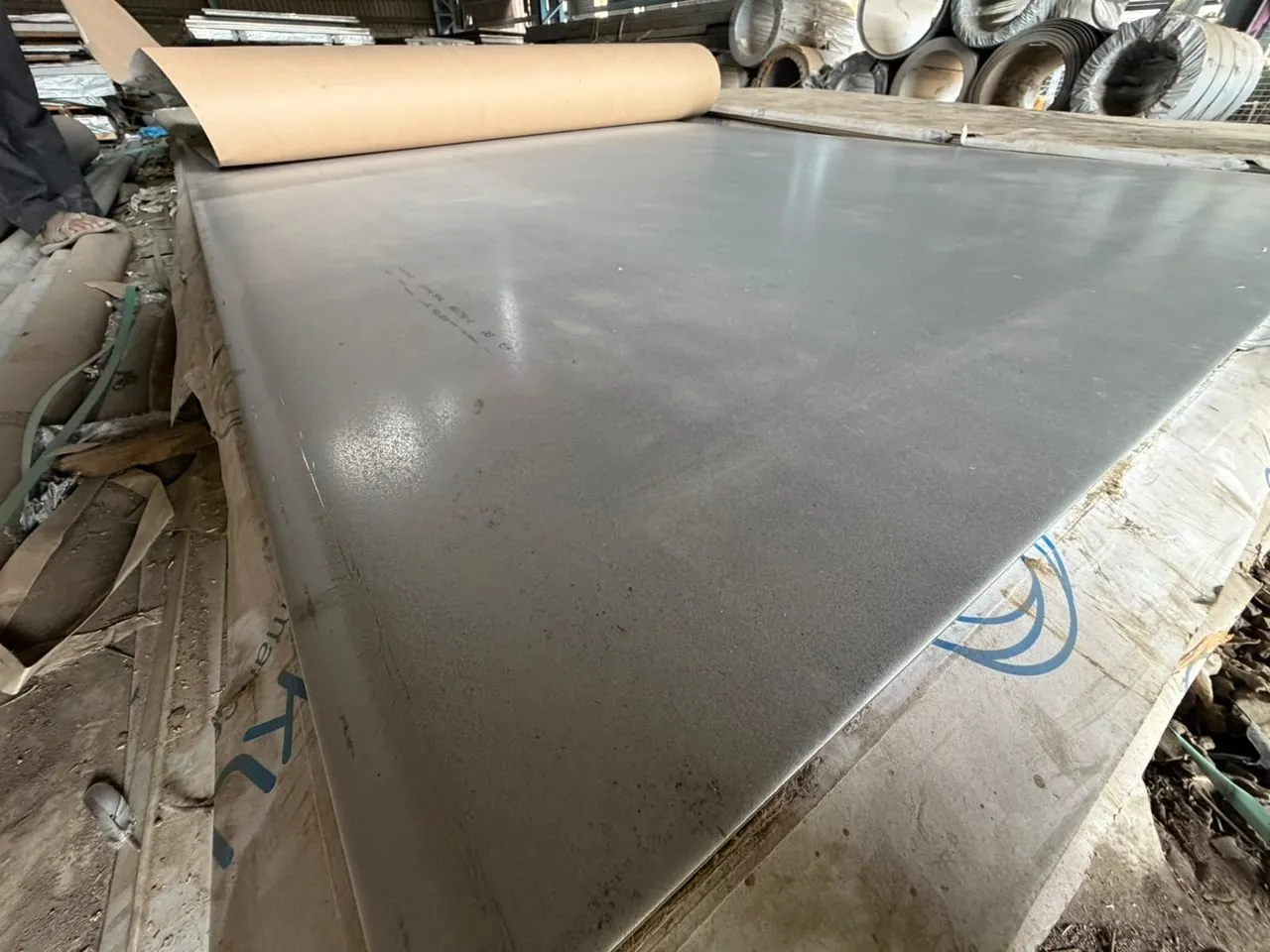
Stock is genuine mill sheet, ready for immediate dispatch. Finishes run 2B, BA, No.4 and No.8, with cut-to-size available on request.
What is 304L stainless steel sheet?
304L is a chromium-nickel austenitic stainless steel, nominally 18% chromium and 8% nickel, the classic "18/8" composition, rolled into flat sheet product. It's the extra-low-carbon variant of 304, sharing the same corrosion behavior and the same ductile, non-magnetic austenitic structure in the annealed condition. For the full grade story and sibling forms, see the 304/304L grade hub.
Since 304L has no molybdenum, it sits at the bottom of the pitting resistance scale right alongside 304. For chloride service, the upgrade is 316L, not a stabilized grade. It's the default choice for corrosion-resistant sheet when a part will be welded and can't be re-solution-annealed afterward.
What does the "L" mean?
The "L" stands for an extra-low carbon grade (C ≤0.03%), not a low-strength or lightweight one. The only metallurgical difference between 304 (C ≤0.08%) and 304L is carbon content. That lower ceiling suppresses sensitization during welding. It costs a bit of yield strength, though, and that trade-off gets covered below.
Chemical composition
UNS S30403 (304L) keeps the same element ranges as ASTM A240 lays out, with 304 listed right beside it so the one real difference between them, carbon, stands out plainly.
| Element | 304L (S30403) wt% | 304 (S30400) wt% |
|---|---|---|
| Carbon (C) | ≤0.030 | ≤0.08 |
| Chromium (Cr) | 18.0–20.0 | 18.0–20.0 |
| Nickel (Ni) | 8.0–12.0 | 8.0–10.5 |
| Manganese (Mn) | ≤2.0 | ≤2.0 |
| Silicon (Si) | ≤0.75 | ≤0.75 |
| Phosphorus (P) | ≤0.045 | ≤0.045 |
| Sulfur (S) | ≤0.030 | ≤0.030 |
| Nitrogen (N) | ≤0.10 | ≤0.10 |
| Iron (Fe) | Balance | Balance |
Why carbon ≤0.03% matters (sensitization)
At 425–815 °C, right in a weld's heat-affected zone, carbon in 304 ties up with chromium and forms chromium carbides along the grain boundaries. That strips chromium from the surrounding area and leaves the boundary exposed to intergranular corrosion (sensitization). Limit carbon to 0.03% and you choke off that reaction. 304L therefore holds its corrosion resistance through the weld with no post-weld solution annealing required. You can get there another way too: a stabilized grade (321/347), or solution annealing. For welded sheet, though, low carbon is simplest, roughly 1/3 the hassle of the alternatives. See how to prevent sensitization.
Mechanical properties
ASTM A240 sets minimum requirements for S30403 sheet in the annealed condition, with 304 included here as a contrast row.
| Property | 304L (S30403) | 304 (S30400) |
|---|---|---|
| Tensile strength (min) | ≥485 MPa (70 ksi) | ≥515 MPa (75 ksi) |
| Yield strength, 0.2% (min) | ≥170 MPa (25 ksi) | ≥205 MPa (30 ksi) |
| Elongation in 50 mm (min) | ≥40% | ≥40% |
| Hardness (max) | ≤201 HBW / ≤92 HRB | ≤201 HBW / ≤92 HRB |
304L vs 304: the strength trade-off
Cutting the carbon costs a bit of strength: 304L carries a minimum 0.2% yield of 170 MPa, while 304 sits at 205 MPa. For most sheet fabrication work, that gap doesn't matter much. Call it the price of weld-safe chemistry. If a design truly needs the higher minimum in the welded condition, though, look at 304L dual-certified to 304 mechanicals, or consider a nitrogen-strengthened grade instead. That comparison is covered in 304 vs 304L.
Physical properties
| Property | Value (304L sheet, annealed) |
|---|---|
| Density | 8.0 g/cm³ |
| Melting range | ~1400–1450 °C |
| Thermal conductivity (100 °C) | ~16.2 W/m·K |
| Mean coefficient of thermal expansion (0–100 °C) | ~17.3 µm/m·°C |
| Elastic modulus | ~193–200 GPa |
| Magnetic response | Non-magnetic (annealed); mildly magnetic after cold work |
In the solution-annealed condition, 304L is non-magnetic. Cold forming, deep drawing, bending, roll-forming, converts some austenite to martensite, and that can leave the part slightly ferromagnetic. That's normal. It doesn't mean you've got the wrong grade.
Corrosion behavior & PREN: what 304L resists and where it stops
304L owes its corrosion resistance to a chromium-rich passive film, and element for element it matches 304. The honest rule for picking between them: 304L protects against intergranular attack after welding. It does nothing extra against pitting.
Intergranular corrosion / sensitization: why 304L exists
This is the differentiator. Because carbon is held ≤0.03%, 304L resists chromium-carbide precipitation in the weld heat-affected zone, so welded, as-fabricated parts stay immune to intergranular corrosion without a post-weld solution anneal. That is the one reason to specify 304L over 304.
General & atmospheric corrosion
In clean indoor, atmospheric, food-contact and architectural service, the 18/8 passive film holds up well against general corrosion. 304L is food-safe, and it's the workhorse sheet for dairy, brewing, catering and interior cladding where chloride levels stay low.
Pitting, crevice & chloride limits (PREN ≈ 18)
With Cr ~18–20, Mo ~0 and N ≤0.10, PREN = Cr + 3.3·Mo + 16·N ≈ 18, identical to 304. 304L therefore has the same modest resistance to pitting corrosion and crevice corrosion as 304, and the same chloride ceiling. A common misconception is that "304L is more corrosion-resistant than 304", it is not more pitting-resistant; the PREN is the same. When chlorides are the problem, step up to 316L, not to a stabilized 300-series grade.
Chloride stress-corrosion cracking
Like all austenitic 18/8 grades, 304L is susceptible to chloride stress-corrosion cracking under tensile stress in warm chloride environments (roughly above 50–60 °C). Low carbon does not change this; it is a structural property of the austenitic lattice. Where hot chlorides and stress coexist, duplex or higher-nickel grades are the correct answer.
Equivalent grades & designations
| System | Designation |
|---|---|
| UNS | S30403 |
| Werkstoff (W.-Nr.) | 1.4307 (X2CrNi18-9) |
| EN name | X2CrNi18-9 |
| JIS | SUS304L |
| BS | 304S11 |
| AISI | 304L |
For a full map across standards, check the UNS / Werkstoff / JIS cross-reference.
304L sheet vs the alternatives: when to choose it
304L vs 304
The decision comes down to welding. Go with 304L over 304 when the part gets welded and won't be solution-annealed afterward. Pick 304 if the section stays unwelded, or if it will be re-annealed and you want that slightly higher yield. For the full carbon and sensitization breakdown, see 304 vs 304L.
304L vs 316L
With chloride-bearing service water, whether coastal, marine-adjacent, de-iced, or laden with process chlorides, 304L's PREN of about 18 falls short. The molybdenum in 316L sheet, with a PREN around 24, justifies the added expense. We walk through the full upgrade decision in 304L vs 316L. Defaulting to 304/304L for chloride-adjacent duty is the field error we see most often, and it pits. Confirm the actual service chlorides before you choose. See also 304 vs 316.
304L vs 321 / 347 (low-carbon vs stabilized)
304L and the stabilized grades solve the same sensitization problem by different routes: 304L starves the carbide reaction by removing carbon, while 321 and 347 tie carbon up with titanium or niobium. For thin welded sheet at ambient to moderate temperature, 304L is simpler and cheaper; the stabilized route earns its place for prolonged service in the sensitizing range (e.g. hot exhaust, 500–800 °C).
| Grade | Anti-sensitization route | PREN | Choose when |
|---|---|---|---|
| 304L | Low carbon (C ≤0.03%) | ~18 | Welded sheet, low chloride, ambient–moderate temp |
| 316L | Low carbon + Mo | ~24 | Chlorides present (coastal, process) |
| 321 / 347 | Ti / Nb stabilized | ~18 | Prolonged service in 425–815 °C range |
PREN / selection ladder
| Grade | PREN (approx.) | Upgrade driver |
|---|---|---|
| 304 / 304L | ~18 | Base of the ladder, general-purpose 18/8 |
| 316 / 316L | ~24 | Adds ~2–3% Mo for chloride pitting resistance |
| 904L | ~34 | Super-austenitic; sulfuric acid, high chloride |
| Duplex 2205 | ~35 | High strength + chloride-SCC resistance |
| Super-duplex 2507 | ~43 | Aggressive seawater / high chloride |
Forms, sizes, thickness & gauge
304L comes stocked as flat sheet, typically up to about 6 mm; anything heavier falls into 304L plate. The usual stock sheet sizes are 1219 × 2438 mm (4 × 8 ft), 1250 × 2500 mm and 1500 × 3000 mm. Cut-to-size is available on request. Here's a gauge/thickness reference:
| Gauge (approx.) | Thickness (mm) |
|---|---|
| 22 ga | 0.8 |
| 20 ga | 1.0 |
| 18 ga | 1.2 |
| 16 ga | 1.5 |
| 14 ga | 2.0 |
| 12 ga | 2.5–2.6 |
| 10 ga | 3.0–3.4 |
Other 304L forms
Heavier sections ship as 304L plate, while continuous rolled stock comes as 304L coil. For the difference between these flat forms, see sheet vs plate vs coil.
Sheet weight & how to calculate
304L carries the same weight as any 18/8 austenitic, density of 8.0 g/cm³. Two formulas cover most buyers:
- Per square meter: kg/m² = thickness (mm) × 8.0
- Per sheet: kg = thickness (mm) × width (m) × length (m) × 8.0
Worked example: take a 2 mm × 1.25 m × 2.5 m sheet. Multiply 2 × 1.25 × 2.5 × 8.0 and you get 50.0 kg (that's 2 × 8.0 = 16.0 kg/m²).
| Thickness (mm) | Weight (kg/m²) |
|---|---|
| 1.0 | 8.0 |
| 1.5 | 12.0 |
| 2.0 | 16.0 |
| 3.0 | 24.0 |
Run your own dimensions through the weight calculator or the stainless steel weight chart.
Finishes
304L sheet comes in standard mill and polished finishes. Which one you pick depends on the application.
- 2B, smooth, cold-rolled, lightly reflective; the default for general fabrication, tanks and process equipment.
- BA (bright annealed), brighter, mirror-approaching cold-rolled finish for hygienic and decorative work.
- No.4, directional brushed/satin finish for architectural panels, kitchens and food-service surfaces.
- No.8 (mirror), highly reflective polished finish for decorative and specular applications.
- 1D / HRAP, hot-rolled, annealed and pickled, for heavier-gauge and non-cosmetic structural use.
For how these are made and matched up, see stainless steel finishes (2B / BA / No.4).
Standards & specifications complied
304L sheet is supplied to the recognized flat-product standards for S30403:
- ASTM A240, chromium and chromium-nickel stainless steel sheet, plate and strip for pressure vessels and general application.
- ASME SA-240, the ASME Boiler & Pressure Vessel Code adoption of A240 for coded equipment.
- EN 10088-2, the European flat-product standard for stainless X2CrNi18-9 (1.4307).
Testing, inspection & certification
Every order comes with an EN 10204 3.1/3.2 mill test certificate that reports heat/cast chemistry and mechanicals against ASTM A240. See EN 10204 3.1 mill test certificate and how to read a mill test certificate. Welded or sensitization-critical work can call for intergranular corrosion testing to ASTM A262 (Practice A or E). Positive material identification (PMI) and dimensional inspection often go alongside it; for more, see testing, MTC, NDT & PMI.
Applications of 304L sheet by industry
304L is the go-to weld-safe austenitic sheet across:
- Food & dairy, tanks, hoppers, work surfaces, and hygienic enclosures where welded 18/8 has to stay corrosion-free.
- Architectural / cladding, interior panels, column covers, and trim finished in No.4 or No.8.
- Chemical processing, low-chloride vessels, ducting, and general plant fabrication.
- Pharmaceutical, clean-room and hygienic equipment in welded sheet form.
- General fabrication, enclosures, brackets, trays, and any welded sheet metal that needs durable, cleanable stainless.
Welding & fabrication of 304L sheet
304L takes to TIG, MIG, resistance and laser welding without much fuss. Pair it with a low-carbon austenitic filler, ER308L / E308L, so the deposit matches the base metal's weld-safe chemistry. No post-weld heat treatment is needed to hold onto the joint's corrosion resistance, and that's really the reason to call out 304L in the first place.
For forming, 304L work-hardens: it draws and bends well but gains strength as it deforms, so allow for springback and interstage annealing on severe draws. It cuts cleanly by laser, plasma and waterjet. On thin sheet, control heat input and interpass temperature to limit distortion. For details, see how to weld 304L.
How we quote & dispatch
Nandini Steel keeps genuine mill 304L sheet on hand from recognized producers, Aperam, Outokumpu, Jindal, POSCO, Nippon Steel and JFE. It ships ex-stock for immediate dispatch, with cut-to-size available on request. Every order comes with an EN 10204 3.1/3.2 mill test certificate. We'll quote live pricing based on your thickness, finish, size and quantity. Send over the specification and you'll get a same-day RFQ; pricing is by quotation only.
FAQ
Is 304L stronger than 304?
Is 304L more corrosion-resistant than 304?
When should I specify 304L instead of 304?
Is 304L sheet magnetic?
Does 304L sheet come with a mill test certificate?
What is the equivalent of 304L stainless steel?
Request a quote
Send us the thickness, finish, size and quantity of 304L (S30403) sheet you're after, and the Nandini Steel Engineering Team will send back a same-day RFQ complete with mill test certification. Call +91 22 43404600, WhatsApp +91 99202 09184, or send an email to reachus@nandinisteel.com. We're an ISO 9001:2015-certified stockist and supplier, offering genuine mill sheet, ex-stock, shipped worldwide.
Related grades to cross-shop
Part of our steel sheet range and all stainless steel sheet grades.