
Key takeaways
Chromium and nickel give these steels an austenitic, face-centered-cubic structure. That's why they're non-magnetic when annealed and why you can't quench-harden them the way you would martensitic stainless.
This is the 300 series, sometimes called the "18-8" steels. The base grade, 304, runs roughly 18% chromium and 8% nickel. Add molybdenum, more nickel, titanium, niobium or copper, and you get the rest of the family.
Each alloying element earns its place by solving a specific corrosion problem. Chromium builds the passive film. Molybdenum adds pitting resistance. Low carbon keeps sensitization at bay.
Chloride stress-corrosion cracking is the wall every lean austenitic grade eventually hits. None of them escape it, and that's precisely why the upgrade path leads to 904L, duplex grades and nickel alloys.
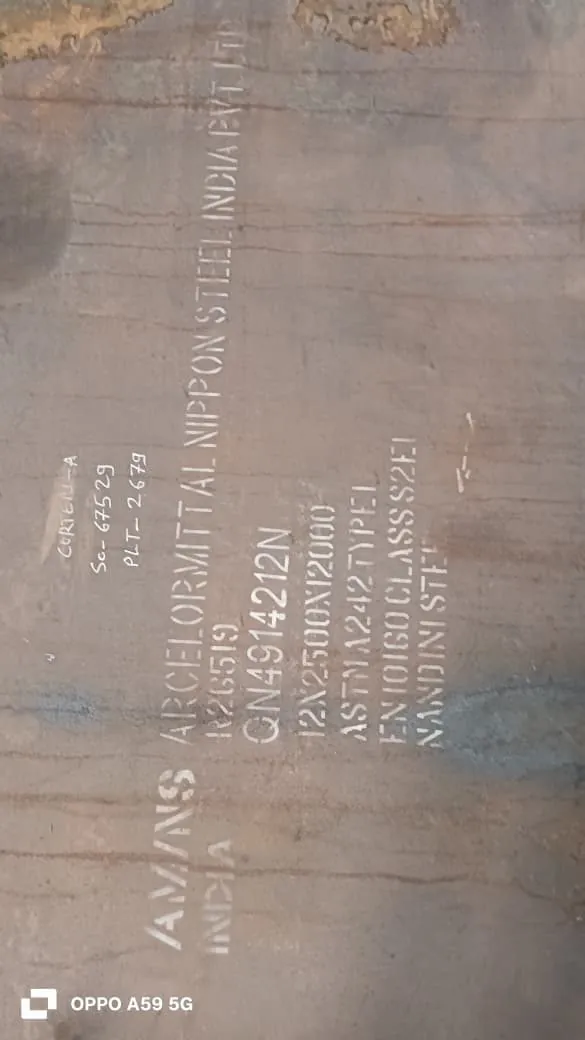
Material ships to ASTM A240 / ASME SA-240 in sheet, plate and coil, backed by an EN 10204 mill test certificate for traceability.
What is austenitic stainless steel?
Austenitic stainless steel is a class of stainless steel where the iron matrix sits in the austenite phase at room temperature, a face-centered-cubic (FCC) crystal structure. It usually runs ~16–26% chromium and ~6–37% nickel, and the nickel, with help from nitrogen and manganese, is what keeps austenite stable as the steel cools from hot-rolling temperature down to ambient. Chromium above roughly 10.5% is what builds the self-repairing passive oxide film that defines stainless steel in the first place; the austenitic family just adds enough nickel on top to lock in that FCC structure. It's the backbone of flat stainless product, and it fits within the broader framework laid out in stainless steel metallurgy.
Why it is non-magnetic and not heat-hardenable
Because the structure is FCC rather than the body-centered-cubic (BCC) ferrite found in carbon and ferritic stainless steels, fully annealed austenitic grades are essentially non-magnetic. That same FCC structure rules out any hardening transformation, you can't raise strength through quench-and-temper. Strengthening austenitic grades takes cold work (strain-hardening) instead. Push a lean grade like 304 hard enough in cold work, though, and it can pick up a slight magnetic response as a bit of strain-induced martensite forms. If softening is what's needed, the right move is solution annealing, not quench-hardening.
The 300 series and the 18-8 shorthand
The AISI 300 series makes up the austenitic family: 304, 304L, 316, 316L, 321, 347, 310 and the super-austenitics. "18-8" is the old shorthand for the base chemistry, roughly 18% chromium and 8% nickel, and that's 304. Modern designation gives these grades UNS numbers with an S30xxx / S31xxx prefix (304 = UNS S30400, 316 = UNS S31600). Full equivalents across UNS, Werkstoff and JIS sit in the UNS / Werkstoff / JIS cross-reference.
How austenite is stabilized: the mechanism
Left to itself, an iron-chromium alloy settles into a ferritic (BCC) structure at room temperature. Nickel changes that: it's an austenite stabilizer, and adding enough of it widens the austenite field so the FCC phase survives all the way down to ambient temperature instead of transforming back. Nitrogen, manganese and copper help it along. From that one fact, the whole character of the family follows. Toughness, formability, the non-magnetic response, the fact that you can't harden these alloys by heat treatment alone, trace it all back to a stable FCC matrix.
Corrosion resistance is a different matter entirely, and it comes down to chromium, which forms a thin, adherent, self-repairing passive chromium-oxide film. Alloying elements then tune that film to suit specific environments. There's no hardening transformation here, so the only way to boost mechanical strength is work-hardening during forming or rolling. In lean grades, heavy deformation can even transform some austenite into martensite locally. For a full element-by-element breakdown, see what each alloying element does.
What changes the behavior: the influencing factors
The grade you pick is really a decision about how much you're paying for each element. Every one of them maps to a corrosion or fabrication problem.
Chromium
Chromium is what turns steel into "stainless": push past roughly 10.5% and it forms a passive film. Austenitic grades run well above that floor, around 18% in 304, climbing to 24–26% in heat-resistant 310. The extra chromium does double duty, boosting general corrosion resistance while also lifting the PREN pitting number.
Nickel
Nickel is the main austenite stabilizer here. Beyond holding the FCC structure in place, more nickel improves formability and low-temperature toughness, and it raises the threshold for chloride stress-corrosion cracking. That last point matters most. The jump from roughly 8% nickel in 304 to about 25% in 904L accounts for much of why the super-austenitic grades shrug off cracking that would take down the lean family.
Molybdenum
Molybdenum is what 304 is missing when it comes to pitting and crevice corrosion. Add 2–3% Mo and 304 becomes 316, it's the single most important upgrade step in the family, and frankly it's what you're paying for when you choose 316 over 304. For the full breakdown, see 304 vs 316.
Carbon and the "L" grades
Carbon is a liability when it comes to corrosion. Hold a standard-carbon grade in the 425–815 °C range and chromium carbides precipitate at the grain boundaries, a process called sensitization. That strips chromium from the surrounding metal and leaves it open to intergranular attack. The fix is low carbon: C ≤ 0.03% in the "L" grades, 304L and 316L. That's why welded fabrications default to them over 304 or 316. Full mechanism: sensitization.
Nitrogen, copper, titanium and niobium
Nitrogen is a strong, cheap austenite stabilizer, and it also boosts strength and PREN. Copper, present at roughly 1.5% in 904L, sharply improves resistance to sulfuric and other reducing acids. Titanium (321) and niobium (347) take a different approach: they tie up carbon as stable carbides. That gives a second, stabilized route to beating sensitization where low-carbon grades fall short. It's especially useful for high-temperature service, where an "L" grade would still sensitize.
PREN: reading the numbers
The Pitting Resistance Equivalent Number (PREN = %Cr + 3.3 × %Mo + 16 × %N) rolls the pitting-relevant elements into a single figure you can compare across grades. It's the fastest way to rank grades for chloride pitting resistance, and the whole upgrade path rests on this ladder. See PREN.
Corrosion behavior and the family's limits
Austenitic stainless isn't immune to corrosion. It resists it, but only within limits, and those limits are exactly where the upgrade decisions live. Four mechanisms matter.
Pitting is a localized breakdown of the passive film under chlorides. 304, with a PREN around 18, is vulnerable. 316 resists it better, thanks to molybdenum, and its PREN runs about 24. Detail: pitting corrosion.
Crevice corrosion is the same attack, but concentrated in tight gaps like gaskets or under deposits. It starts at lower chloride levels than open-surface pitting does. Detail: crevice corrosion.
Chloride stress-corrosion cracking is the defining weakness of austenitic grades. Put a lean austenitic under tensile stress, add chlorides and warm temperatures (typically above roughly 50-60 °C), and it can crack even while general corrosion looks negligible. Detail: chloride stress-corrosion cracking.
Intergranular attack follows sensitization at welds or within the 425-815 °C band. The low-carbon or stabilized route prevents it. Detail: sensitization.
Family limits at a glance
| Mechanism | Austenitic behavior | Mitigation / grade move |
|---|---|---|
| Pitting | 304 susceptible; improves with Mo | Step 304 → 316 → 904L (rising PREN) |
| Crevice corrosion | Initiates below pitting threshold in gaps | Higher-Mo grade; design out crevices |
| Chloride SCC | Family-wide weakness in lean grades | Raise nickel: 904L, or leave for duplex / nickel alloy |
| Intergranular (sensitization) | At 425–815 °C / welds in standard-C grades | Low-carbon "L" grade, 321/347, or solution anneal |
Sensitization and how it is prevented
Sensitization kicks in when chromium carbides precipitate at grain boundaries between 425–815 °C, and the metal right next to those boundaries ends up depleted of chromium. Three prevention routes hold up to scrutiny.
| Cause | Prevention route | Grade it maps to |
|---|---|---|
| Cr-carbide precipitation at 425–815 °C | Low carbon (C ≤ 0.03%) | 304L, 316L |
| Stabilizing with Ti / Nb | 321 (Ti), 347 (Nb) | |
| Solution annealing + rapid quench | Any austenitic grade |
Which grades are austenitic: the family map
This is where the concept pays off: once you know the limits above, the grade follows. The table below ranks the common austenitic grades, along with the signal that tells you when to step up.
| Grade | UNS | Distinguishing element | Headline trait | Step up when… |
|---|---|---|---|---|
| 304 | S30400 | 18Cr-8Ni base | General-purpose workhorse | Chlorides present → 316 |
| 304L | S30403 | C ≤ 0.03% | Weldable 304, no sensitization | Chlorides present → 316L |
| 316 | S31600 | Mo 2–3% | Pitting / marine resistance | Hot concentrated chlorides → 904L |
| 316L | S31603 | Mo + C ≤ 0.03% | Welded pharma / food duty | Acids / high chloride → 904L |
| 321 | S32100 | Ti-stabilized | High-temp, sensitization-proof | More pitting needed → 316Ti / 904L |
| 347 | S34700 | Nb-stabilized | High-temp welded service | Severe chlorides → super-austenitic |
| 310 | S31008 | 25Cr-20Ni | Oxidation to ~1100 °C | Aqueous chlorides → 316/904L |
| 904L | N08904 | Ni ~25, Mo ~4.5, Cu ~1.5 | Super-austenitic; acid + chloride | 6-Mo / super-duplex territory |
304 vs 316: the molybdenum step
The most consequential choice in the family is 304 versus 316, and it comes down to one element: molybdenum. The 2–3% Mo in 316 buys pitting and crevice resistance that 304 simply does not have. If the service sees chlorides, coastal air, process water, marine, de-icing salts, 316 (or 316L for welds) is the honest minimum. If it is dry, indoor and chloride-free, 304 is usually enough. The full trade-off, including cost and PREN, is in 304 vs 316.
When austenitic runs out: super-austenitic, duplex, nickel alloy
When hot concentrated chlorides or acids defeat even 316L, you leave the lean family. The next rung is the super-austenitic stainless steel 904L, with its high nickel and copper; beyond that lie duplex stainless steel (higher strength, higher SCC resistance) and the nickel alloys such as Incoloy 825 for sour and mixed-acid duty.
The austenitic PREN and upgrade ladder
PREN lays out the upgrade path as a clean sequence. Within the lean family, you move from 304 to 316 to 904L; the alloys that break out of that family climb even higher.
| Grade | PREN (approx.) | Leaves the family when… |
|---|---|---|
| 304 / 304L | ~18 | Any chloride service, move to 316 |
| 316 / 316L | ~24 | Hot / concentrated chlorides, move to 904L |
| 904L | ~34 | 6-Mo or super-duplex genuinely required |
| Duplex 2205 | ~35 | Exit grade, higher strength + SCC resistance |
| Incoloy 825 | ~31–40 | Exit alloy, sour / mixed-acid service |
| Super-Duplex 2507 | ~43 | Top rung of chloride resistance |
Representative composition (family level)
Representative chemistry only. Each row links to the grade page for the full certified ranges, and all values are given in weight percent.
| Grade | Cr | Ni | Mo | C (max) | Other |
|---|---|---|---|---|---|
| 304 | 18–20 | 8–10.5 | – | 0.08 | – |
| 304L | 18–20 | 8–12 | – | 0.03 | – |
| 316 | 16–18 | 10–14 | 2–3 | 0.08 | – |
| 316L | 16–18 | 10–14 | 2–3 | 0.03 | – |
| 904L | 19–23 | ~23–28 | ~4–5 | 0.02 | Cu ~1–2 |
Standards the family is supplied to
Austenitic flat product gets specified to ASTM A240 (chemistry and mechanical properties for chromium and chromium-nickel plate, sheet and strip) and its pressure-vessel counterpart, ASME SA-240. Material identity and properties are documented on an EN 10204 mill test certificate; an EN 10204 3.1/3.2 certificate ships with every order, tying the heat number on the plate to its certified chemistry and test results. Cross-reference the UNS / Werkstoff / JIS cross-reference for equivalents across designation systems. Austenitic grades sit in stock as sheet, plate and coil. Not sure which form fits the job? Check sheet vs plate vs coil.
Where austenitic stainless is used: examples by industry
The family splits cleanly by grade and environment.
- 304 / 304L, general fabrication, architectural work, food and dairy equipment where conditions stay mild and there's no chloride exposure.
- 316 / 316L, marine, chemical and acid processing and pharmaceutical / hygienic duty. Pick this whenever moderate chloride levels take 304 off the table.
- 904L, sulfuric-acid plants, FGD scrubbers, pulp and paper and the tougher pharmaceutical process lines. Its copper-bearing chemistry, with roughly 4.5% Mo, is what justifies choosing it over 316.
Fabrication, welding and heat treatment notes
Austenitic grades work-harden fast, so forming and machining decisions need to plan around strain-hardening rather than any hardening heat treatment. Solution annealing is what softens the material and restores corrosion resistance: heat it high, then quench fast. Quench-hardening won't do that job. See solution annealing for the full process. Welding calls for a filler that matches the base metal. 304L takes ER308L, 316L takes ER316L, and 904L needs an over-alloyed filler such as ER385 or a nickel-base alloy to keep the weld metal as corrosion-resistant as the plate itself. Interpass temperature has to stay under control too, or you risk drifting into the sensitization band. For the full picture, see welding austenitic stainless.
A stockist's view: the common mistakes
From the Nandini Steel stock and export desk, two spec errors keep showing up across the austenitic family:
- 304 picked for jobs with chlorides in the mix. This is the mistake we see most: someone defaults to 304 on coastal work, marine-adjacent fittings, or anything with chloride-bearing process fluid, and it pits. Check the actual chloride level in service before settling on 304 over 316. Stepping up a grade costs far less than replacing a failed part.
- 316 held onto when hot, concentrated chlorides demand more. The flip side happens too, buyers stick with 316 when hot, concentrated chlorides or acids really call for 904L or duplex. That 2–3% molybdenum content is the thing you're paying for. Match it to the real pitting risk, not force of habit.
For welded fabrications headed into 425–815 °C service, call out the L grade (C ≤ 0.03%) to dodge sensitization without needing a post-weld anneal. Here's a quick, defensible rule of thumb the desk relies on:
| Service condition | Defensible starting grade |
|---|---|
| Dry / indoor / chloride-free | 304 (304L if welded) |
| Chlorides present (marine, process water) | 316 (316L if welded) |
| Hot / concentrated chlorides or acids | 904L |
| High chloride + stress + temperature | Duplex / nickel alloy |
Commonly used austenitic grades and forms, 304, 304L, 316, 316L, 321, 347, 310 and 904L in sheet, plate and coil, sit ex-stock for immediate dispatch, with genuine mill plate coming from Aperam, Outokumpu, Jindal, POSCO, Nippon Steel and JFE. Narrowing a choice is easy enough: try the stainless grade selector, or read how to select a stainless grade.
FAQ
Is 304 stainless steel magnetic?
Is 904L austenitic stainless steel?
Can austenitic stainless steel be hardened by heat treatment?
Why does austenitic stainless steel crack in chlorides?
What does 18-8 stainless steel mean?
Sourcing the right austenitic grade? Nandini Steel, an ISO 9001:2015-certified stockist and supplier established in 2003, holds the austenitic family ex-stock for immediate dispatch, each order supplied with an EN 10204 3.1/3.2 mill test certificate. Share your service conditions, grade and form for live pricing: WhatsApp +91 99202 09184, email reachus@nandinisteel.com, or start with the stainless grade selector.