
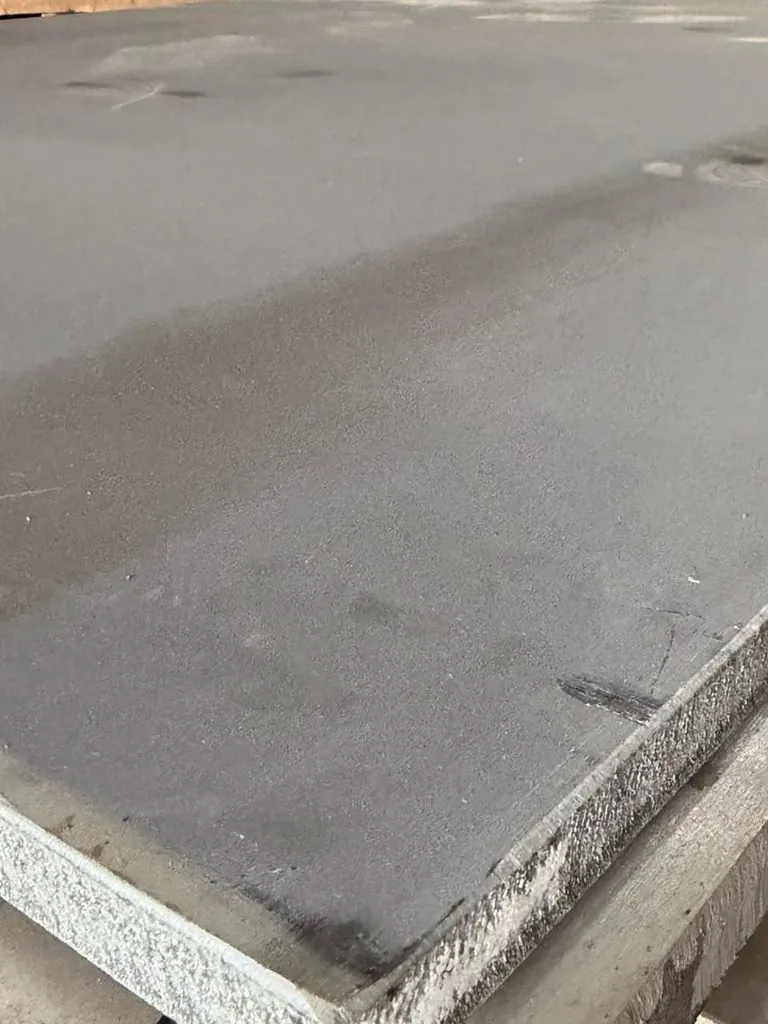
304 vs 304L at a Glance: The Verdict Table
For a welded fabrication that will sit in the 425–815 °C sensitizing range during fabrication, 304L is the safe default; for thin, rapidly-cooled, non-corrosive work, standard 304 is correct and slightly stronger. The table below is the whole decision in one view.
| Factor | 304 (UNS S30400) | 304L (UNS S30403) |
|---|---|---|
| Carbon content | C ≤ 0.08% | C ≤ 0.03% (low-carbon) |
| PREN (pitting resistance) | ~18 | ~18 (equal) |
| General / oxidizing corrosion | Good | Good (identical) |
| Sensitization / IGC risk when welded | Susceptible | Resists |
| Yield strength (0.2%, ASTM A240) | ≥ 205 MPa (30 ksi) | ≥ 170 MPa (25 ksi) |
| Tensile strength (ASTM A240) | ≥ 515 MPa (75 ksi) | ≥ 485 MPa (70 ksi) |
| Relative cost | Baseline | Small premium / often parity on dual-certified stock |
| Choose when | Thin, non-welded, rapidly-cooled or non-corrosive parts | Welded, heavy-section, or corrosive-at-weld service you can't solution-anneal |
304 and 304L Are the Same Alloy: Carbon Is the Difference
Both 304 and 304L belong to the austenitic (18-8) stainless family: nominally 18% chromium and 8% nickel, with no molybdenum in either. The "L" in 304L simply means low carbon, it is not a different chemistry, a different strength class, or a more corrosion-resistant alloy. Chromium and nickel ranges are the same, so the pitting resistance equivalent number (PREN) is ~18 for both.
The only material divergence in composition is the carbon ceiling, 0.08% for 304 versus 0.03% for 304L, plus a slightly wider nickel allowance in 304L. In designation terms, 304 is UNS S30400 / Werkstoff 1.4301 / AISI 304, while 304L is UNS S30403 / Werkstoff 1.4307. Both are austenitic, both are non-magnetic in the annealed condition, and both are part of the broader austenitic stainless steel group.
The Real Decision: Sensitization and Intergranular Corrosion
Why carbon matters is the heart of this comparison. The decision is not "which grade is better", it is "will this part see the thermal conditions that make carbon dangerous?"
What Sensitization Is
When austenitic stainless is held in the 425–815 °C band, exactly what the heat-affected zone (HAZ) of a weld experiences, carbon combines with chromium to precipitate chromium carbides (Cr₂₃C₆) at the grain boundaries. That reaction depletes chromium locally, leaving a thin, chromium-starved zone that no longer forms a protective passive film. The result is sensitization, and the corrosion that follows along those grain boundaries is intergranular corrosion (sensitization), historically called "weld decay."
Why 304L Avoids It
304L starves the reaction of fuel. With carbon capped at ≤0.03%, there is too little carbon to precipitate enough chromium carbide to deplete the grain boundaries during normal welding, so 304L resists intergranular attack after welding without any post-weld heat treatment. The alternative route to the same goal is a stabilized grade, titanium-stabilized 321 or niobium-stabilized 347, which ties up carbon as stable carbides instead. For practical weld-safe fabrication, 304L is the simplest path; see our guide on how to prevent sensitization.
When 304's 0.08% Carbon Is Still Fine
Standard 304 is perfectly sound, and marginally stronger, when the part never dwells in the sensitizing range long enough to matter: thin sheet that cools rapidly after welding, non-welded machined or formed parts, service that is not corrosive at the weld, or any fabrication that receives a post-weld solution anneal (1010–1120 °C followed by a rapid quench, see solution annealing). In those cases paying for L-grade buys nothing.
Chemical Composition Compared
Only carbon (and the nickel maximum) differs materially; every other element is shared. Compositions below follow ASTM A240 / ASME SA-240.
| Element | 304 (S30400) | 304L (S30403) |
|---|---|---|
| Carbon (C) | ≤ 0.08 | ≤ 0.030 |
| Chromium (Cr) | 18.0–20.0 | 18.0–20.0 |
| Nickel (Ni) | 8.0–10.5 | 8.0–12.0 |
| Manganese (Mn) | ≤ 2.0 | ≤ 2.0 |
| Silicon (Si) | ≤ 0.75 | ≤ 0.75 |
| Phosphorus (P) | ≤ 0.045 | ≤ 0.045 |
| Sulfur (S) | ≤ 0.030 | ≤ 0.030 |
| Nitrogen (N) | ≤ 0.10 | ≤ 0.10 |
| Iron (Fe) | Balance | Balance |
Mechanical Properties Compared
The strength trade-off is the price of low carbon. Because carbon contributes to solid-solution strength, 304L's minima under ASTM A240 sit a step below 304's. In practice the difference is modest and rarely governs a design, but it is real and it is why you don't automatically "upgrade" to 304L on a highly loaded, non-welded part.
| Property | 304 | 304L |
|---|---|---|
| Tensile strength (min) | 515 MPa (75 ksi) | 485 MPa (70 ksi) |
| Yield strength 0.2% (min) | 205 MPa (30 ksi) | 170 MPa (25 ksi) |
| Elongation (min) | 40% | 40% |
| Hardness (max) | 201 HBW / 92 HRB | 201 HBW / 92 HRB |
Physical Properties
For density, thermal behavior, and magnetic response the two are effectively identical, a consequence of sharing the same alloy base. This is why the same weight calculator serves both grades.
| Property | Value (both grades) |
|---|---|
| Density | 7.9–8.0 g/cm³ |
| Melting range | ~1400–1455 °C |
| Thermal conductivity (100 °C) | ~16.2 W/m·K |
| Mean CTE (0–100 °C) | ~17.3 µm/m·°C |
| Elastic modulus | ~193 GPa |
| Magnetic response (annealed) | Non-magnetic |
Corrosion Resistance: Identical PREN, One Caveat
A persistent misconception deserves a flat correction: 304L does not resist general or pitting corrosion better than 304. Both have PREN ~18 (chromium plus 3.3 × molybdenum plus 16 × nitrogen, with molybdenum at zero in both), so both handle the same general and oxidizing conditions and both are equally susceptible to chloride pitting corrosion and chloride stress-corrosion cracking.
The only corrosion divergence between the two is at the weld: sensitized 304 suffers intergranular attack where 304L does not. If your problem is chlorides, coastal air, process brines, seawater, neither grade is the answer, and the upgrade path is molybdenum-bearing 316, not 304L. See 304 vs 316 for that cross-grade decision, and 316 vs 316L for the same low-carbon choice one rung up the PREN ladder.
Equivalent Grades and Designations
| System | 304 | 304L | 304H |
|---|---|---|---|
| UNS | S30400 | S30403 | S30409 |
| Werkstoff (WNr) | 1.4301 | 1.4307 | 1.4948 |
| JIS | SUS304 | SUS304L | SUS304H |
| EN name | X5CrNi18-10 | X2CrNi18-9 | X6CrNi18-10 |
| AISI | 304 | 304L | 304H |
| Common | 18-8 | 18-8 (low-C) | 18-8 (high-C) |
Full cross-referencing across UNS, Werkstoff, JIS and EN is on our UNS / Werkstoff cross-reference page.
Dual-Certified 304/304L: The Stockist's Default
Most modern sheet and plate gets made to a chemistry that satisfies both specifications at once: carbon low enough for 304L, strength still high enough to clear 304's minimums. Mills certify and stamp that material as dual-certified 304/304L. For a buyer, it's the best of both worlds. You get the weld-safe low carbon of 304L and the mechanical minima of 304 on a single heat, backed by one mill test certificate. Most of our ex-stock 304/304L flat product ships dual-certified. That's why the "304 or 304L?" question usually answers itself at the stockholder, at least for welded jobs.
304H and the Other Direction
Low carbon is not always the goal. When a part must carry load at high temperature, carbon is an asset, it provides creep strength. That is the role of 304H (UNS S30409), which specifies a higher minimum carbon (0.04–0.10%) and a coarser grain size for elevated-temperature ASME Boiler & Pressure Vessel service. So the full variant map runs 304L (weld-safe, low carbon) → 304 (general purpose) → 304H (high-temperature, high carbon). You accept some sensitization risk with 304H precisely because the application needs the carbon.
Weldability and Fabrication Compared
Both grades weld readily with the same low-carbon filler, ER308L, which keeps the weld metal itself resistant to carbide precipitation. The difference is in the parent metal: 304L forgives multi-pass and heavy-section welds, where the HAZ dwells longer in the sensitizing range, whereas a thick 304 weldment can sensitize unless it is solution-annealed afterward.
The post-weld remedy for 304, where it is required, is a full solution anneal at 1010–1120 °C followed by a rapid quench, which redissolves the carbides and restores grain-boundary chromium. On large welded assemblies that heat treatment is often impractical, which is the single most common reason fabricators specify 304L from the start. Where a weld-critical order needs proof of non-sensitization, an ASTM A262 intergranular corrosion test (Practice A or E) demonstrates resistance to intergranular attack; see also how to prevent sensitization.
Forms, Sizes and Availability
Both grades are stocked as flat product and ship ex-stock for immediate dispatch, each with an EN 10204 3.1 mill test certificate (3.1/3.2). Standard mill finishes, 2B, No.4 and BA, are the same for both.
| Form | 304 | 304L |
|---|---|---|
| Sheet | 304 sheet | 304L sheet |
| Plate | 304 plate | 304L plate |
| Coil | 304 coil | On request |
Both grades are anchored to the 304 stainless steel grade hub and the dedicated 304L page. Material is genuine mill plate from named producers, Aperam, Outokumpu, Jindal, POSCO, Nippon Steel and JFE, so the chemistry on the certificate is the chemistry you receive.
Cost Difference: Is 304L Worth the Premium?
Any price difference between 304 and 304L is small, and on dual-certified stock it often disappears entirely. Set that modest delta against what L-grade removes: the risk of a sensitized weld failing by intergranular corrosion in service, and the cost of a post-weld solution anneal you would otherwise need. For welded, heavy-section or corrosive-at-weld work, 304L (or dual-certified 304/304L) is almost always the economical choice. Because material markets move, we quote live pricing on RFQ rather than publishing bands, contact us for a current quote on your size and quantity.
Decision Guide: Choose 304, 304L or 304H
- Will the part run hot, sustained elevated-temperature, creep-governed service (e.g. ASME B&PV)? → Specify 304H for the carbon-derived creep strength.
- Is it welded in thick sections, or welded and then exposed to a corrosive medium, with no practical post-weld solution anneal? → Specify 304L (or dual-certified 304/304L) to avoid sensitization.
- Is it thin, rapidly cooled, non-welded, or not corrosive at the weld, and is strength at a premium? → Standard 304 is correct and marginally stronger.
- Is the real threat chlorides (pitting / SCC), not sensitization? → Neither 304 variant solves it; step up to molybdenum-bearing 304 vs 316, and for severe chloride-acid duty consider the super-austenitic upgrade.
From the Nandini Steel Engineering Team: The most common error we see is defaulting to 304 for chloride-adjacent or coastal duty, where it pits, confirm the actual service chlorides before choosing 304 over 316, because stepping up is far cheaper than a failed part. Conversely, for welded fabrications that dwell at 425–815 °C, specify 304L (C ≤ 0.03%) and skip the post-weld anneal.
FAQ
What does the "L" mean in 304L?
Is 304L stronger than 304?
Do 304 and 304L have the same corrosion resistance?
Why is 304L used for welding?
What does dual-certified 304/304L mean?
Should I use 304/304L or 316?
Request a Quote
Nandini Steel is an ISO 9001:2015-certified stockist and supplier of 304 and 304L stainless steel in sheet, plate and coil, all ex-stock for immediate dispatch, supplied with an EN 10204 3.1/3.2 mill test certificate on every order. Over 20+ years since 2003 we have delivered 307+ projects for 260+ clients across 36+ export countries. Send your grade, form, size and quantity for live pricing: call +91 22 43404600, WhatsApp +91 99202 09184, email reachus@nandinisteel.com, or use our RFQ / contact form.