
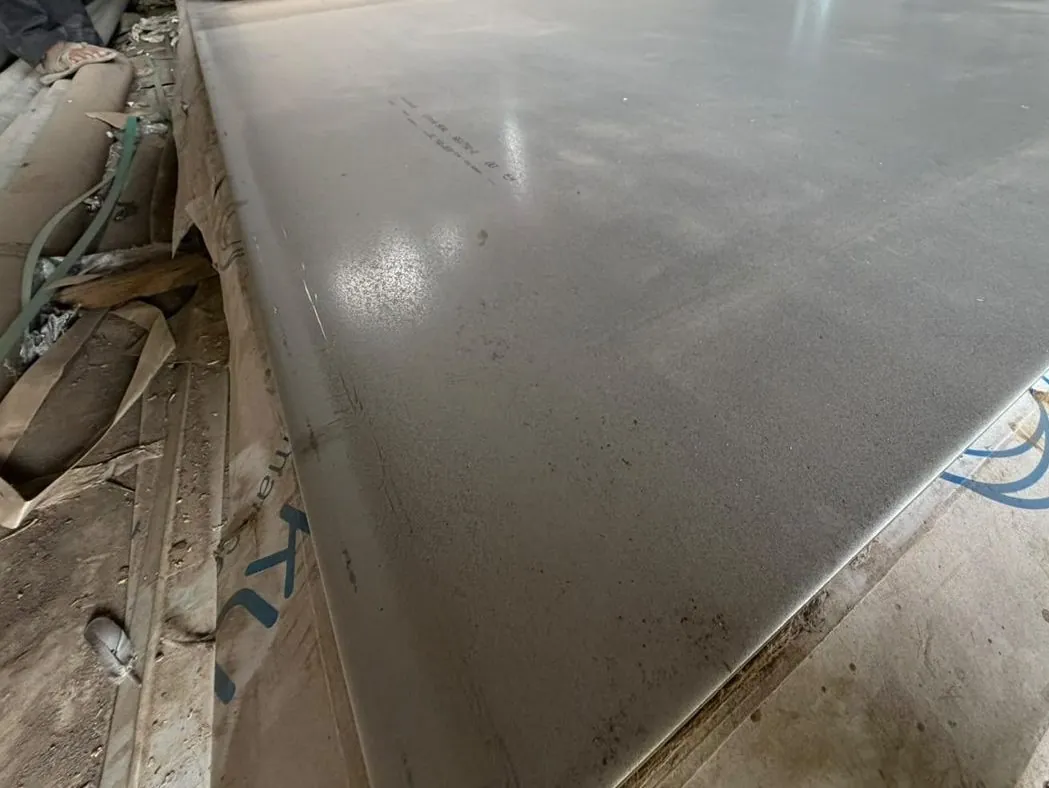
316 vs 316L at a Glance: The Verdict Table
This isn't an upgrade for corrosion resistance. Both grades share the same molybdenum content and roughly the same PREN of 24, so pitting and crevice resistance come out equal. What actually separates them is carbon content and whether the part gets welded or held at elevated temperature. The table below lays out that whole choice at a glance.
| Factor | 316 (UNS S31600) | 316L (UNS S31603) |
|---|---|---|
| Carbon content | C ≤ 0.08% | C ≤ 0.03% (low-carbon) |
| Molybdenum | 2.0–3.0% | 2.0–3.0% (same) |
| PREN (pitting resistance) | ~24 | ~24 (equal) |
| Pitting / chloride resistance | Good | Good (identical) |
| Sensitization / IGC risk when welded | Susceptible | Resists |
| Yield strength (0.2%, ASTM A240) | ≥ 205 MPa (30 ksi) | ≥ 170 MPa (25 ksi) |
| Tensile strength (ASTM A240) | ≥ 515 MPa (75 ksi) | ≥ 485 MPa (70 ksi) |
| Relative cost | Baseline | Small premium / often parity on dual-certified stock |
| Choose when | Higher strength on thin, non-welded or post-weld-annealed parts | Welded, heavy-section or hot-service work you can't solution-anneal |
The One Real Difference: Carbon (and What It Does)
316 and 316L are both molybdenum-bearing austenitic stainless steels. They're nominally 16–18% chromium, 10–14% nickel and 2–3% molybdenum, and that chemistry is what gives 316 its edge in pitting resistance over 304 stainless steel. The "L" doesn't signal a different alloy. It isn't a stronger grade, and it isn't more corrosion-resistant either. It just means low carbon.
What the "L" Means
316L caps carbon at ≤0.03%, while standard 316 allows up to ≤0.08%. Everything else in the spec stays the same: chromium, nickel, molybdenum, PREN. In designation terms, 316 is UNS S31600 (Werkstoff 1.4401), and 316L is UNS S31603 (Werkstoff 1.4404). Both grades are austenitic. Neither is magnetic in the annealed condition, and both sit within the broader austenitic stainless steel group.
Sensitization and Weld Decay
Carbon is why this comparison matters at all. Hold austenitic stainless in the 425–815 °C range, which is exactly what happens in a weld's heat-affected zone, and carbon starts pairing up with chromium, precipitating chromium carbides (Cr₂₃C₆) along the grain boundaries. Chromium gets pulled out of the surrounding metal as a result, leaving a thin zone that's starved of it and can no longer build a protective passive film. That's sensitization. What follows is attack along those same grain boundaries: intergranular corrosion (sensitization), known in older literature as weld decay.
316L starves that reaction of fuel. With carbon capped at ≤0.03%, there just isn't enough of it to precipitate the chromium carbide needed to deplete the grain boundaries during normal welding. That's why 316L resists intergranular attack as-welded, with no post-weld heat treatment required. To reach the same end by other means, you'd turn to a stabilized grade, titanium-stabilized 321 or niobium-stabilized 347, or run a full solution anneal; see how to prevent sensitization.
Chemical Composition Compared
Carbon is the only element that differs materially between the two grades; the rest are shared. Compositions below follow ASTM A240 / ASME SA-240.
| Element | 316 (S31600) | 316L (S31603) |
|---|---|---|
| Carbon (C) | ≤ 0.08 | ≤ 0.030 |
| Chromium (Cr) | 16.0–18.0 | 16.0–18.0 |
| Nickel (Ni) | 10.0–14.0 | 10.0–14.0 |
| Molybdenum (Mo) | 2.0–3.0 | 2.0–3.0 |
| Manganese (Mn) | ≤ 2.0 | ≤ 2.0 |
| Silicon (Si) | ≤ 0.75 | ≤ 0.75 |
| Phosphorus (P) | ≤ 0.045 | ≤ 0.045 |
| Sulfur (S) | ≤ 0.030 | ≤ 0.030 |
| Nitrogen (N) | ≤ 0.10 | ≤ 0.10 |
| Iron (Fe) | Balance | Balance |
Everything Except Carbon Is the Same
Read the carbon row, then read the rest: chromium, nickel and molybdenum are specified identically. That's the single most important fact on this page. PREN is calculated from chromium, molybdenum and nitrogen, and it doesn't include carbon, so the two grades sit on exactly the same rung of the pitting-resistance ladder.
Mechanical Properties Compared
Low carbon costs you strength. Carbon helps pin the solid-solution strength up, so 316L's minimum values under ASTM A240 sit a notch below 316's. That gap rarely decides a design and it's usually modest, but it's real. It's also the one honest argument for picking standard 316 over 316L on a heavily loaded part that won't be welded.
| Property | 316 | 316L |
|---|---|---|
| Tensile strength (min) | 515 MPa (75 ksi) | 485 MPa (70 ksi) |
| Yield strength 0.2% (min) | 205 MPa (30 ksi) | 170 MPa (25 ksi) |
| Elongation (min) | 40% | 40% |
| Hardness (max) | 217 HBW / 95 HRB | 217 HBW / 95 HRB |
Physical Properties
For density, thermal behavior and magnetic response, the two are effectively identical. That's a direct result of sharing the same alloy base. One column covers both grades, so the same weight calculator serves either one.
| Property | Value (both grades) |
|---|---|
| Density | 7.98–8.00 g/cm³ |
| Melting range | ~1375–1400 °C |
| Thermal conductivity (100 °C) | ~16.2 W/m·K |
| Mean CTE (0–100 °C) | ~16.0 µm/m·°C |
| Elastic modulus | ~193 GPa |
| Magnetic response (annealed) | Non-magnetic |
Corrosion Behavior and PREN: Why They Are Equal
The AI answers and spec sheets that frame 316L as "more corrosion-resistant" are wrong, and this is the correction the page exists to make.
Same PREN ~24, Same Molybdenum 2–3%
Pitting resistance is captured by the pitting resistance equivalent number: PREN = Cr + 3.3 × Mo + 16 × N. With chromium 16–18%, molybdenum 2–3% and nitrogen to 0.10%, both grades compute to PREN ~24, and carbon appears nowhere in the formula. So 316 and 316L handle the same chlorides, resist pitting corrosion to the same degree, and offer the same crevice resistance. Neither outperforms the other in a chloride environment.
Both Are Susceptible to Chloride SCC
Being austenitic, both grades share the same vulnerability to chloride stress-corrosion cracking above roughly 60 °C in chloride-bearing service. The low-carbon chemistry of 316L does nothing to change that, SCC is a function of the austenitic structure and the chloride/temperature/stress combination, not of carbon. If chloride SCC is your failure mode, the answer is a higher-alloy family, not 316L.
Where 316L Genuinely Wins: As-Welded IGC Resistance
The weld is where the two alloys actually part ways on corrosion. Sensitized 316 suffers intergranular attack in the HAZ, while 316L resists it as-welded. That's the whole corrosion argument for 316L: not better pitting performance, not better chloride resistance, just immunity to weld-induced sensitization in service.
Equivalent Grades and Designations
| System | 316 | 316L |
|---|---|---|
| UNS | S31600 | S31603 |
| Werkstoff (WNr) | 1.4401 | 1.4404 |
| EN name | X5CrNiMo17-12-2 | X2CrNiMo17-12-2 |
| JIS | SUS316 | SUS316L |
| BS | 316S31 | 316S11 |
| AISI | 316 | 316L |
Full cross-referencing across UNS, Werkstoff, JIS and EN standards is available on our UNS / Werkstoff cross-reference page.
Weldability: The Deciding Attribute
Weldability is where the carbon difference really matters, and it's usually the deciding factor. Both grades weld with the same low-carbon filler, ER316L, which keeps the weld metal itself resistant to carbide precipitation. The difference lies in the parent metal.
316L As-Welded vs 316 Needing a Post-Weld Anneal
316L takes welding in stride. Its heat-affected zone resists sensitization with no extra steps needed. Standard 316 is a different story: the HAZ can sensitize, and once it does, the fix is a full solution anneal at 1010–1120 °C followed by a rapid quench (solution annealing). That redissolves the carbides and brings chromium back to the grain boundaries.
Thick Sections and Multi-Pass Welds
Over an 815 °C anneal for 316, thicker sections and more weld passes mean the HAZ spends more time sitting in the 425–815 °C range. That's the main thing driving the heat treatment. On large assemblies, though, doing a post-weld anneal is often impractical. That alone is the most common reason fabricators choose 316L from the start. If an order calls for proof, an ASTM A262 intergranular-corrosion test (Practice A or E) can show as-welded resistance. For procedure detail, see our guide on how to weld 316 / 316L.
Temperature: Where 316 (and 316H) Pull Ahead
Low carbon isn't always the goal. For sustained service in the 425–815 °C range, carbon actually helps: it adds creep strength. That's the reason standard 316, and especially the high-carbon variant 316H (UNS S31609), specified at 0.04–0.10% carbon with a coarser grain size, gets chosen for elevated-temperature pressure-vessel and boiler work. Some sensitization risk comes with 316H, but engineers accept it because the application needs that carbon-derived creep strength. The full variant map, then, runs 316L (weld-safe, low carbon) through 316 (general purpose) to 316H (high-temperature, high carbon).
When to Choose Which: The Decision Rules
- Is it welded in thick sections, or welded and then exposed to a corrosive medium, with no practical post-weld solution anneal? → Specify 316L (or dual-certified 316/316L) to avoid sensitization.
- Will the part run hot, sustained 425–815 °C, creep-governed service such as ASME B&PV work? → Specify 316 or 316H for the carbon-derived creep strength.
- Is it thin, cooled quickly, non-welded, or post-weld solution-annealed, with strength at a premium? → Standard 316 fits here and is marginally stronger.
- Is the real threat hot concentrated chlorides or acids beyond what 316 can handle? → Neither grade will solve that. You'll need to step up the PREN ladder (see below).
Just Buy Dual-Certified 316/316L
For most buyers, the decision gets made for them at the stockholder level. Much modern sheet and plate is produced to a chemistry that satisfies both specifications at once: carbon held low enough for 316L, strength high enough to still meet 316's minima. That material gets certified and stamped as dual-certified 316/316L, weld-safe low carbon sitting alongside 316 mechanical minima on one heat, all covered by a single mill test certificate. It's the pragmatic buy for most fabrication work, and a good chunk of our ex-stock 316/316L flat product ships dual-certified.
When Both Are Not Enough: The Upgrade Path
316 and 316L sit on the same rung of the PREN ladder. When hot, concentrated chlorides or reducing acids push past what roughly 24 PREN can handle, swapping 316 for 316L won't fix it. You need to climb the ladder instead.
| Grade | PREN (approx.) | Choose when |
|---|---|---|
| 304 / 304L | ~18 | Non-chloride general fabrication |
| 316 ≈ 316L | ~24 (same rung) | Moderate chlorides, marine atmosphere, pharma/food |
| 904L | ~34 | Hot chlorides, sulfuric acid, higher SCC resistance |
| Duplex 2205 | ~35 | High chloride with strength / SCC resistance |
| Super-duplex 2507 | ~43 | Severe chloride / seawater duty |
The first step beyond 316/316L is super-austenitic 904L stainless steel, see 904L vs 316L for that decision. For the sibling comparison without molybdenum, see 304 vs 316; and for the same low-carbon choice one family down, 304 vs 304L. Titanium-stabilized 316Ti is another route to weld-safe service where high-temperature stability is also needed.
Forms, Sizes and Availability
Both grades sit in stock as flat product and ship ex-stock for immediate dispatch. Each comes with an EN 10204 3.1 mill test certificate (3.1/3.2). The standard mill finishes, 2B, No.1 and No.4, don't differ between the two.
| Form | 316 | 316L |
|---|---|---|
| Sheet | 316 sheet | 316L sheet |
| Plate | 316 plate | 316L plate |
| Coil | On request | On request |
Both 316 and 316L sit under the grade hub for 316 stainless steel and the dedicated 316L page. You'll find these grades used across marine work, chemical processing, pharmaceutical / hygienic settings, and food and dairy service. The material comes as genuine mill plate from named producers: Aperam, Outokumpu, Jindal, POSCO, Nippon Steel and JFE. What's on the certificate matches what you get.
Standards Complied
Both 316 and 316L are supplied to ASTM A240 and the pressure-vessel equivalent ASME SA-240, which set the composition and mechanical minima for S31600 and S31603 used throughout this page. A single standard covers both grades, the specification simply calls out the carbon ceiling that separates them.
Testing and Certification
Every order ships with an EN 10204 3.1/3.2 mill test certificate reporting heat chemistry and mechanical results against ASTM A240, with heat and cast traceability, see how we handle MTCs. For welded 316L where as-welded sensitization resistance must be proven, an ASTM A262 Practice A or E intergranular-corrosion test can be furnished, alongside positive material identification (PMI) to confirm the molybdenum content that distinguishes 316 from 304.
Price and Cost Difference
Any price difference between 316 and 316L tends to be small, and on dual-certified stock it often vanishes altogether. Weigh that modest gap against what L-grade saves you: the risk of a sensitized weld cracking from intergranular corrosion, plus the cost of a post-weld solution anneal you'd otherwise need. Material markets shift constantly, so we quote live pricing on RFQ instead of posting fixed bands. Contact us for a current quote on your grade, size and quantity.
FAQ
What is the difference between 316 and 316L stainless steel?
Is 316L more corrosion resistant than 316?
Can I use 316 instead of 316L?
Is 316L stronger than 316?
What does dual-certified 316/316L mean?
What is the UNS number for 316 and 316L?
Request a Quote
Nandini Steel holds ISO 9001:2015 certification and works as a stockist and supplier of 316 and 316L stainless steel in sheet, plate and coil. Everything sits ex-stock, ready for immediate dispatch, and every order ships with an EN 10204 3.1/3.2 mill test certificate. We've been at this since 2003, over 20 years now, and in that time we've delivered 307+ projects for 260+ clients across 36+ export countries. Send your grade, form, size and quantity and we'll get you live pricing. Call +91 22 43404600, WhatsApp +91 99202 09184, email reachus@nandinisteel.com, or use our RFQ / contact form.