
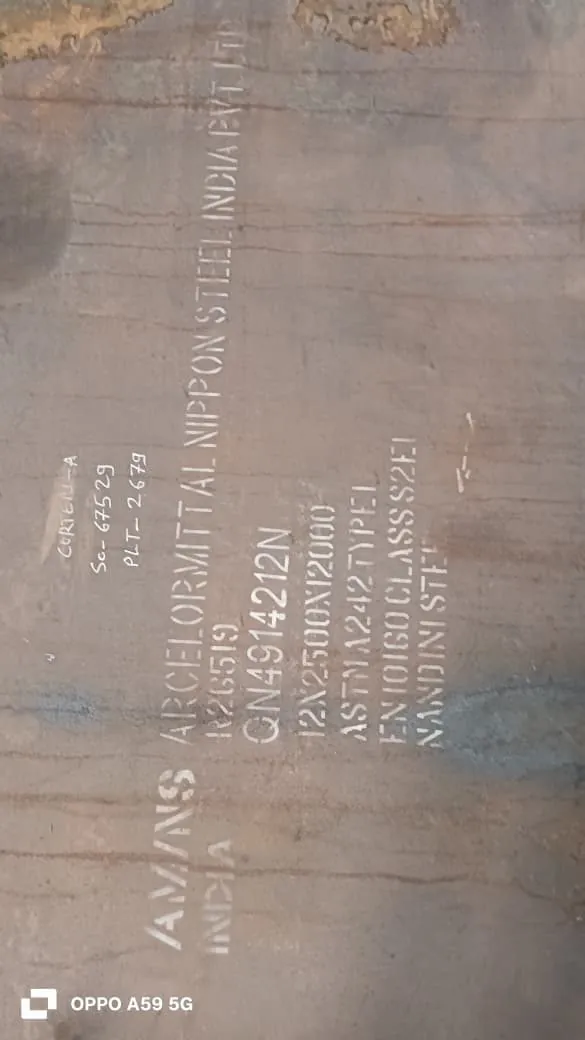
Weld decay isn't a mystery you troubleshoot at the torch, it's a decision you make before anyone strikes an arc. Pick the right base metal and the right filler, and heat-affected-zone attack never gets a foothold. Everything that follows is about making those two calls correctly from the start, then backing them up with intergranular corrosion (sensitization) testing and the mill certificate.
What is weld decay?
Weld decay is a localized type of intergranular corrosion (IGC) that eats away at the heat-affected zone (HAZ) of a welded austenitic stainless steel. In service, you'll see it as two corroded lines running parallel to the weld bead, set back a few millimeters from the fusion line. That's the band of parent metal the welding thermal cycle held inside the sensitization temperature range.
The weld filler and the arc aren't responsible for this. The real cause is sensitization triggered by the weld's thermal cycle: the base metal in that narrow band heats up, sits in the critical range as the joint cools, and becomes sensitized. The parent plate passed every corrosion check when it arrived. Now there's a strip beside the weld that no longer resists its service environment. So weld decay is intergranular corrosion, plain and simple, just the same grain-boundary mechanism, localized to a welded component.
The mechanism: sensitization in the heat-affected zone
Weld decay is just one example within the broader types of corrosion that stainless steel can suffer. To understand why it shows up exactly where it does, you have to look at what carbon and chromium are doing at the grain boundaries.
Chromium-carbide precipitation (Cr₂₃C₆)
Austenitic stainless steel resists corrosion because dissolved chromium forms a continuous passive film. Dwell time in the sensitization range changes that: carbon and chromium combine and precipitate as chromium carbide (Cr₂₃C₆) along the grain boundaries. Carbon diffuses quickly. Chromium doesn't. The result is that the carbide draws chromium out of the metal immediately adjacent to each boundary.
Chromium depletion below the passive limit
Passivity needs roughly 10.5–12% chromium sitting in solid solution. As Cr₂₃C₆ forms and grows, the thin zone right next to each grain boundary gets stripped of chromium and drops below that threshold. Those depleted boundaries aren't stainless anymore. They corrode on their own while the grain interiors stay untouched. The result: grain-boundary, or intergranular, attack. The chain of cause and effect holds exactly: chromium plus carbon form Cr₂₃C₆ at grain boundaries, which depletes chromium locally, which destroys passivity.
Why the attack appears as lines beside the weld (the 425–815 °C band)
Sensitization happens between 425–815 °C (800–1500 °F). Metal sitting right in the weld pool gets far hotter and cools too fast to sensitize; metal farther out from the joint never reaches that temperature at all. Only a narrow band, a few millimeters from the fusion line, lingers inside that window long enough to precipitate carbides. That's why corrosion traces this band as parallel lines, and why those lines are the visual signature of weld decay. The role of carbon, titanium and niobium covers how these elements govern the process in more depth.
What influences weld decay severity
Three variables decide whether a welded joint sensitizes and how badly.
Carbon content (the dominant lever)
Carbon is what feeds Cr₂₃C₆. A standard-carbon grade (up to roughly 0.08% C) carries enough carbon to sensitize during a normal weld cycle. A low-carbon "L" grade (≤0.03% C), by contrast, doesn't have enough free carbon to form continuous grain-boundary carbide in the time available. Cutting carbon is the single most effective lever. That's why the decision gets made at the specifying stage, not the welding stage.
Time in the sensitization range: heat input, section thickness, interpass temperature, multipass
Sensitization comes down to one thing: how long the metal sits hot. High heat input, thick sections that cool slowly, a high interpass temperature, repeated passes in multipass work, each one stretches the time spent in the 425–815 °C range and makes the damage worse. You can tighten heat input and interpass temperature to narrow that sensitized band. On a standard-carbon grade, though, you won't eliminate it.
Grade chemistry & stabilization
The alloy's chemistry sets the ceiling here. Low carbon starves the reaction. Stabilizing elements, titanium in 321, niobium in 347, preferentially tie up carbon as TiC or NbC, so it's not left available to form chromium carbide. A grade that is both low-carbon and correctly solution-annealed arrives immune to ordinary weld decay.
Which grades are affected: and which resist
Weld-decay susceptibility is a grade property, resolvable before purchase.
| Grade (UNS) | Carbon condition | Sensitization risk on welding | Mitigation |
|---|---|---|---|
| 304 (S30400) / 316 (S31600) | ≤0.08% C (standard) | Susceptible | Specify the L variant, or solution-anneal after welding |
| 310, 317 (standard-carbon) | Standard C | Susceptible | Low-carbon variant or PWHT |
| 304L (S30403) / 316L (S31603) | ≤0.03% C | Resists | Low carbon, no PWHT needed for normal sections |
| 904L (N08904) | ≤0.02% C | Resists | Extra-low carbon + high Ni/Mo/Cu |
| 321 (S32100) Ti / 347 (S34700) Nb | Stabilized | Resists, watch knife-line attack | Ti/Nb tie up carbon; use stabilizing anneal where specified |
| Incoloy 825 (N08825) | Ti-stabilized | Resists | Titanium stabilization, like 321 |
Standard-carbon austenitics (304, 316, 310, 317): susceptible
These grades carry enough carbon to sensitize during a normal weld cycle. Used in welded fabrication without a low-carbon substitution or post-weld anneal, they're the classic weld-decay candidates. Welding them more carefully never fixes it. Buying the L grade does.
Low-carbon "L" grades (304L, 316L, 904L): resist by low carbon
304L (low-carbon) and 316L hold carbon at ≤0.03%, below the threshold for continuous carbide formation, so they resist sensitization in as-welded condition for normal section thicknesses. 904L super-austenitic goes further at ≤0.02% C and backs it with ~25% Ni and ~4.5% Mo. For welded service, specifying the L grade up front is the cleanest route, and Nandini Steel holds the low-carbon "L" variants ex-stock for immediate dispatch.
Stabilized grades (321 Ti, 347 Nb) & knife-line attack
321 stabilizes with titanium, and 347 relies on niobium; each ties up carbon as a stable TiC or NbC, so chromium carbide never gets the chance to form. That resistance to ordinary weld decay holds even at standard carbon levels. There's one catch, though: knife-line attack. It's a narrow, sensitized band that can show up in a thin zone right at the fusion line after certain re-heating cycles. Where service conditions call for it, a stabilizing anneal keeps it in check.
Nickel alloys (Incoloy 825 Ti-stabilized) & super-austenitics
Higher-alloy materials fight weld decay for the same reason. Incoloy 825 (UNS N08825, a Ni-Fe-Cr alloy, often miscalled "Inconel 825") is titanium-stabilized. That means it behaves like 321 and resists sensitization. It conformsTo ASTM B424 / NACE MR0175 for sour service. Super-austenitic and nickel-base alloys pair very low carbon with high chromium, which leaves little room for grain-boundary depletion. Their filler selection, covered below, follows its own set of rules.
Filler-metal selection: matching vs over-alloyed
Choosing the base metal solves half the problem. The weld metal itself has to hold up against corrosion too, and that's where filler selection gets strict.
The rule: never under-match the base metal's corrosion grade
The filler has to match or beat the parent metal's corrosion resistance once it's deposited, full stop. Under-matching, say welding a high-alloy base with a leaner filler, leaves you with a weld bead that corrodes before the plate does. That defeats the whole point of the specification. Match it or exceed it. Never fall short.
Use low-carbon or stabilized filler (ER308L / ER316L) to keep the weld metal itself from sensitizing
For standard austenitics, matching the filler's low carbon content to the base metal keeps the weld deposit under the carbide threshold, the same way the L grade does on its own. 304 and 304L get welded with ER308L; 316L gets welded with ER316L. The "308" composition runs a bit richer than 304's chromium-nickel balance, and that's by design. It makes up for dilution, so the finished weld metal ends up with the right chemistry.
Over-alloyed fillers for super-austenitics & Ni alloys (ER385 / Ni-base for 904L; ERNiFeCr-1 / FM 65 for Incoloy 825)
High-alloy base metals need filler metal that over-matches them. The reason comes down to two things: dilution and microsegregation. As the weld pool solidifies, molybdenum and chromium segregate away from the growing dendrites, so the last metal to freeze ends up leaner than the nominal chemistry. Dilution with the base metal pulls that number down even further. That's why 904L gets weldedWith an over-alloyed filler, either ER385, a 25-20 Cu-bearing wire, or a nickel-base consumable, so even the thinnest interdendritic zones still beat 904L's own resistance. Incoloy 825 pairs with ERNiFeCr-1 (FM 65) for the same reason: a nickel-base wire that over-matches the parent metal and holds up against hot cracking. Inconel 625 runs on ERNiCrMo-3, following the identical logic.
Ferrite number & hot cracking (why a little delta-ferrite helps austenitics but Ni alloys weld fully austenitic)
Standard austenitic weld metal solidifies with a small amount of delta-ferrite, a ferrite number (FN) of roughly 3–10, and that ferrite dissolves sulfur and phosphorus that would otherwise cause solidification (hot) cracking. That's why ER308L/ER316L deposits are designed to retain a little ferrite. Nickel-base and super-austenitic deposits solidify fully austenitic instead, with no ferrite around to tolerate impurities. Their consumables lean on tight impurity control and specific alloying to make up for it. It's one more reason they over-match rather than match.
Filler-selection quick reference
Nandini Steel's full grade lineup, matched to its recommended filler and the reasoning behind each pairing, sits in this one consolidated matrix. Anyone specifying a welded corrosion-resistant joint can pull straight from it as a reusable reference.
| Base grade (UNS) | Family | Recommended filler (AWS class) | Matching vs over-alloyed | Why |
|---|---|---|---|---|
| 304 / 304L (S30400 / S30403) | Austenitic SS | ER308L | Matched (low-carbon) | 308 balance compensates for dilution; L keeps weld metal below the carbide threshold |
| 316 / 316L (S31600 / S31603) | Austenitic SS (Mo) | ER316L | Matched (low-carbon) | Carries the 2–3% Mo into the weld so the bead matches the plate's pitting resistance |
| 321 (S32100) | Austenitic SS (Ti) | ER347 | Matched (stabilized) | Nb-stabilized filler is the welding equivalent of Ti stabilization; ties up carbon |
| 347 (S34700) | Austenitic SS (Nb) | ER347 | Matched (stabilized) | Niobium carries through to the weld; resists weld-metal sensitization |
| 904L (N08904) | Super-austenitic SS | ER385 / Ni-base | Over-alloyed | Dilution and Mo microsegregation force an over-match so even lean zones exceed 904L |
| Incoloy 825 (N08825) | Ni-Fe-Cr alloy | ERNiFeCr-1 (FM 65) | Over-alloyed | Ni-base wire over-matches the parent and avoids fully-austenitic hot cracking |
| Inconel 625 (N06625) | Ni-Cr-Mo alloy | ERNiCrMo-3 | Matched (Ni-base) | Matching nickel-base consumable keeps the high Mo/Cr in the deposit |
| A516 Gr 70 (carbon) | PVQ carbon steel | E7018 / ER70S | Matched (strength) | Non-sensitizing base metal; filler matched for strength and toughness, not IGC |
How to prevent and verify it
Prevention happens at the specification stage. Verification is a document you hold in hand before fabrication ever begins.
Specify the right grade up front (L or stabilized)
The primary control starts with the base metal. Pick a low-carbon grade (304L, 316L, 904L) or a stabilized one (321, 347, Incoloy 825), and you remove the carbon that fuels sensitization before the joint ever sees a torch. For a direct side-by-side on the most common decision, see 304 vs 304L for welded service.
Control heat input / interpass; avoid the dwell
Whatever grade you're working with, keep heat input low, don't let interpass temperature climb, and cool the joint fast through the sensitization band. The goal: minimum time spent at 425–815 °C. For step-by-step procedure, check the process guides. how to weld 316 stainless and how to weld 904L cover those grades directly, while how to weld Incoloy 825 handles that alloy. The complete prevention workflow sits in how to prevent sensitization.
Post-weld solution annealing when required (1040–1150 °C + rapid quench)
Where a standard-carbon grade had to be used, or a stabilized grade needs resetting, post-weld solution annealing reverses sensitization: heating to 1040–1150 °C re-dissolves the chromium carbides and restores chromium to the grain boundaries, and a rapid quench locks the carbon back in solution so it cannot re-precipitate on cooling.
Verify with ASTM A262 (IGC) + the correct MTC
Weld decay susceptibility calls for testing under ASTM A262, the set of intergranular-corrosion practices labeled A through E. Practice E is the Strauss Cu-CuSO₄ immersion test; Practice A is the oxalic-acid etch, used for quick screening. So what actually proves a grade will resist weld decay? It's material supplied in the solution-annealed, low-carbon condition specified in its ASTM A262 testing and MTC. Every Nandini Steel order ships with an EN 10204 3.1/3.2 mill test certificate stating the heat chemistry and delivery condition. The carbon level and the solution-anneal step behind weld-decay resistance aren't just assumed. They're documented. When a job demands certified proof, specify ASTM A262 intergranular testing on the order itself, so that result gets recorded too.
Worked examples
Short cases that show the specifying decision playing out.
A 304 tank that failed early is usually a 304L / ER308L problem. The most common mistake is specifying standard-carbon 304 for a welded fabrication that's going to sit in the 425–815 °C range. Within months of acid service, the HAZ sensitizes and starts corroding in neat parallel lines. The fix is straightforward: 304L base metal welded with ER308L, keeping carbon low in both the plate and the weld metal. That removes the risk entirely, with no post-weld anneal needed. Specifying the L grade at the quotation stage costs far less than cutting out a sensitized joint and re-welding it later.
A 904L acid line welded with ER385. On super-austenitic sulfuric-acid duty, a fabricator who under-matches with a plain 316-type filler watches the weld bead corrode while the 904L plate stays sound. Dilution and molybdenum segregation leave the deposit leaner than the parent metal. Welding 904L with over-alloyed ER385, or a nickel-base wire, keeps even the interdendritic zones above 904L's resistance. The joint ends up matching the plate.
An Incoloy 825 joint for sour service, welded with FM 65. On a sour-gas or mixed-acid line, Incoloy 825 earns its place through combined resistance to reducing and oxidizing acids, plus its NACE MR0175 / ISO 15156 qualification. The weld itself uses ERNiFeCr-1 (FM 65), a nickel-base consumable that over-matches the parent metal. It also sidesteps the hot-cracking risk that comes with a fully austenitic deposit. The order should cite MR0175 directly, so the heat shows up already in the qualified condition.
Related grades & guides
Weld decay sits underneath a lot of the material and application calls documented elsewhere on the site. It's the fabrication-risk factor nobody can skip.
- Grades that resolve weld decay by chemistry: 304L (low-carbon), 316L, 904L super-austenitic, and Incoloy 825.
- The mechanism and process neighbors: intergranular corrosion (sensitization), welding stainless & nickel alloys, and solution annealing.
- Procedure and verification: how to prevent sensitization and ASTM A262 testing and MTC.
- Where welded CRA integrity is critical: hygienic / pharma fabrication, pulp & paper bleaching plant, and fertilizer / acid service.
FAQ
Is weld decay the same as sensitization?
Does 316L need post-weld heat treatment?
What filler should I use to weld 304 stainless?
What is knife-line attack?
Can nickel alloys suffer weld decay?
Need a welded joint that won't corrode under pressure? Nandini Steel can help with that. Founded in 2003 and certified to ISO 9001:2015, the company operates as a stockist and supplier with a certified specialty in 904L, Alloy 28, Incoloy 800 and Hastelloy. The low-carbon "L" grades sit ex-stock, ready for immediate dispatch. Every order ships with an EN 10204 3.1/3.2 mill test certificate drawn from genuine mill plate, sourced from Aperam, Outokumpu, Jindal, POSCO, Nippon Steel and JFE, recording the heat chemistry and delivery condition. That means the low-carbon, solution-annealed condition is proven, not assumed. Twenty years in business. 307+ projects completed. 260+ clients served across 36+ export countries. Send your specifications for live pricing: reachus@nandinisteel.com · +91 22 43404600 · WhatsApp +91 99202 09184.