
The right fit comes from matching the grade to the service, not falling back on habit. Each grade below links to its full specification page. Start by specifying the corrosion environment and the mechanical duty, then order the finish and diameter your part actually needs.
Stainless Steel Round Bar Grades at a Glance
Pick the grade based on what environment the part will actually face, not whatever the shop happens to have on the shelf.
- 304 stainless, the austenitic baseline. Pick it for general fabrication, food and dairy work, and dry indoor duty where chlorides aren't in the picture.
- 316 stainless, adds 2–3% molybdenum. Go with this one when chlorides show up: marine shafts, chemical handling, hygienic wash-down parts.
- 321 titanium-stabilized bar, holds up against sensitization across the 425–815 °C range. Suited to welded and high-temperature assemblies.
- 310S heat-resistant bar, 24–26% Cr, 19–22% Ni. The right choice for furnace components and anything facing sustained high-temperature oxidation.
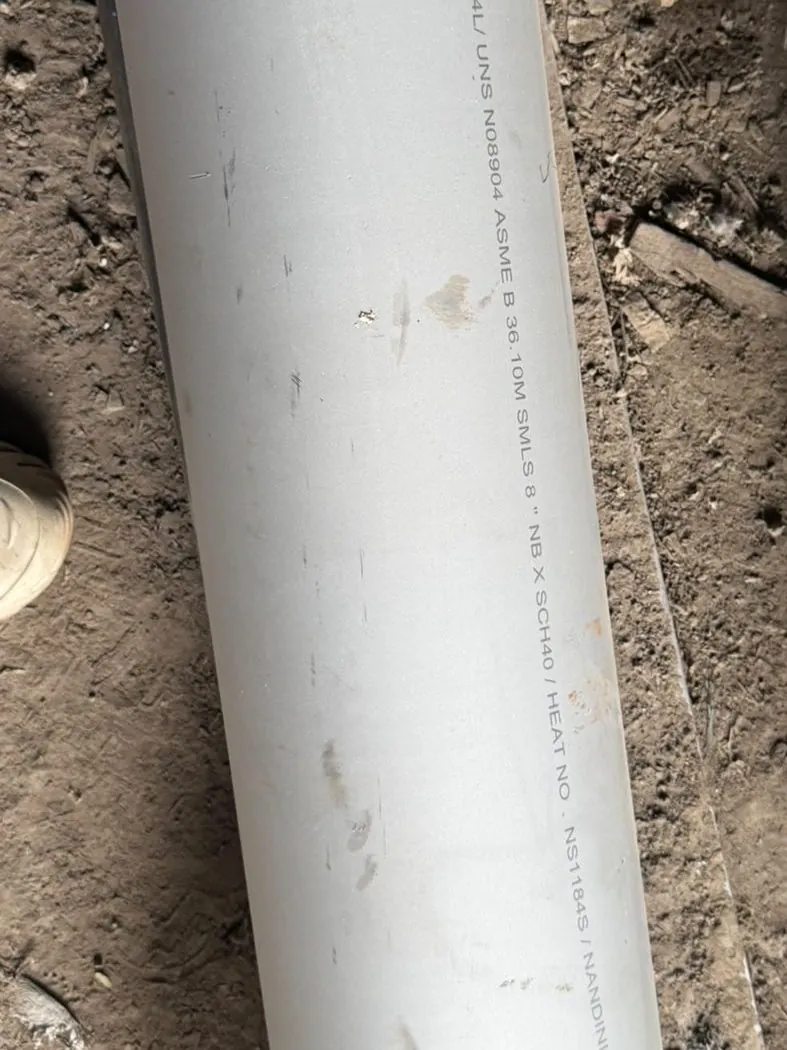
- 904L super-austenitic bar, copper-bearing, roughly 4.5% Mo, PREN around 34. Reach for it in sulfuric acid service and high-chloride environments. Nandini Steel is a certified specialist in 904L.
Chemical Composition by Grade
Nominal weight percentages for the stocked stainless round bar grades, per ASTM A276/A479, with the balance made up of iron:
| Grade | C | Cr | Ni | Mo | Other |
|---|---|---|---|---|---|
| 304 | ≤0.08 | 18.0–20.0 | 8.0–10.5 | – | Mn ≤2.0, Si ≤0.75 |
| 304L | ≤0.030 | 18.0–20.0 | 8.0–12.0 | – | Low-carbon variant |
| 316 | ≤0.08 | 16.0–18.0 | 10.0–14.0 | 2.0–3.0 | Mo for pitting resistance |
| 316L | ≤0.030 | 16.0–18.0 | 10.0–14.0 | 2.0–3.0 | Low-carbon variant |
| 321 | ≤0.08 | 17.0–19.0 | 9.0–12.0 | – | Ti 5×C–0.70 (stabilized) |
| 310S | ≤0.08 | 24.0–26.0 | 19.0–22.0 | – | High Cr/Ni for heat |
| 904L | ≤0.020 | 19.0–23.0 | 23.0–28.0 | 4.0–5.0 | Cu 1.0–2.0 |
Mechanical Properties
Minima for bar in the solution-annealed condition, to ASTM A276/A479:
| Grade / family | Tensile (min) | Yield 0.2% (min) | Elongation (min) | Hardness (max) |
|---|---|---|---|---|
| 304 / 316 / 321 / 310S | 515 MPa (75 ksi) | 205 MPa (30 ksi) | 30–40% | 217 HB / 95 HRB |
| 304L / 316L | 515 MPa (75 ksi) | 170 MPa (25 ksi) | 30% | 217 HB / 95 HRB |
| 904L | 490 MPa | 220 MPa | 35% | – |
Austenitic bar comes supplied solution-annealed. For more on that process, see solution annealing, and for how the resulting mechanical properties get defined, check this guide.
Physical Properties
Density drives bar weight. All austenitic grades are essentially non-magnetic in the annealed condition.
| Grade | Density (g/cm³) | Melting range (°C) | Magnetic response (annealed) |
|---|---|---|---|
| 304 | 7.93 | ~1400–1450 | Essentially non-magnetic |
| 316 | 7.98 | ~1375–1400 | Essentially non-magnetic |
| 321 | 7.90 | ~1400–1425 | Essentially non-magnetic |
| 310S | 7.90 | ~1400–1450 | Essentially non-magnetic |
| 904L | 7.95 | ~1300–1400 | Essentially non-magnetic |
Corrosion & Grade Selection: the PREN Ladder
Pitting resistance climbs as you add chromium, molybdenum and nitrogen, and the PREN (pitting resistance equivalent number) captures all three in one figure. For stainless round bar the orderable ladder runs 304 (~18) < 316 (~24) < 904L (~34). 304 falls prey to pitting and chloride stress-corrosion cracking. The 2–3% molybdenum in 316 pushes pitting resistance well above that. And 904L, with its copper content and roughly 4.5% Mo, stands up to sulfuric acid and chloride attack alike. Titanium-stabilized 321, for its part, holds off intergranular corrosion from sensitization in welded, hot service.
Nandini Steel Engineering Team note: Defaulting to 304 for chloride-adjacent or coastal duty is the most common bar-stock mistake, and that's exactly where it pits. Check the actual service chlorides before choosing 304 over 316; stepping up costs far less than a failed shaft does. Buyers also swing the other way: they pay for 316 where dry, indoor 304 would do the job, or they reach for Alloy 20 or 625 on sulfuric-acid duty that 904L already covers at lower cost. Match the molybdenum to the real pitting risk.
304 vs 316 for Bar Stock
For most shafts, pins, and fasteners, it really comes down to one question: is chlorine present? If the part is going to see salt, brackish water, or chemical process fluids, go with 316 over 304. For dry, non-chloride service, stick with 304, there's no reason to pay for molybdenum you'll never use. The full 304 vs 316 comparison lays out the spec-by-spec breakdown and the cost logic behind it.
Equivalent Grades & Designations
Cross-reference for specifying bar on international orders. See the full UNS/WNr/JIS cross-reference:
| Grade | UNS | Werkstoff (WNr) | JIS |
|---|---|---|---|
| 304 | S30400 | 1.4301 | SUS304 |
| 304L | S30403 | 1.4307 | SUS304L |
| 316 | S31600 | 1.4401 | SUS316 |
| 316L | S31603 | 1.4404 | SUS316L |
| 321 | S32100 | 1.4541 | SUS321 |
| 310S | S31008 | 1.4845 | SUS310S |
| 904L | N08904 | 1.4539 | SUS890L |
Available Forms, Finishes & Sizes
Stainless round bar comes in three standard conditions, and each one carries its own tolerance band. All bar ships ex-stock for immediate dispatch. Send an RFQ for the exact diameters, lengths and grades you need against your inquiry.
| Finish / condition | Typical tolerance class | Typical use |
|---|---|---|
| Bright drawn (cold-drawn) | h9 / h11 | Small-diameter shafts, pins, fasteners, clean, dimensionally close |
| Peeled & centreless-ground | h9 / h11 | Precision shaft blanks requiring a defect-free skin |
| Hot-rolled annealed & pickled (black) | Mill tolerance | Larger diameters and machining stock turned to size |
Bar meets the general dimension and tolerance requirements of ASTM A484. Before ordering, check whether bright, peeled, or black finish fits your machining allowance.
Bar Weight: kg/m
Round bar mass per meter depends on diameter and density. Here's the formula:
kg/m = diameter_mm² × 0.006165 × (density ÷ 7.85)
For 304 (7.93 g/cm³), that works out to roughly diameter_mm² × 0.00623. Here are some representative figures:
| Diameter (mm) | 304 (kg/m) | 316 (kg/m) |
|---|---|---|
| 12 | 0.90 | 0.90 |
| 20 | 2.49 | 2.51 |
| 25 | 3.89 | 3.92 |
| 40 | 9.96 | 10.03 |
| 60 | 22.4 | 22.6 |
For other grades and forms, use the weight calculator.
Standards & Specifications
Stainless round bar is ordered primarily to ASTM A276 (bars and shapes) and ASTM A479 (bars for use in boiler and pressure-vessel service), with ASTM A484 covering general dimensional and tolerance requirements. The 904L grade conforms to A276/A479 as UNS N08904. Specify the standard, grade, UNS number, finish and tolerance class on the purchase order so the heat is supplied in the correct condition.
Testing, Inspection & MTC
Every order ships with an EN 10204 3.1/3.2 mill test certificate, reporting heat chemistry and mechanical results tied to the cast. For the full picture, see EN 10204 3.1 mill test certificate and the broader overview of testing, MTC, NDT and PMI. PMI confirms grade right on receipt. No guesswork there. Where sensitization is a concern, intergranular-corrosion testing to ASTM A262 can be added to the scope. The bar itself is genuine mill material, sourced from producers such as Aperam, Outokumpu, Jindal, POSCO, Nippon Steel and JFE, with heat and cast traceability that doesn't break between certificate and stamped bar. Nandini Steel holds ISO 9001:2015 certification, Certificate No. 1283438, issued by Unitas Certification Services UCS-UK and valid through 11 January 2028.
Applications of Stainless Round Bar
Stainless round bar gets machined into parts wherever corrosion resistance and dependable mechanical strength both matter.
Pumps and valves with marine or chemical shafts need 316, since chlorides eat away at 304; for general rotating parts, 304 does the job fine.
In pharmaceutical and food or dairy settings, hygienic shafts, agitator spindles and fitting blanks have to passivate cleanly, which is why 316L and 304 get used there.
Furnace fixtures call for 310S to handle high heat. Welded hot assemblies are different: they need 321, which resists sensitization.
- Acid and process plant, 904L for pump and valve internals in sulfuric-acid and high-chloride service.
Other Round-Bar Materials & Other Stainless Forms
Need a different material in bar, or stainless in another form? Nandini Steel also supplies alloy steel round bars, along with Hastelloy and Inconel round bars, all sitting within the round bars range. For stainless, those same grades come as stainless pipe, flanges and fasteners too. Not sure which grade fits your order? The guide to selecting a stainless grade will help you pin it down.
FAQ
What standards apply to stainless steel round bars?
How do I choose between 304 and 316 round bar?
What finishes and tolerances are available?
How is stainless round bar weight calculated?
Request a Quote
Nandini Steel keeps all stainless round bar grades ex-stock, so dispatch is immediate. Every order ships with an EN 10204 3.1/3.2 mill test certificate and full heat traceability. Send over your grade, finish, diameter, length and quantity, and you'll get live pricing back. Reach the team by phone on +91 22 43404600, on WhatsApp at +91 99202 09184, or by email at reachus@nandinisteel.com. The company has worked as a stockist and supplier since 2003, and the numbers speak for themselves: 307+ projects delivered, 260+ clients served, and exports reaching 36+ countries.