
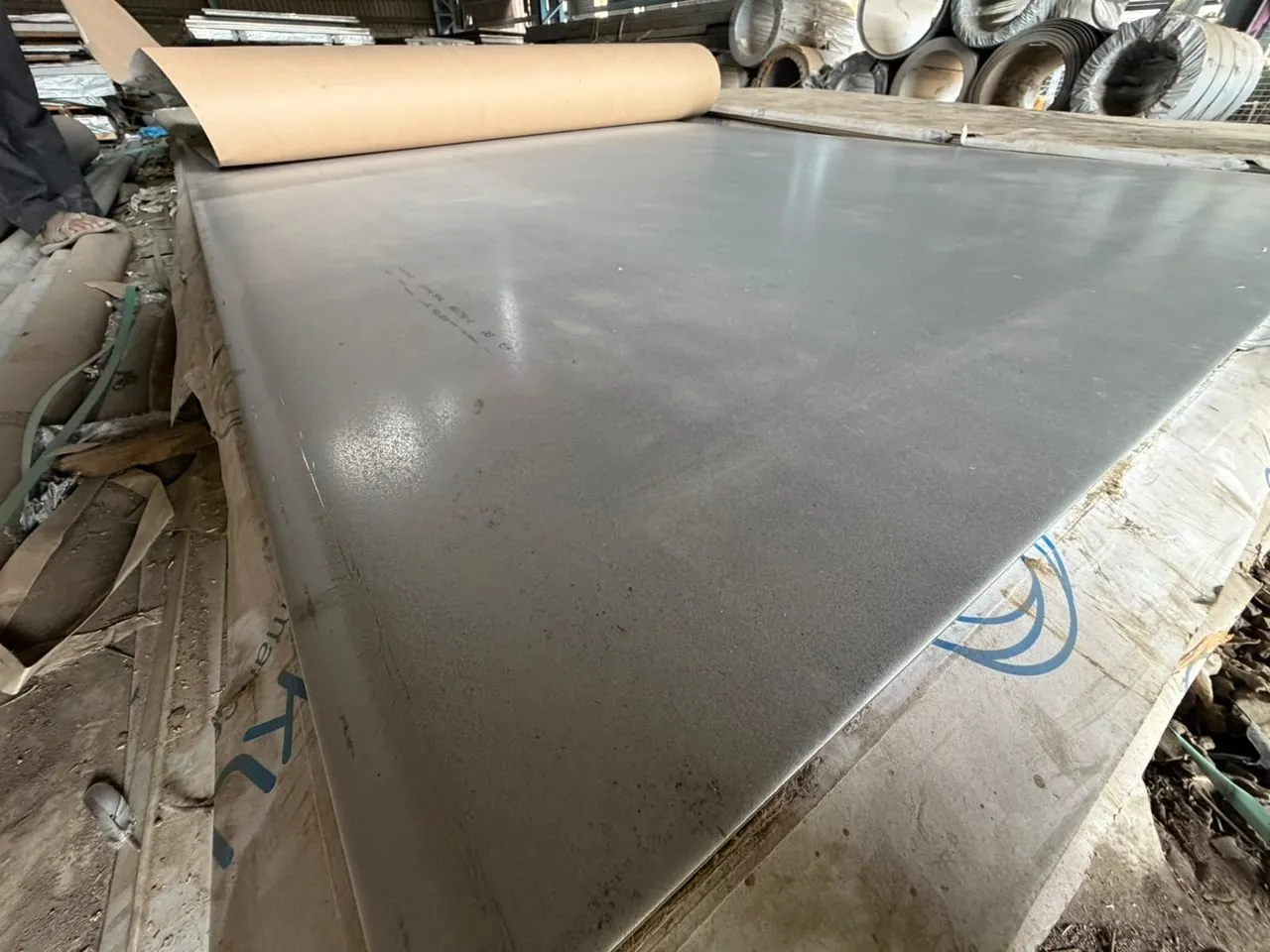
The goal: match the grade to the environment, not the other way round
Grade selection works by elimination. The service environment sets the terms: chloride level, acid type and concentration, temperature, H₂S, applied stress. Each of those knocks out candidate grades one failure mode at a time. You don't just pick a grade and hope it holds up. You let the environment cross grades off the list until only one is left standing, and that's where you stop.
The survivors all sit on one ordering backbone: the PREN (pitting resistance equivalent) and cost ladder, running 304 < 316/316L < 904L < duplex 2205 ≈ Incoloy 825 < super-duplex/nickel alloy. The method doesn't play favorites either way. Specify a nickel alloy where 904L would already clear the bar, and you've wasted money. Specify 304 for warm chlorides, and the part pits. The right grade is the lowest rung that beats every mechanism at work, nothing higher. And when corrosion isn't even the issue, when pressure is the real driver, the tree sends you out of stainless altogether and into pressure-vessel (PVQ) steel.
Before you start: the 5 inputs you must define
The decision tree only holds up if those five inputs are actual numbers pulled from a datasheet, a process spec or a design code, not guesses. Pin down each one before you touch the ladder.
| Input | Why it decides the grade | Where to get it |
|---|---|---|
| Corrosive medium & concentration | Reducing vs oxidizing acid, salt, caustic, sets whether Mo, Cu or Ni is the driver | Process fluid list / P&ID |
| Chloride level (ppm) & temperature | Together they set the pitting, crevice and chloride-SCC risk, the single biggest austenitic eliminator | Water analysis / process spec |
| Mechanical / pressure demand | Yield, toughness and design code (ASME) can force PVQ plate or a duplex over an austenitic | Vessel calc / design code |
| Fabrication & welding plan | Welded assemblies held at 425–815 °C need a low-carbon (L) or stabilized grade to avoid sensitization | Fabrication drawing / WPS |
| Standard, form & budget ceiling | Governing standard (A240, B424, A516), the form you need, and the cost ceiling that stops the climb | Purchase spec / RFQ |
Two of these lean on composition and strength fundamentals. See the role of alloying elements for why Mo, Cu, Ni and N move the ladder, and mechanical properties for reading yield, tensile and toughness onto the design case.
The decision tree: 6 steps from service condition to grade
Work the steps in order. Each one either narrows the candidate list or turns a condition into a number you can rank.
Step 1: Classify the environment
Sort the service into one of six buckets: mild (indoor, dry, potable), chloride-bearing (coastal, brackish, process water), acidic (sulfuric, phosphoric, mixed), high-temperature (oxidation, scaling, creep), sour (H₂S present), or stress-loaded (tensile stress plus aggressive medium). Most real duties don't fall neatly into one category. Classify every condition present, because the grade has to clear all of them. Start from the mechanisms in types of corrosion.
Step 2: Set the corrosion mechanism you must defeat
Translate each environment into the specific mechanism that attacks it: chlorides lead to pitting and crevice corrosion. Chlorides combined with tensile stress and heat produce chloride stress-corrosion cracking. Welding without a low-carbon grade brings on sensitization and intergranular attack. Dissimilar metals sitting in an electrolyte cause galvanic corrosion. Acids drive general attack governed by sulfuric-acid resistance. And H₂S brings sour service (NACE MR0175) cracking. What a grade resists, or falls victim to, comes down to the mechanism itself, not the name of the medium.
Step 3: Convert that into a PREN / resistance threshold
For chloride pitting and crevice attack, the orderable number is PREN:
PREN = Cr + 3.3 × Mo + 16 × N
A higher PREN resists pitting at higher chloride and temperature. As a working rule, mild and low-chloride water sits fine with 304-class PREN (around 18). General chloride service needs 316-class, roughly 24. Warm or concentrated chlorides and seawater push things toward 904L (about 34), duplex 2205 (around 35), and beyond. For mapping a chloride-temperature limit to a PREN target, read PREN (pitting resistance equivalent), then cross-check against a materials authority's chloride-temperature curves. Acid and sour service work differently: PREN stops being the controlling number, and acid concentration/temperature iso-corrosion limits along with NACE MR0175 / ISO 15156 qualification take over instead.
Step 4: Walk the grade ladder to the first grade that clears every threshold
Climb from the bottom and stop at the first rung whose PREN and resistance clear every mechanism from Step 2. Everything else in the method hangs on this ordering fact.
| Grade | Family | PREN | Key composition driver | Survives when… |
|---|---|---|---|---|
| 304 / 304L | Austenitic SS | ~18 | Cr-Ni, no Mo | Mild, dry, low-chloride, potable |
| 316 / 316L | Austenitic SS | ~24 | Mo 2–3% | General chlorides, marine atmosphere, food/pharma |
| 904L super-austenitic | Super-austenitic SS | ~34 | Mo ~4.5%, Cu ~1.5%, Ni ~25% | Sulfuric acid, warm/high chlorides, crevices |
| Duplex 2205 | Ferritic/duplex SS | ~35 | Cr-Mo, duplex structure | Chloride-SCC risk + high strength needed |
| Incoloy 825 | Ni-Fe-Cr alloy | ~31–40 | Ni 38–46%, Mo, Cu, Ti | Sour service, mixed reducing + oxidizing acids |
| Super-Duplex 2507 | Ferritic/duplex SS | ~43 | High Cr-Mo-N | Seawater, extreme chloride + stress |
304 shows poor resistance to pitting and chloride-SCC, and it fails the moment chlorides show up. 316/316L holds up better than 304 against pitting, thanks to its 2–3% molybdenum content, but it's still an austenitic grade, so chloride-SCC remains a risk. It's the default choice for general service, though its ceiling is low. 904L handles sulfuric acid well because of its copper content, and it stands up to chloride pitting and crevice attack at a PREN near 34, beating 316L on chloride-SCC resistance. Incoloy 825 is built for sour service. It meets NACE MR0175 / ISO 15156 and holds up against both reducing and oxidizing acids, making it the right rung for mixed-acid and sour-gas duty. For the decisions between adjacent rungs, see the comparisons on 304 vs 316, 316 vs 316L, when to upgrade from 316L to 904L, and 904L vs duplex 2205.
Step 5: Check mechanical, temperature and fabrication constraints
A grade that holds up against corrosion can still trip you up on the shop floor. Confirm it welds without sensitizing first, for welded assemblies, pick a low-carbon (L) grade (C ≤ 0.03%), go with a stabilized grade (321/347), or specify solution annealing after welding. Check toughness at the design temperature too. And make sure the structure actually suits the joint; duplex and nickel alloys don't weld the same way austenitics do. See welding stainless & nickel alloys and prevent sensitization for the details. If pressure and temperature are driving the decision rather than corrosion, step off the stainless ladder altogether and specify PVQ plate instead. Read carbon vs stainless vs alloy steel to confirm which family the duty actually belongs to.
Step 6: Apply the cost ceiling: stop at the lowest grade that survives
The ladder goes up in both resistance and cost, and the right pick is the lowest rung that clears every failure mechanism, not the most capable grade on the list. Don't pay for Incoloy 825 when 904L already handles the acid and chloride limits. Don't buy 904L when 316L already resists the pitting risk. And don't default to 316 where dry, indoor conditions let plain 304 do the job. Over-specifying costs you quietly, again and again. Under-specifying just fails outright. Sometimes the honest answer is the cheap one.
Worked examples: the tree applied to real service conditions
| Service | Inputs | Mechanism to defeat | PREN / qualifier | Grade → form |
|---|---|---|---|---|
| Seawater heat exchanger | ~19,000 ppm chloride, 40–60 °C, welded tubes | Pitting + crevice + chloride-SCC | PREN ≥ ~34 | 904L (or super-duplex) → 904L plate |
| Sulfuric-acid transfer line | Dilute–mid H₂SO₄, moderate temperature | General acid attack | Cu-bearing, iso-corrosion limit | 904L → plate/pipe, per fertilizer / acid-regeneration service |
| Sour oil & gas separator | H₂S present, chlorides, elevated pressure | Sour cracking + pitting | NACE MR0175 / ISO 15156 | Incoloy 825 → 825 plate; vessel body in A516 Gr 70 |
Hygienic work follows the same path toward 316L (see pharmaceutical / hygienic), but the chemistry in a bleach plant, as covered under pulp & paper bleaching, usually calls for 904L instead.
Common selection mistakes (and how to avoid them)
| Mistake | Consequence | Fix |
|---|---|---|
| Defaulting to 304 for coastal or chloride-adjacent duty | Pitting, rust bleed, early failure | Confirm service chlorides; step up to 316, see pitting |
| Forgetting crevice attack at gaskets, flanges and lap joints | Localized attack where bulk PREN looked adequate | Design out crevices; rate for crevice corrosion, not just open-surface pitting |
| Ignoring chloride-SCC on austenitics under warm, stressed service | Sudden cracking of 304/316 despite no general corrosion | Move to duplex or a high-nickel grade, see chloride stress-corrosion cracking |
| Using a non-L grade on a welded assembly | Sensitization at 425–815 °C → intergranular attack in the HAZ | Specify 304L/316L or stabilized 321/347, see sensitization |
| Galvanic pairing of dissimilar metals in an electrolyte | Accelerated attack of the less-noble member | Isolate or match grades, see galvanic corrosion |
| Assuming "316 marine grade" survives warm seawater | Pitting once chloride and temperature exceed the 316 limit | Check PREN against the duty; upgrade to 904L/super-duplex |
Nandini Steel Engineering Team's supply experience points to two common over-specifications. One is calling for Alloy 20, 625 or titanium on sulfuric-acid duty that 904L's copper-bearing ~4.5% Mo chemistry already handles. The other is ordering Incoloy 825 where 904L clears the acid and chloride limits just fine. Before paying for either upgrade, check the concentration and temperature against the 904L iso-corrosion limits.
Verify before you buy: prove the grade with testing and traceability
A grade only means something if the metal you get matches what's on the label. That's why closing the selection means verifying it.
- Confirm identity by PMI, positive material identification on the delivered item verifies the alloy itself, not just what's written on the paper.
- Prove heat chemistry by MTC, an EN 10204 3.1/3.2 mill test certificate ties the plate back to its heat chemistry and mechanical properties. Nandini Steel includes an EN 10204 3.1/3.2 mill test certificate with every order.
- Check IGC where welding matters, ASTM A262 intergranular-corrosion testing on a cut sample shows the grade won't sensitize once it's in service.
- Write the grade onto the RFQ precisely. List the UNS number, standard, form, and any NACE or HIC call-out. That way, the heat you qualified is the one that actually ships.
For how heat and cast numbers get carried through, see PMI, MTC & NDT testing and material traceability. For reading chemistry and mechanicals off the document itself, check how to read a mill test certificate. Every grade on the ladder sits ex-stock, ready for immediate dispatch, and it's cut from genuine mill plate supplied by Aperam, Outokumpu, Jindal, POSCO, Nippon Steel and JFE. 904L, Alloy 28, Incoloy 800 and Hastelloy plates are a different matter: a third-party-certified specialty, held under Nandini Steel's ISO 9001:2015 scope.
Grade quick-reference by environment
| Environment | Mechanism to defeat | Recommended grade(s) | Approx. PREN | Governing standard |
|---|---|---|---|---|
| Mild / indoor / potable water | General corrosion | 304 / 304L | ~18 | ASTM A240 / SA-240 |
| General chlorides / marine atmosphere / food & pharma | Pitting (moderate) | 316 / 316L | ~24 | ASTM A240 / SA-240 |
| Warm / concentrated chlorides, seawater | Pitting + crevice + chloride-SCC | 904L, duplex 2205 | ~34–35 | ASTM A240 / SA-240 |
| Sulfuric & mixed acids | Acid attack | 904L; Incoloy 825 for mixed/reducing | ~34 / ~31–40 | A240 / ASTM B424 |
| Sour service (H₂S) | Sour cracking + pitting | Incoloy 825; A516 Gr 70 HIC for vessel body | ~31–40 | NACE MR0175 / ISO 15156 |
| High-pressure, non-corrosive | Pressure / toughness (not corrosion) | A516 Gr 70 pressure-vessel plate | n/a | ASTM A516 / SA-516 |
Related grades and where to go next
The method sends you to a named grade and form. Follow whichever rung you landed on.
- General service: 304 stainless and the 304 vs 316 decision.
- Chloride / marine / hygienic: 316 / 316L and 316 vs 316L.
- Acid / high-chloride: 904L super-austenitic, with when to upgrade from 316L to 904L and 904L vs duplex 2205.
- Sour / mixed-acid: Incoloy 825.
- Pressure-driven: A516 Gr 70 pressure-vessel plate.
For the metallurgy behind the families, see stainless steel metallurgy, austenitic stainless, super-austenitic stainless steel and duplex stainless. Want to run the same tree yourself? The stainless grade selector tool walks through it interactively. Once you've settled on a grade, size the section using choosing plate thickness, then calculate plate weight.