
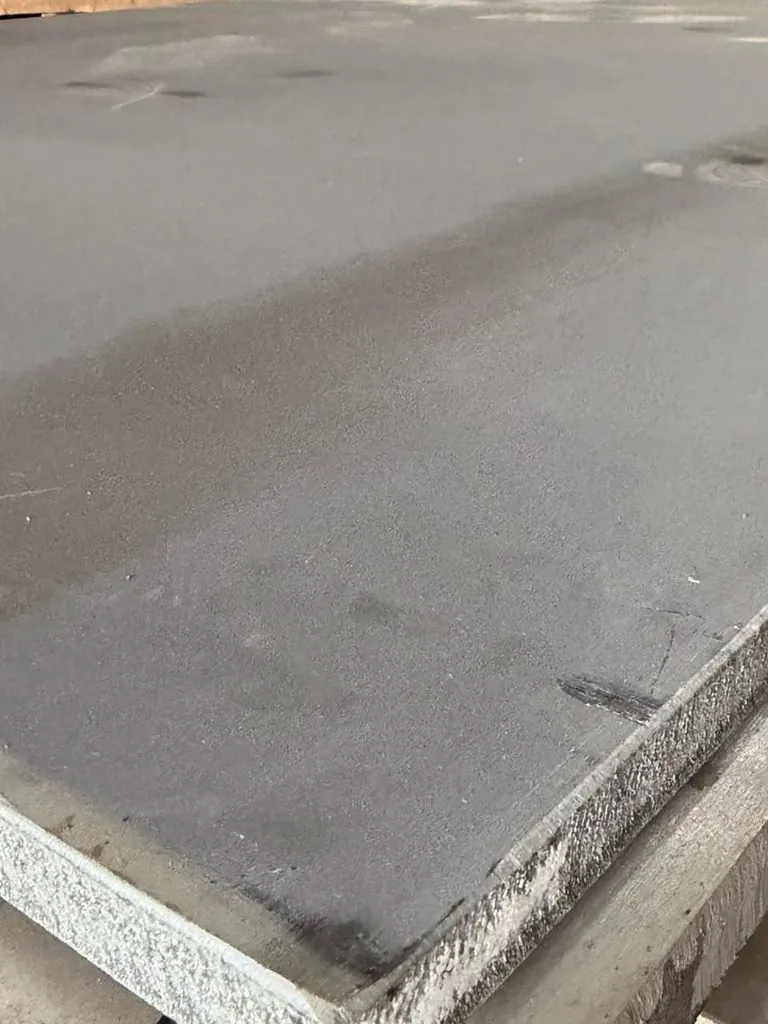
What ASTM A480 Covers
A480 does not assign the chemistry or mechanical properties of a specific grade. That job belongs to the product specification, most often ASTM A240 for chromium and chromium-nickel stainless plate, sheet and strip. Instead, A480 defines the requirements that apply to all of those products in common: how composition is checked, how thickness and width are measured, what finishes mean, how flatness is judged, and how material is marked, tested and certified.
In practice you cite both numbers together. A line item might read "ASTM A240 Type 316L, A480 finish No. 2B," where A240 fixes the grade and A480 fixes the form, tolerance and surface. The ASME pressure-vessel editions, ASME SA-240 and its A480 counterpart, carry the same content for code work.
Product Forms Defined
A480 separates flat-rolled stainless by thickness and width, and the distinction changes which tolerance table applies. A short reference guide to the three forms sits in sheet vs plate vs coil.
| Form | Typical definition | Common supply |
|---|---|---|
| Plate | Over 4.76 mm (3/16 in) thick, over 250 mm wide | Hot-rolled, annealed, descaled |
| Sheet | Under 4.76 mm thick, 600 mm and wider | Cold-rolled, 2B or BA finish |
| Strip | Under 4.76 mm thick, under 600 mm wide | Cold-rolled, slit to width |
Chemistry and Composition Verification
A480 requires that each heat conform to the composition limits of the applicable product specification and that a chemical analysis be reported. For austenitic grades the carbon ceiling is the figure that most often drives a buyer's choice. The low-carbon "L" grades such as 304L and 316L hold carbon at or below 0.03%, which suppresses chromium-carbide precipitation and protects the weld heat-affected zone against sensitization. Where chloride pitting resistance matters, molybdenum is the element to confirm on the certificate.
| Grade | Family | Key composition note | PREN (approx.) |
|---|---|---|---|
| 304 / 304L | Austenitic | L grade holds C ≤ 0.03% | ~18 |
| 316 / 316L | Austenitic | Mo 2–3% for pitting resistance | ~24 |
| 904L | Super-austenitic | Ni ~25%, Mo ~4.5%, Cu ~1.5% | ~34 |
The pitting resistance equivalent number lets you rank grades on chloride resistance before you commit. The method is explained in PREN and pitting resistance, and the carbon-driven weld-decay risk is covered in intergranular corrosion and sensitization.
Surface Finishes Under A480
Finish is where A480 does its most visible work. The standard names each flat-rolled finish so a buyer and a mill mean the same thing by "2B" or "No. 4." Choosing the finish is a corrosion and hygiene decision as much as an aesthetic one, since a smoother, more passive surface cleans more easily and holds fewer initiation sites for pitting. A deeper walk-through sits in stainless steel finishes: 2B, BA, No. 4.
| A480 finish | Process | Appearance | Typical use |
|---|---|---|---|
| No. 1 | Hot-rolled, annealed, descaled | Dull, rough | Plate for tanks, structural |
| 2D | Cold-rolled, annealed, descaled | Uniform dull matte | Deep-drawn parts, painting base |
| 2B | 2D plus light cold roll on polished rolls | Smooth, moderately reflective | Most general sheet and coil work |
| BA | Bright annealed in controlled atmosphere | Bright, mirror-like | Hygienic and decorative surfaces |
| No. 4 | Abrasive polished, roughly 150–180 grit | Directional satin brush | Food, dairy, architectural |
| No. 8 | Successively finer polishing | Mirror reflective | Decorative panels, reflectors |
For hygienic duty in food and dairy and food and beverage work, 2B and BA sheet in 304 or 316 are the usual starting points. For architectural facades and railings, a No. 4 brushed finish is the common request.
Dimensional Tolerances
A480 fixes the permitted deviation on thickness, width, length, flatness, edge condition and out-of-square. The tolerance that applies depends on the form, the finish and the ordered size, so hot-rolled plate, cold-rolled sheet and slit strip each read from their own tables. These tolerances are what let you plan nesting, weld-gap fit-up and final machining allowance with confidence.
- Thickness is held to the tightest band on cold-rolled sheet and strip, with wider allowances on hot-rolled plate.
- Flatness is specified so plate lies within a defined deviation over a given length, which matters for laser cutting and fit-up.
- Width and length tolerances distinguish mill edge, trimmed edge and slit strip.
When you need to turn an ordered size into shipping weight, the steel plate weight calculator and the how to calculate plate weight guide do the arithmetic.
Testing, Marking and Certification
A480 sets out how flat-rolled stainless is tested and documented: chemical analysis per heat, mechanical testing per the product spec, and marking that ties each piece back to its heat number. That chain of traceability is what a receiving inspector checks against the mill test certificate. Every order Nandini Steel ships carries an EN 10204 3.1 or 3.2 mill test certificate, so the chemistry, mechanicals and finish on the paperwork match the plate, sheet or strip in the stack. If you are new to reading one, how to read a mill test certificate walks through each field.
For intergranular-attack-sensitive service, ASTM A262 practices can be specified on the order to confirm resistance to sensitization.
Related Standards for Other Product Forms
A480 governs stainless flat-rolled product. Nickel-alloy and heat-resisting flat product read from their own general and product specifications, which is worth knowing when a project mixes materials.
| Material | Flat-product standard | Form |
|---|---|---|
| Chromium / Cr-Ni stainless | ASTM A240 under A480 | Plate, sheet, strip |
| Hastelloy C-276 / C-22 | ASTM B575 | Plate, sheet, strip |
| Incoloy 800 / 825 | ASTM B409, ASTM B424 | Plate, sheet, strip |
| Inconel 625 | ASTM B443 | Plate, sheet, strip |
Stock and Supply
Nandini Steel is an ISO 9001:2015-certified stockist and supplier, established in 2003, holding stainless plate, sheet, coil and strip to ASTM A240 and A480 in grades including 304, 304L, 316, 316L and 904L. Representative stock pages include 304 plate, 316L plate, 304 sheet, 316 coil and 904L plate. As a certified specialist in 904L and the higher nickel alloys, we also supply Alloy 28, Incoloy 800 and Hastelloy plate. All material is ex-stock for immediate dispatch with a mill test certificate on every order.
Frequently Asked Questions
What is the difference between ASTM A480 and ASTM A240?
Does ASTM A480 define the finish names like 2B and No. 4?
Is ASTM A480 the same as ASME SA-480?
Does A480 apply to nickel alloys like Incoloy or Hastelloy?
What tolerances does ASTM A480 control?
For live pricing and availability on A240 and A480 stainless plate, sheet, coil or strip in any grade or finish, send your specification to Nandini Steel at reachus@nandinisteel.com or WhatsApp +91 99202 09184 for a same-day quote from ex-stock material.