Stainless Steel Pipe Fittings at a Glance
Butt-weld (BW) elbows (45°/90°, LR/SR), equal and reducing tees, concentric and eccentric reducers, caps, stub ends, crosses and couplings round out the type list.
- Grades stocked: wrought austenitic 304/304L, 316/316L, 321, 347, 310S and super-austenitic 904L.
Standards: ASTM A403 covers wrought austenitic BW fittings, built to ASME B16.9 dimensions. For forged socket-weld and threaded fittings, we work to ASTM A182 with ASME B16.11.
Traceability: every order ships with an EN 10204 3.1/3.2 mill test certificate. PMI and IGC testing per ASTM A262, along with hydrostatic testing, are available on request.
Sourcing: everything is ex-stock, ready for immediate dispatch. Mill plate and billet come straight from Aperam, Outokumpu, Jindal, POSCO, Nippon Steel and JFE.
Nandini Steel has been supplying stainless connection components since 2003. That's over 20 years, spanning 307+ projects, 260+ clients and 36+ export countries. Request pricing through the RFQ form for live quotes, broken down by grade and size.
Fitting Types & Configurations
Stainless steel pipe fittings handle every direction, branch and transition you'll find in an austenitic piping system. Butt-weld fittings come supplied to ASTM A403, dimensioned to ASME B16.9, and get welded straight into the line. The result: full-bore, high-integrity joints.
- Elbows, 45° and 90°, long-radius (LR, 1.5D) and short-radius (SR, 1D) for routing and tight layouts.
- Tees, equal and reducing, for branch connections off the main run.
- Reducers, concentric for vertical runs, eccentric to hold a flat invert in horizontal lines.
- Caps, to close the end of a run or vessel nozzle.
- Stub ends, paired with lap-joint flanges for dismantlable, low-cost flanged joints.
- Crosses and couplings, four-way branches and small-bore connections.
Butt-Weld vs Socket-Weld & Threaded Fittings
The split comes down to dimensions: size and service. Butt-weld fittings (ASTM A403 + ASME B16.9) are wrought, full-penetration welded, and they dominate NPS 2 and above. Socket-weld and threaded fittings, by contrast, are forged to ASTM A182 with ASME B16.11 dimensions, and they're built for small-bore, high-pressure lines. For the forged range, see our stainless forged fittings.
| Attribute | Butt-weld (BW) | Socket-weld / threaded |
|---|---|---|
| Standard | ASTM A403 + ASME B16.9 | ASTM A182 + ASME B16.11 |
| Product condition | Wrought austenitic, formed | Forged |
| Joint | Full-penetration butt weld | Fillet weld (socket) or NPT thread |
| Typical size range | NPS 2 and larger | NPS 2 and smaller |
| Designation | WP304 / WP316 / WP321 | F304 / F316 / F321 |
Grades Stocked & Chemical Composition
All grades are wrought austenitic (or super-austenitic) stainless steel grades, supplied to the composition limits of ASTM A403 / ASTM A182. The 2–3% molybdenum in 316/316L gives pitting resistance that 304 simply doesn't have. The low-carbon "L" grades keep carbon at or below 0.03% to stop sensitization in the weld HAZ. And 321 and 347? Stabilized with titanium and niobium, built for high-temperature welded service.
| Grade | C | Cr | Ni | Mo | Other |
|---|---|---|---|---|---|
| 304 (WP304) | ≤0.08 | 18.0–20.0 | 8.0–10.5 | – | Mn ≤2, Fe bal |
| 304L (WP304L) | ≤0.03 | 18.0–20.0 | 8.0–12.0 | – | Mn ≤2, Fe bal |
| 316 (WP316) | ≤0.08 | 16.0–18.0 | 10.0–14.0 | 2.0–3.0 | Fe bal |
| 316L (WP316L) | ≤0.03 | 16.0–18.0 | 10.0–14.0 | 2.0–3.0 | Fe bal |
| 321 (WP321) | ≤0.08 | 17.0–19.0 | 9.0–12.0 | – | Ti ≥5×C |
| 347 (WP347) | ≤0.08 | 17.0–19.0 | 9.0–13.0 | – | Nb ≥10×C |
| 310S (WP310S) | ≤0.08 | 24.0–26.0 | 19.0–22.0 | – | Fe bal |
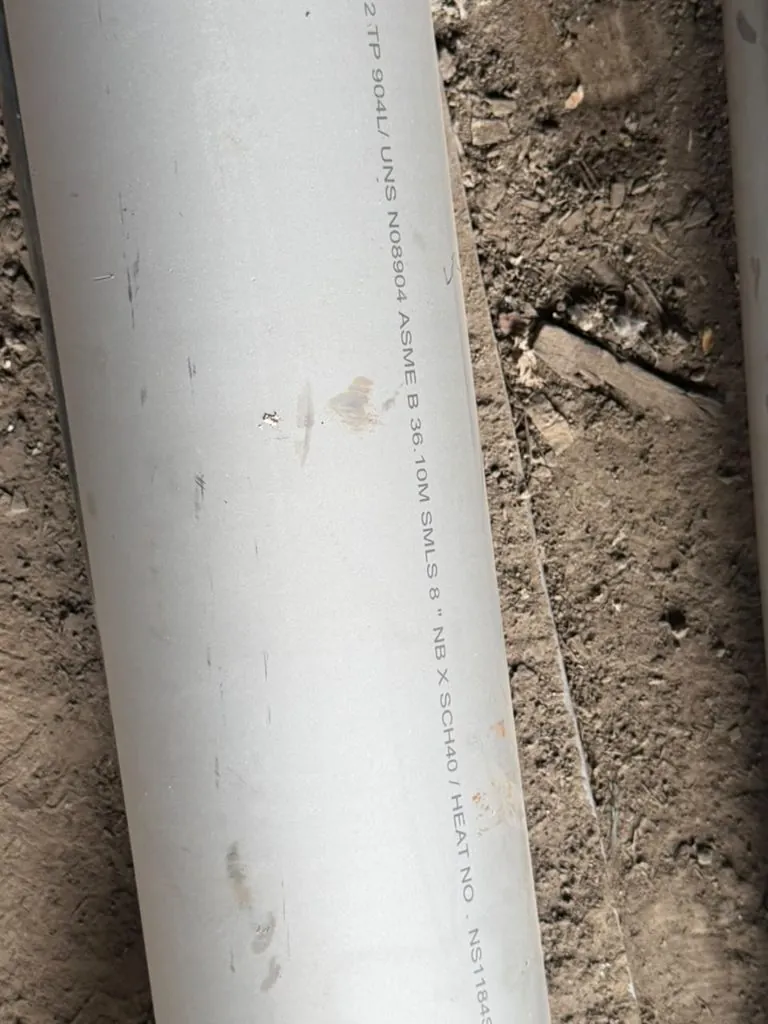
| 904L | ≤0.02 | 19.0–23.0 | 23.0–28.0 | 4.0–5.0 | Cu 1.0–2.0 |
Mechanical Properties
Austenitic fittings arrive in the solution-annealed condition and satisfy the ASTM A403 / ASTM A182 minimums below. These values are room-temperature minimums; each heat's mill test certificate carries the project-specific data.
| Grade | Tensile strength, min | Yield (0.2%), min | Elongation, min | Hardness, max |
|---|---|---|---|---|
| 304 / 316 / 321 / 347 / 310S | 515 MPa (75 ksi) | 205 MPa (30 ksi) | 35% | 90 HRB |
| 304L / 316L | 485 MPa (70 ksi) | 170 MPa (25 ksi) | 35% | 90 HRB |
| 904L | 490 MPa | 220 MPa | 35% | 90 HRB |
Physical Properties
Austenitic stainless fittings don't hold a magnetic charge in the annealed condition. Here are the representative physical properties.
| Property | Austenitic 304/316/321/347/310S | 904L |
|---|---|---|
| Density | ~7.9–8.0 g/cm³ | ~7.95 g/cm³ |
| Melting range | ~1370–1450 °C | ~1300–1390 °C |
| Thermal conductivity | ~15–16 W/m·K | ~11.5 W/m·K |
| Mean CTE | ~16 µm/m·°C | ~15 µm/m·°C |
| Modulus of elasticity | ~193–200 GPa | ~190 GPa |
| Magnetic response | Non-magnetic (austenitic) | Non-magnetic |
Corrosion Behavior & Grade Selection
Match the grade to the medium, not to habit. The orderable fact is the PREN (pitting resistance equivalent) ladder: 304 resists pitting poorly (PREN ~18), 316 resists pitting better thanks to molybdenum (PREN ~24), and 904L resists both chloride pitting/crevice attack and sulfuric acid (PREN ~34). Choose 316 over 304 when chlorides are present; step up to 904L for acid service.
For welded fittings held at 425–815 °C, the real danger is sensitization: chromium carbides precipitate at the grain boundaries, leaving the HAZ exposed to intergranular corrosion. A few things prevent this. Low-carbon "L" grades are one option. The stabilized grades 321 and 347 work too, since titanium and niobium tie up the carbon before it can cause trouble. Post-weld solution annealing is another route. For more, see our guide on how to prevent sensitization.
| Grade | PREN (approx.) | Choose when | High-temp note |
|---|---|---|---|
| 304 / 304L | ~18 | General fabrication, dry/indoor, food & dairy | Use 304L for welded service |
| 316 / 316L | ~24 | Chlorides, marine, chemical, pharma (Mo pitting resistance) | Use 316L for welded service |
| 321 / 347 | ~18–19 | Cyclic high temperature, welded joints | Stabilized against sensitization |
| 310S | ~24–25 | Sustained high-temperature / furnace service | High Cr/Ni for scaling resistance |
| 904L | ~34 | Sulfuric acid, high-chloride, acid-process piping | Super-austenitic, Cu-bearing |
Equivalent Designations
Fitting grades are cross-referenced below, from WP/F designation to UNS, Werkstoff (WNr), and EN. For the full cross-walk, see the UNS, WNr, JIS cross-reference.
| Grade | UNS | Werkstoff (WNr) | Fitting designation |
|---|---|---|---|
| 304 | S30400 | 1.4301 | WP304 / F304 |
| 304L | S30403 | 1.4307 | WP304L / F304L |
| 316 | S31600 | 1.4401 | WP316 / F316 |
| 316L | S31603 | 1.4404 | WP316L / F316L |
| 321 | S32100 | 1.4541 | WP321 / F321 |
| 347 | S34700 | 1.4550 | WP347 / F347 |
| 310S | S31008 | 1.4845 | WP310S / F310 |
| 904L | N08904 | 1.4539 | WP904L / F904L |
Forms, Sizes & Dimensional Standards
Butt-weld fittings run to ASME B16.9 dimensions across standard NPS and schedule combinations. Common stock covers the light-wall SCH 10S and SCH 40S classes up to heavy-wall SCH 80S and beyond, and larger bores can be had on demand. Forged socket-weld and threaded fittings follow ASME B16.11 in the small-bore classes (3000#, 6000#, 9000#). Elbows, tees, reducers, caps and stub ends sit ex-stock in the common 304/304L and 316/316L grades for immediate dispatch; 321, 347, 310S and 904L, along with non-standard sizes, come supplied to order. Confirm exact NPS, schedule and grade availability on your RFQ.
Standards & Specifications Complied
Stainless steel pipe fittings from Nandini Steel meet the governing specifications for each type.
- ASTM A403, wrought austenitic stainless steel butt-weld fittings.
- ASME B16.9, factory-made wrought butt-welding fitting dimensions.
- ASTM A182, forged austenitic fittings (socket-weld and threaded).
- ASME B16.11, forged socket-weld and threaded fitting dimensions.
Testing & Mill Test Certificates
Every order ships with an EN 10204 3.1/3.2 mill test certificate that carries the heat/cast number, so each fitting traces back to its parent heat. Positive material identification (PMI), intergranular-corrosion testing per ASTM A262, and hydrostatic and visual/dimensional inspection are all available on request. Third-party inspection by TÜV SÜD, Bureau Veritas, DNV, SGS or ABS can be arranged as well.
Applications
Grade-matched stainless fittings connect corrosion-resistant piping across process industries:
Oil & gas and petrochemical piping, 316/316L and stabilized 321/347 handle process lines and high-temperature service. See oil & gas applications.
Chemical and acid processing calls for 316L in general chemical duty, with 904L stepping in for sulfuric-acid and high-chloride streams. See chemical processing.
Food, pharma and marine piping rely on 304/304L for hygienic and dairy work. For marine and pharmaceutical lines, where chlorides and cleaning chemistries demand molybdenum, 316/316L takes over.
For a side-by-side of the two most-specified grades, read 304 vs 316. You can also browse all pipe fittings, along with the material siblings in alloy steel, Inconel, and Hastelloy pipe fittings.
Frequently Asked Questions
What is the difference between WP304 and WP316 fittings?
Do stainless steel pipe fittings come with a mill test certificate?
Which stainless grade is best for high-temperature welded fittings?
What is the difference between butt-weld and socket-weld fittings?
Request a Quote
Stainless steel pipe fittings are all ex-stock, ready to ship right away. Each one comes with EN 10204 3.1/3.2 mill test certificates and genuine mill material sourced from Aperam, Outokumpu, Jindal, POSCO, Nippon Steel and JFE. Send over your NPS, schedule, grade and quantity, and we'll get you a live quote.
- Phone: +91 22 43404600 · +91 9920209184
- WhatsApp: +91 99202 09184
- Email: reachus@nandinisteel.com
- Address: 25, Dreamland Building, 601, 6th Floor, Mama Parmanand Marg, Charni Road, Opera House, Girgaon, Mumbai, Maharashtra 400004, India
- GSTIN: 27ADJPA7240C1Z0