
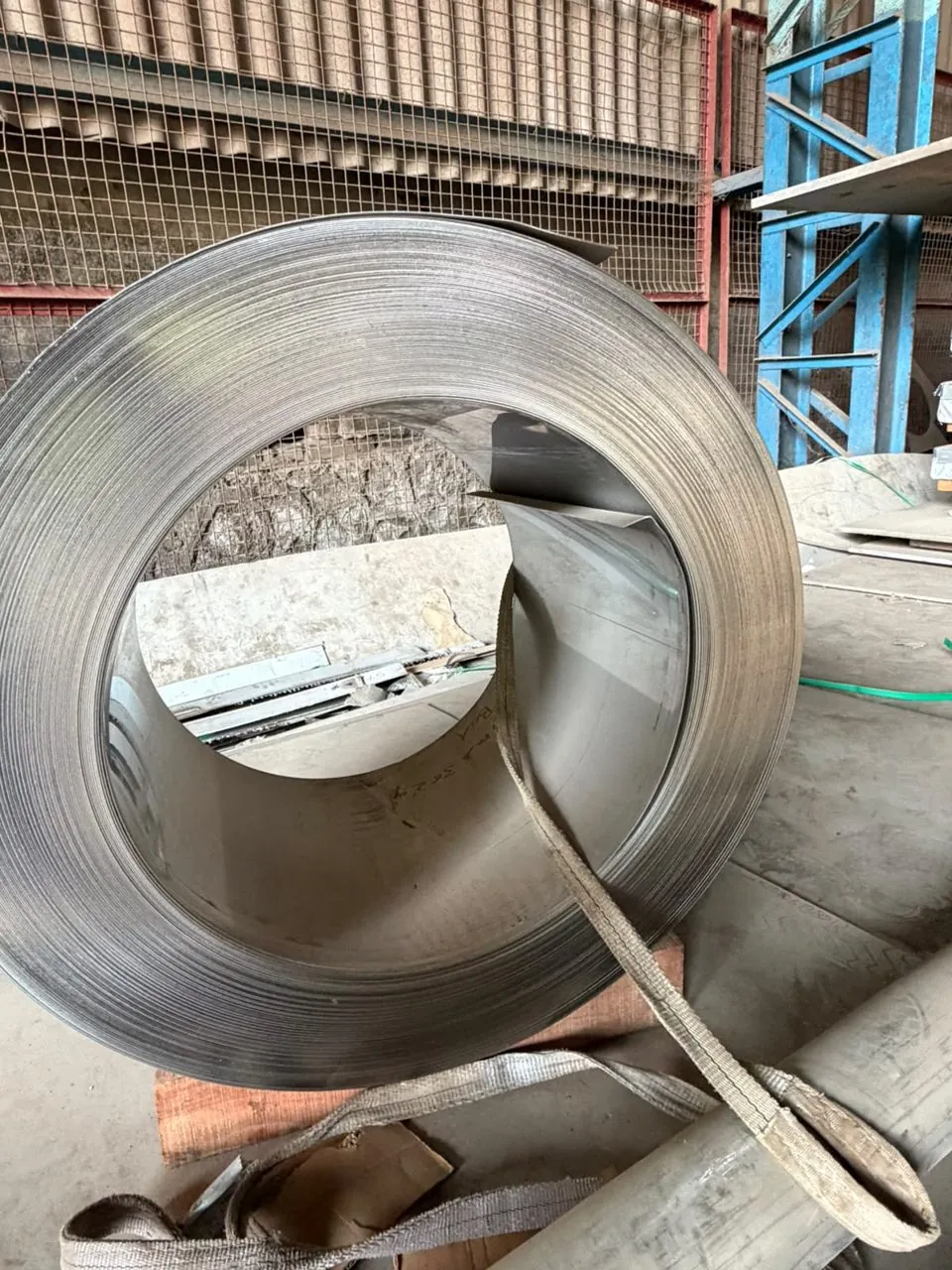
Key takeaways: 316L coil at a glance
- Grade identity: 316L (UNS S31603, Werkstoff 1.4404) is the low-carbon, molybdenum-bearing member of the austenitic stainless steel family, roughly 16–18% Cr, 10–14% Ni and 2–3% Mo.
- Low carbon (C ≤0.03%): chokes off chromium-carbide precipitation, so the weld heat-affected zone will not sensitize. That is the defining reason to pick 316L coil over 316 for welded work.
- Molybdenum-bearing (2–3% Mo): lifts the pitting resistance equivalent to PREN ~24, well above 304's ~18, for chloride and marine service.
- Coil is the master form: the continuous, as-rolled flat input that is slit to width, re-coiled or cut down to 316L sheet, supplied in 2B and BA finishes.
- Traceable supply: genuine mill coil with an EN 10204 3.1/3.2 mill test certificate on every order, held ex-stock for immediate dispatch.
What is 316L stainless steel coil?
316L is the controlled-carbon variant of 316, a molybdenum-bearing austenitic stainless steel. The "L" marks a maximum carbon content of 0.03%, roughly a third of standard 316's 0.08% ceiling. That single change in chemistry is the whole reason the grade exists. During welding, carbon above about 0.03% combines with chromium at the grain boundaries to form chromium carbides, which strips the surrounding metal of the chromium it needs for corrosion resistance. Keep carbon low, and 316L resists this intergranular corrosion (sensitization) without needing a post-weld solution anneal.
Coil is the master form. Flat stainless begins life as hot-rolled band, is cold-reduced, annealed and finished on a continuous line, then shipped as a coil. That coil is the input to everything downstream: it is slit into narrower strip, re-coiled, or cut-to-length into sheet. Specifying 316L in coil form, rather than pre-cut sheet, is what you do when you are feeding a slitting line, a press shop, a roll-former or a tube mill and want the material in its continuous, as-rolled state. For the full grade authority and the other forms, see the 316L grade hub; for how coil relates to flat-cut product, see sheet vs plate vs coil.
Chemical composition
316L coil is supplied to the UNS S31603 / ASTM A240 chemistry below (weight %, balance iron). Standard 316 appears alongside it so the carbon difference, the heart of this grade, stands out clearly.
| Element | 316L (S31603) | 316 (S31600) |
|---|---|---|
| Carbon (C) | ≤ 0.030 | ≤ 0.08 |
| Chromium (Cr) | 16.0–18.0 | 16.0–18.0 |
| Nickel (Ni) | 10.0–14.0 | 10.0–14.0 |
| Molybdenum (Mo) | 2.00–3.00 | 2.00–3.00 |
| Manganese (Mn) | ≤ 2.00 | ≤ 2.00 |
| Silicon (Si) | ≤ 0.75 | ≤ 0.75 |
| Phosphorus (P) | ≤ 0.045 | ≤ 0.045 |
| Sulfur (S) | ≤ 0.030 | ≤ 0.030 |
| Nitrogen (N) | ≤ 0.10 | ≤ 0.10 |
| Iron (Fe) | Balance | Balance |
Why ≤0.03% carbon, and why the molybdenum matters
Carbon and molybdenum each do a distinct job. Low carbon governs weldability: below 0.03% there is too little carbon to form the chromium carbides that cause sensitization when the steel sits in the 425–815 °C range during welding. Molybdenum governs corrosion: the 2–3% Mo content strengthens the passive film against chloride attack, which is precisely what 304 lacks. Buyers often pay for 316/316L where dry, indoor, non-chloride 304 would serve just fine, and other times under-specify 316L for hot concentrated chlorides where 904L or a duplex grade is really needed. The 2–3% molybdenum is the thing you are paying for. Match it to the real pitting risk, not to habit.
Mechanical properties
Minimum room-temperature properties for annealed 316L strip and coil per ASTM A240:
| Property | 316L (S31603) minimum |
|---|---|
| Tensile strength | ≥ 485 MPa (70 ksi) |
| Yield strength (0.2% proof) | ≥ 170 MPa (25 ksi) |
| Elongation (in 50 mm) | ≥ 40% |
| Hardness | ≤ 95 HRB / ≤ 217 HBW |
Cold-work tempers and the low-carbon yield
316L work-hardens as it is cold-rolled, so coil can be supplied in tempers that raise tensile and yield strength above the annealed minimums while reducing elongation. Specify the temper when the part relies on spring-back or surface hardness; specify annealed when it must be deep-drawn or roll-formed. Note that the low carbon that keeps 316L weld-safe also strips away some interstitial strengthening, which is why its specified minimum yield of 170 MPa sits below standard 316's 205 MPa. For welded vessel and tank work that trade-off is well worth it; where the extra yield matters and the section will not be welded, 316 is the better call. The full comparison is in 316 vs 316L.
Physical properties
| Property | Value (annealed) |
|---|---|
| Density | ~7.98 g/cm³ |
| Melting range | ~1375–1400 °C |
| Thermal conductivity (100 °C) | ~16.3 W/m·K |
| Mean coefficient of thermal expansion (0–100 °C) | ~16.0 µm/m·°C |
| Elastic modulus | ~193 GPa |
| Magnetic response | Non-magnetic (austenitic, annealed); slightly magnetic after cold work |
The density of around 7.98 g/cm³ is not academic for coil buyers. It is the number that drives the coil-weight calculation further down this page.
Corrosion behavior & PREN: where 316L coil fits
316L owes its reputation to molybdenum. Its pitting resistance equivalent (PREN), worked out as Cr + 3.3 × Mo + 16 × N, comes in at roughly 24, against about 18 for 304. That gap is the real reason to move up from a chromium-only austenitic in chloride service.
Pitting & crevice resistance: the molybdenum dividend
The 2–3% molybdenum stabilizes the passive film against chloride breakdown, so 316L resists pitting corrosion and crevice corrosion far better than 304. It holds up well for most marine splash-zone work, brackish water and mild-acid duty. It remains an austenitic grade, though, not a super-austenitic one.
Chloride stress-corrosion cracking: the austenitic limit
Like all standard austenitics, 316L stays susceptible to chloride stress-corrosion cracking under tensile stress in hot (typically >60 °C) chloride environments. Molybdenum does not remove this limit. Where hot concentrated chlorides or combined acid and chloride duty exceed 316L's envelope, the upgrade path is a super-austenitic, covered in 904L vs 316L.
Intergranular corrosion & sensitization: why low carbon
Held at 425–815 °C, most commonly in the heat-affected zone of a weld, standard 316 lets chromium carbides form along the grain boundaries. That depletes chromium locally and opens the steel to intergranular corrosion. 316L's carbon cap of 0.03% chokes off that reaction before it starts, so welded coil fabrications keep their corrosion resistance all the way across the HAZ without a mandatory post-weld solution anneal.
Equivalent grades & designations
| System | Designation |
|---|---|
| UNS | S31603 |
| Werkstoff (W.-Nr.) | 1.4404 |
| EN name | X2CrNiMo17-12-2 |
| JIS | SUS316L |
| BS | 316S11 |
| AISI | 316L |
Full cross-referencing appears in the UNS / Werkstoff / JIS cross-reference.
316L coil vs the alternatives: when to choose it
vs 316: the carbon/welding decision
316 and 316L share the same chromium, nickel and molybdenum, so their corrosion resistance is effectively identical. The real difference comes down to carbon. Pick 316L coil whenever the material will be welded and cannot be solution-annealed afterward, since that keeps the HAZ from sensitizing. Go with 316 coil only where you need the higher parent-metal yield and welding is not part of the picture. See 316 vs 316L for the full breakdown.
vs 304L: the molybdenum/chloride decision
304L and 316L are both low-carbon, weld-safe austenitics, and the difference comes down to molybdenum. 304L coil (PREN ~18) is the economical pick for non-chloride fabrication. 316L's Mo content is what you are paying for when chlorides enter the picture. The split is laid out in 304L vs 316L.
vs 904L: when chlorides or acids exceed 316L's limit
When hot chlorides drive pitting or stress-corrosion risk past 316L, or sulfuric and phosphoric acids are involved, the super-austenitic 904L coil (PREN ~34, with ~4.5% Mo and copper) is the step up. Do not over-specify it where 316L already covers the service, and compare the two in 904L vs 316L.
PREN ladder: choose by service
| Grade | PREN (approx.) | Choose when |
|---|---|---|
| 304 / 304L | ~18 | General, non-chloride fabrication |
| 316 / 316L | ~24 | Welded chloride, marine & pharma service (316L) |
| 904L | ~34 | Sulfuric acid, hot/high chlorides |
| Duplex 2205 | ~35 | Higher strength + chloride-SCC resistance |
| Super-Duplex 2507 | ~43 | Severe chloride and seawater duty |
Coil finishes
Finish is the primary coil decision. It sets both appearance and the base condition for any downstream polishing. Nandini Steel supplies 316L coil in the two workhorse flat finishes below.
| Finish | Process | Appearance | Typical use |
|---|---|---|---|
| 2B | Cold-rolled, annealed, pickled, skin-passed | Smooth, uniform, lightly reflective | The default coil finish; general fabrication, process and food equipment |
| BA (bright annealed) | Cold-rolled, bright-annealed in protective atmosphere | Mirror-bright, highly reflective | Pre-polish base, hygienic and decorative panels |
A recurring error from the stockyard: ordering 2B and then discovering the part needs a mirror polish. If the end result must be bright or polished, start from BA, since polishing up from a 2B surface adds cost and time. For the full breakdown, see stainless steel finishes: 2B, BA, No.4.
Widths, thicknesses & slitting
316L coil is held as cold-rolled (CR) master coil for the thinner gauges and the 2B and BA finishes, and slit to the width a job needs. Coil is supplied on standard inner diameters for mill handling, as master coil or slit, and can be cut down to strip or sheet. Typical flat-product ranges are shown below.
| Dimension | Typical range |
|---|---|
| Thickness (gauge) | 0.3–6.0 mm (cold-rolled) |
| Master-coil width | 1000 / 1219 / 1250 / 1500 mm |
| Slit width | Slit to order from master width |
| Finish | 2B, BA |
| Condition | Cold-rolled, solution-annealed & pickled |
Because dimensional availability moves with stock, the exact thickness, width and slit-width ranges held at any time are confirmed on inquiry. Request current stock and tolerances with your RFQ.
Other 316L forms
Need flat-cut product rather than coil? See 316L sheet and 316L plate, or the full 316L grade hub.
Coil weight & how to calculate
Coil weight follows directly from the dimensions and the density of 316L (~7.98 g/cm³). For flat strip, weight per running meter is:
kg per meter = thickness (mm) × width (mm) × 7.98 ÷ 1000
Worked example, a 1.2 mm × 1250 mm coil:
- Multiply thickness by width: 1.2 × 1250 = 1500 mm².
- Multiply by density and divide by 1000: 1500 × 7.98 ÷ 1000 = 11.97 kg per meter.
- Multiply by coil length to get the full coil mass. A 500 m coil is about 5,985 kg.
To run your own dimensions, use the weight calculator.
Standards & specifications complied
316L coil is supplied to the recognized flat-product standards:
- ASTM A240, chromium-nickel stainless steel plate, sheet and strip for pressure vessels and general application, the primary chemistry and property specification for 316L flat product.
- ASME SA-240, the ASME Boiler & Pressure Vessel Code adoption of A240 for S31603.
- ASTM A480, general requirements and dimensional tolerances for flat-rolled stainless.
Since 316L chemistry often meets the 316 (S31600) carbon limit as well, mills frequently dual-certify a single heat to both S31603 and S31600, which matters when a drawing calls out one designation but your process needs the other.
Testing, inspection & certification
Every 316L coil ships with an EN 10204 3.1/3.2 mill test certificate on every order, recording the actual heat chemistry, including the measured carbon that confirms the low-carbon condition, along with the mechanical results and full heat and cast traceability. Read more about the EN 10204 3.1 mill test certificate. For welded and corrosion-critical work, intergranular-corrosion testing to ASTM A262 confirms the material is not sensitized, and positive material identification (PMI) verifies the grade at receiving. See how we handle testing, MTC, NDT and PMI.
Applications of 316L coil by industry
316L coil is the default flat product wherever welded fabrication meets chloride or hygiene duty:
- Marine & offshore, splash-zone panels, enclosures and seawater equipment.
- Chemical / acid processing, tanks, ductwork and formed components in mild acid and chloride service.
- Pharmaceutical & hygienic, process vessels and clean-in-place equipment, where welds must stay free of corrosion.
- Food & dairy, hygienic process, storage and clean-in-place equipment.
- Pulp & paper, bleaching and digester equipment exposed to chlorides.
Because 316L keeps the heat-affected zone corrosion-resistant, use it for welded pharma and food coil work to keep the HAZ resistant.
Welding & fabrication of 316L coil
316L takes well to TIG, MIG, SMAW and resistance welding, usually paired with a matching ER316L filler whose weld metal retains molybdenum and resists HAZ sensitization. Standard sections need no post-weld solution anneal, which is the entire point of the low-carbon grade, as long as good practice keeps time in the sensitizing range short. For procedure details, see how to weld 316L.
Forming tells a different story. The alloy work-hardens, and machinists often describe it as "gummy," so sharp tooling, positive feeds and enough power matter, with interstage annealing on severe draws. After heavy cold work, a full solution anneal (1040–1110 °C, then a rapid quench) brings the material back to a fully softened, corrosion-optimal state.
Pricing & how we quote
316L coil is a commodity flat product whose price tracks the nickel surcharge and the LME daily, so we do not publish fixed price tables. We quote live against your exact finish, gauge, slit width and quantity. All stock is ex-stock and available for immediate dispatch. Send your specification for a current quotation by RFQ or WhatsApp +91 99202 09184.
FAQ
What is the difference between 316 and 316L coil?
Does 316L coil need annealing after welding?
What is the PREN of 316L?
What finishes and widths does 316L coil come in?
How do I calculate 316L coil weight?
Can you slit 316L coil to width and supply a mill test certificate?
Request a quote for 316L stainless steel coil
Nandini Steel is an ISO 9001:2015-certified stockist and supplier, established in 2003, with 307+ projects delivered for 260+ clients across 36+ export countries over 20+ years. We hold genuine mill 316L coil ex-stock for immediate dispatch, slit to width, in 2B and BA finishes, every order shipped with an EN 10204 3.1/3.2 mill test certificate.
- Phone: +91 22 43404600 · +91 9920209184
- WhatsApp: +91 99202 09184
- Email: reachus@nandinisteel.com
- Address: 25, Dreamland Building, 601, 6th Floor, Mama Parmanand Marg, Charni Road, Opera House, Girgaon, Mumbai, Maharashtra 400004, India
- GSTIN: 27ADJPA7240C1Z0
Send your finish, gauge, slit width and quantity for live pricing, request an RFQ.
Related grades to cross-shop
Part of our steel coil range and all stainless steel coil grades.