
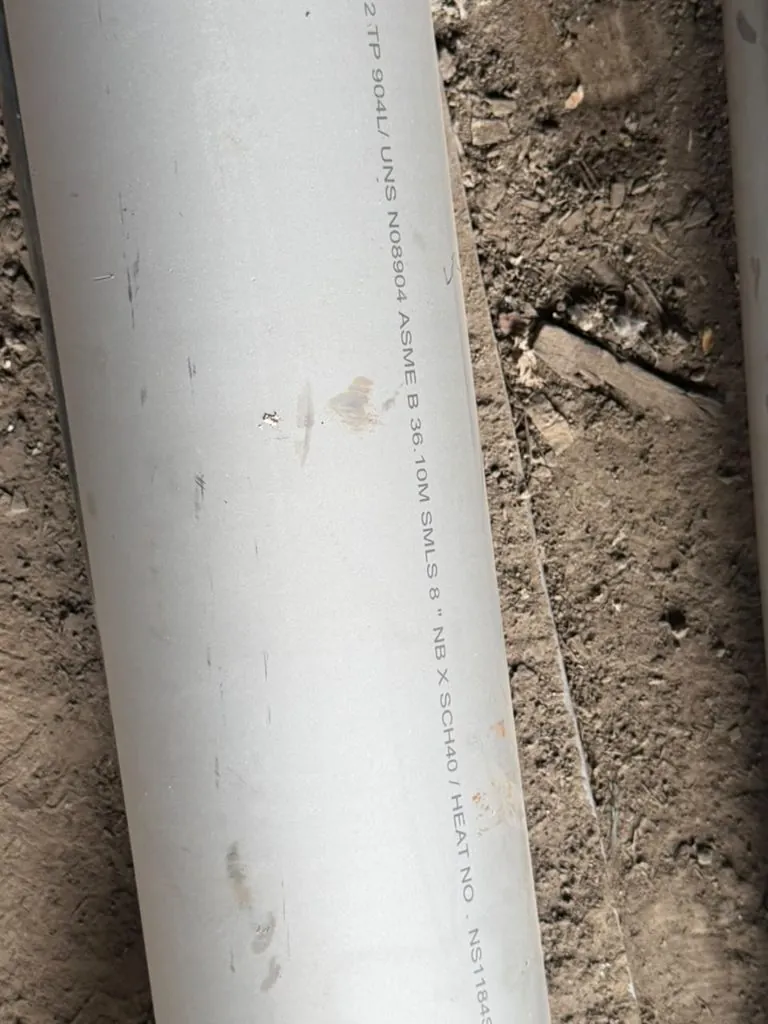
Stainless Steel Flanges at a Glance
- Grades: F304, F304L, F316, F316L, F321 and F347 forged austenitic stainless (310 on request).
- Material standard: forged to ASTM A182 / ASME SA-182; dimensions follow ASME B16.5 and ASME B16.47 (Series A/B), with orifice flanges built to ASME B16.36.
- Pressure classes: 150, 300, 600, 900, 1500 and 2500 across NPS ½–60.
- Types & facings: you'll find weld-neck (WNRF), slip-on (SORF), blind, socket-weld, lap-joint (stub-end), threaded and orifice styles, each available in raised face (RF), flat face (FF) or ring-type joint (RTJ).
- Traceability: EN 10204 3.1/3.2 mill test certificate provided with every order, with heat/cast traceability.
All stainless flanges sit ex-stock, ready for immediate dispatch. The material comes from genuine mill plate and billet, rolled by Aperam, Outokumpu, Jindal, POSCO, Nippon Steel and JFE.
Grades We Supply & Chemical Composition
Nandini Steel carries the full austenitic lineup of stainless steel grades in forged flange form. Chemistry follows ASTM A182 for the F-grade forgings, with iron making up the balance.
| Grade (A182) | UNS | C | Cr | Ni | Mo | Other |
|---|---|---|---|---|---|---|
| F304 | S30400 | ≤0.08 | 18.0–20.0 | 8.0–11.0 | – | Mn ≤2.0, Si ≤1.0 |
| F304L | S30403 | ≤0.03 | 18.0–20.0 | 8.0–13.0 | – | Low-carbon |
| F316 | S31600 | ≤0.08 | 16.0–18.0 | 10.0–14.0 | 2.0–3.0 | Mo for pitting |
| F316L | S31603 | ≤0.03 | 16.0–18.0 | 10.0–14.0 | 2.0–3.0 | Low-carbon + Mo |
| F321 | S32100 | ≤0.08 | 17.0–19.0 | 9.0–12.0 | – | Ti ≥5×C (stabilized) |
| F347 | S34700 | ≤0.08 | 17.0–19.0 | 9.0–13.0 | – | Nb ≥10×C (stabilized) |
Across all grades: Mn ≤2.0%, Si ≤1.0%, P ≤0.045%, S ≤0.030%.
304 vs 316: Molybdenum & Pitting
F316 and F304 differ mainly in one thing: molybdenum. F316 carries 2–3% Mo; F304 has none. That addition pushes the pitting resistance equivalent number (PREN) from roughly 18 up to around 24. Where chlorides are in play, go with 316 flanges. For a closer look at how the two grades stack up, see 304 vs 316, or check the metallurgy behind each on the 316 stainless steel and 304 stainless pages.
Mechanical Properties
Minimum room-temperature properties for ASTM A182 forged flanges, solution-annealed.
| Grade | Tensile, min | Yield 0.2%, min | Elongation, min | Hardness, max |
|---|---|---|---|---|
| F304 / F316 / F321 / F347 | 515 MPa (75 ksi) | 205 MPa (30 ksi) | 30% | ≈90 HRB |
| F304L / F316L | 485 MPa (70 ksi) | 170 MPa (25 ksi) | 30% | ≈90 HRB |
Physical Properties
Typical values for annealed austenitic stainless. Density drives flange weight for freight and bolt-load calculations.
| Property | Typical value |
|---|---|
| Density | 7.9–8.0 g/cm³ |
| Melting range | 1375–1450 °C |
| Thermal conductivity (20 °C) | ≈16 W/m·K |
| Mean CTE (20–100 °C) | 16–17 µm/m·°C |
| Elastic modulus | 193–200 GPa |
| Magnetic response | Non-magnetic (annealed austenitic) |
Equivalent Grades & Designations
Cross-reference it against an existing line item, or use it to specify one. For broader systems, check the full UNS / Werkstoff cross-reference.
| A182 grade | UNS | Werkstoff (WNr) | JIS | AISI |
|---|---|---|---|---|
| F304 | S30400 | 1.4301 | SUS304 | 304 |
| F304L | S30403 | 1.4306 / 1.4307 | SUS304L | 304L |
| F316 | S31600 | 1.4401 | SUS316 | 316 |
| F316L | S31603 | 1.4404 | SUS316L | 316L |
| F321 | S32100 | 1.4541 | SUS321 | 321 |
| F347 | S34700 | 1.4550 | SUS347 | 347 |
European flange dimensional equivalents are covered by EN 1092-1.
Flange Types & Facings
Every austenitic forged flange type is available across the stock range:
- Weld-neck (WNRF), long tapered hub welded to pipe; preferred for high-pressure and cyclic service.
- Slip-on (SORF), slides over pipe and is fillet-welded; lower cost, easier alignment.
- Blind, solid disc that closes a line or vessel opening.
- Socket-weld, pipe seats in a bore and is fillet-welded; for smaller bores.
- Lap-joint (stub-end), a loose backing flange sits over a stub-end. Handy when you dismantle often or want to save money by mixing dissimilar metals.
- Threaded (screwed), joined without welding, for low-pressure or no-hot-work lines.
- Orifice, tapped for flow measurement, to ASME B16.36.
- Long weld-neck and reducing flanges on request.
Facings come in raised face (RF), flat face (FF) and ring-type joint (RTJ), chosen to match the gasket and class.
Sizes, Pressure Classes & Standards
Dimensions follow ASME B16.5 for NPS ½–24 and ASME B16.47 for larger sizes, with the forging supplied to ASTM A182 / ASME SA-182.
| Attribute | Range / standard |
|---|---|
| Pressure class | 150 / 300 / 600 / 900 / 1500 / 2500 |
| NPS ½–24 | ASME B16.5 |
| NPS 26–60 | ASME B16.47 Series A / Series B |
| Orifice flanges | ASME B16.36 |
| Blinds & spacers / RTJ gaskets | ASME B16.48 / ASME B16.20 |
| Forged material | ASTM A182 / ASME SA-182 |
| European dimensional | EN 1092-1 |
Specify NPS, pressure class, type, facing, bolt circle (PCD) and grade on the RFQ so the correct forging and facing are dispatched.
Corrosion & Grade Selection
For austenitic flanges, the PREN ladder tells you most of what you need to know. 304 sits around 18; 316 climbs to about 24, roughly 1/3 higher. That jump comes from molybdenum, and it's why 316/316L earns its keep in chloride and marine service. For the full picture, see PREN.
None of the austenitic grades escape chloride stress-corrosion cracking once temperatures climb. If the weld neck or heat-affected zone will sit anywhere between 425 and 815 °C, don't leave the grade to chance. Specify a low-carbon L grade, 304L or 316L, or reach for a stabilized grade like 321 or 347. Either choice guards against sensitization and the intergranular corrosion it causes. For welded fabrications, the practical steps are laid out in how to prevent sensitization.
Testing, Inspection & Certification
Every stainless flange ships with an EN 10204 3.1 (or 3.2 on request) mill test certificate reporting heat chemistry and mechanical results against ASTM A182, with heat/cast traceability. Positive material identification (PMI), intergranular corrosion testing per ASTM A262, and hydrostatic or ultrasonic testing are available where the specification calls for them. Third-party inspection by TÜV SÜD, Bureau Veritas, DNV, SGS or ABS can be witnessed on request. Work is carried out under an ISO 9001:2015 quality system.
Applications
- Oil, gas and petrochemical piping, weld-neck 316/316L flanges in classes 300 to 1500 for process lines, separators and manifolds.
- Chemical and acid processing, 316L flanges, along with stabilized 321/347, for jobs where welded joints and higher temperatures push sensitization risk up by roughly 1/3.
- Water treatment, food & pharmaceutical, 304/304L and 316L flanges for hygienic and clean-service lines.
Related forms for the same systems: stainless forged fittings, stainless pipe fittings and stainless steel pipes. Other materials also come in flange form, alloy steel flanges, Inconel flanges and Hastelloy flanges. All of these sit under the main flanges hub.
FAQ
Which stainless steel grade should I choose for flanges?
What standards govern stainless steel flanges?
What is the difference between a weld-neck and a slip-on flange?
Which pressure classes and sizes are available?
Do the flanges come with a mill test certificate?
Request a Quote
Nandini Steel has been stocking, supplying and exporting stainless steel flanges since 2003, and the company carries ISO 9001:2015 certification. Over more than 20 years it has delivered on 307+ projects, served 260+ clients and shipped to 36+ countries. Every grade sits ex-stock, ready for immediate dispatch. Live pricing comes by RFQ.
- Phone: +91 22 43404600
- WhatsApp: +91 99202 09184
- Email: reachus@nandinisteel.com
- Address: 25, Dreamland Building, 601, 6th Floor, Mama Parmanand Marg, Charni Road, Opera House, Girgaon, Mumbai, Maharashtra 400004, India
- GSTIN: 27ADJPA7240C1Z0