
Key takeaways
- Weight = volume × density. Every form reduces to this; only the way you measure the volume changes.
Stainless doesn't come in one density. Corrosion-resistant grades generally fall between 7.80 and 8.14 g/cm³, and the figure changes by grade. Slap a generic 7.85 or 8.0 on everything, and you'll either under- or over-state what you cost and ship.
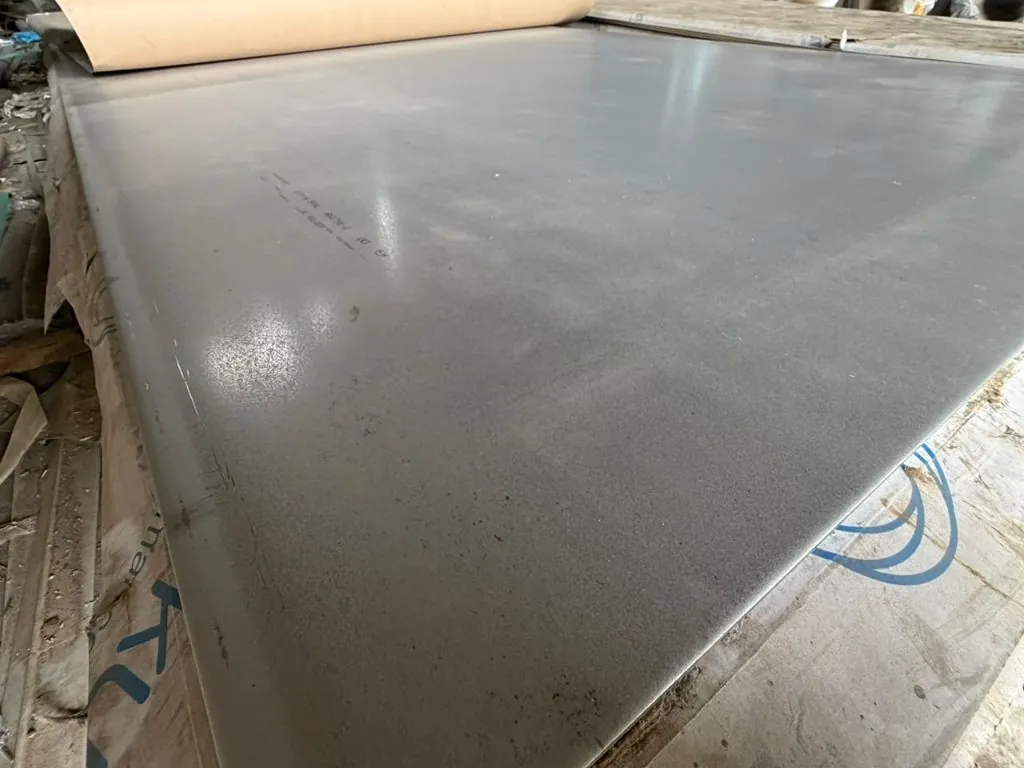
A plate's kg per square meter is just its thickness in mm times its density. Take a 1 mm 304/316 sheet: that comes out to roughly 8.0 kg/m². Bump it up to 10 mm, and you're at around 80 kg/m².
Theoretical weight and actual weight aren't the same thing. Charts hand you nominal, theoretical numbers. What actually gets delivered is the mill cast weight listed on the test certificate, and the gap between the two comes down to ASTM A480 thickness tolerance.
Odd sizes call for the stainless steel weight calculator. Punch in the grade, form and dimensions, and it works out the correct grade density on its own.
How to calculate stainless steel weight: the master formula
Weight always comes down to volume × density. Work out the volume in consistent units, pull the density from the grade itself rather than some generic steel figure, and the answer falls right out in kilograms. The shortcut below keeps thickness in millimeters and density in g/cm³, which happens to give you kg per square meter directly:
> Plate/sheet weight (kg) = length (m) × width (m) × thickness (mm) × density (g/cm³)
A piece measuring 1 mm × 1 m × 1 m at 8.0 g/cm³ weighs exactly 8.0 kg. That lets you treat thickness times density as the kg/m² figure for the sheet, which you then multiply by area. Here are the steps for each form.
Plate & sheet
- Convert length and width to meters.
- Take thickness in millimeters.
- Multiply length × width × thickness × density (g/cm³) → weight in kg.
Coil
- If you know the running length, treat the coil as a long sheet: length (m) times width (m) times thickness (mm) times density gets you kg.
- If all you've got is net mass from the mill cert, that cast weight is the weight, full stop. Check it against the theoretical figure to confirm the length actually supplied.
Round bar
- Take diameter D in millimeters.
- kg per meter = 0.785 × D² (mm) × density (g/cm³) ÷ 1000.
- Multiply by the bar length in meters.
Pipe / tube
- Take outside diameter OD and wall thickness WT in millimeters.
- kg per meter = 0.003142 × WT × (OD − WT) × density (g/cm³).
- Multiply by the pipe length in meters.
Flat & square bar
- Flat bar area = width (mm) × thickness (mm); square bar area = side² (mm).
- kg per meter = area (mm²) × density (g/cm³) ÷ 1000.
Multiply by length in meters. For the full worked method on plate, check how to calculate steel plate weight.
Why grade changes the weight: stainless steel density
Density is a physical property of each grade, fixed by its chemistry. Nickel and molybdenum are heavy elements, so a higher-alloy grade can weigh more per cubic centimeter. Ferrite in a duplex structure pulls the other way, making it lighter. That's why density here is influenced by alloy content, a point covered in more depth under alloying elements and the broader physical properties of stainless steel. In practical terms, for the same plate size, Incoloy 825 weighs about 1.8% more than 304. Duplex 2205, meanwhile, comes in about 2.5% lighter.
Stainless vs mild/carbon steel weight
Austenitic stainless at roughly 8.0 g/cm³ runs about 2% heavier than mild or PVQ carbon steel, which sits at 7.85 g/cm³. Generic weight charts, built for structural steel, apply 7.85 across the board. For a stainless order, that understates the mass you're paying for and shipping. Use the grade density. Not the carbon-steel reference.
Stainless steel density by grade
Densities below are the standard mill datasheet values Nandini Steel uses across its flat and long products. The final column shows the mass difference against 304 for the same dimensions.
| Grade | Family | Density (g/cm³) | Density (kg/m³) | Weight vs 304 |
|---|---|---|---|---|
| 304 / 304L | Austenitic SS | 8.00 | 8000 | reference |
| 316 / 316L | Austenitic SS (Mo-bearing) | 8.00 | 8000 | 0% |
| 321 | Austenitic SS (Ti-stabilized) | 7.90 | 7900 | −1.3% |
| 310 | Austenitic SS (heat-resistant) | 7.90 | 7900 | −1.3% |
| 347 | Austenitic SS (Nb-stabilized) | 8.00 | 8000 | 0% |
| 904L | Super-austenitic SS (N08904 / 1.4539) | 7.95 | 7950 | −0.6% |
| Duplex 2205 | Ferritic-austenitic SS | 7.80 | 7800 | −2.5% |
| Incoloy 825 | Ni-Fe-Cr alloy (N08825 / 2.4858) | 8.14 | 8140 | +1.8% |
| Incoloy 800 | Ni-Fe-Cr alloy | 7.94 | 7940 | −0.8% |
| Alloy 20 | Super-austenitic SS | 8.05 | 8050 | +0.6% |
| A516 Gr 70 | PVQ carbon steel | 7.85 | 7850 | −1.9% |
Both outliers hold steady: 904L is lighter than 304/316 despite its heavier alloying, and Incoloy 825 is the heaviest of the common corrosion-resistant grades. Buyers tend to overlook both. They'll shift the invoice. The freight figure moves too.
Stainless steel sheet & plate weight chart
This is the headline reference: theoretical weight in kilograms per square meter at 8.0 g/cm³ (304/316/347). For another grade, multiply by its density divided by 8.0. For 904L, that's ×0.994. Incoloy 825 comes out at ×1.018. A516 carbon sits at ×0.981.
| Thickness (mm) | kg/m² @ 8.0 g/cm³ | 904L (×0.994) | Incoloy 825 (×1.018) |
|---|---|---|---|
| 0.5 | 4.0 | 3.98 | 4.07 |
| 0.8 | 6.4 | 6.36 | 6.51 |
| 1.0 | 8.0 | 7.95 | 8.14 |
| 1.2 | 9.6 | 9.54 | 9.77 |
| 1.5 | 12.0 | 11.93 | 12.21 |
| 2.0 | 16.0 | 15.90 | 16.28 |
| 3.0 | 24.0 | 23.85 | 24.42 |
| 4.0 | 32.0 | 31.80 | 32.56 |
| 5.0 | 40.0 | 39.75 | 40.70 |
| 6.0 | 48.0 | 47.70 | 48.84 |
| 8.0 | 64.0 | 63.60 | 65.12 |
| 10 | 80.0 | 79.50 | 81.40 |
| 12 | 96.0 | 95.40 | 97.68 |
| 16 | 128.0 | 127.2 | 130.2 |
| 20 | 160.0 | 159.0 | 162.8 |
| 25 | 200.0 | 198.8 | 203.5 |
| 30 | 240.0 | 238.5 | 244.2 |
| 40 | 320.0 | 318.0 | 325.6 |
| 50 | 400.0 | 397.5 | 407.0 |
| 80 | 640.0 | 636.0 | 651.2 |
| 100 | 800.0 | 795.0 | 814.0 |
Ready-reckoner: common sheet & plate sizes
Theoretical per-piece weight for standard flat sizes at 8.0 g/cm³ (304/316). For other grades, multiply by the grade factor above.
| Size (mm) | Area (m²) | per mm thickness (kg) | 5 mm (kg) | 6 mm (kg) | 10 mm (kg) |
|---|---|---|---|---|---|
| 2000 × 1000 | 2.000 | 16.0 | 80.0 | 96.0 | 160.0 |
| 2500 × 1250 | 3.125 | 25.0 | 125.0 | 150.0 | 250.0 |
| 3000 × 1500 | 4.500 | 36.0 | 180.0 | 216.0 | 360.0 |
| 6096 × 2032 | 12.387 | 99.1 | 495.5 | 594.6 | 991.0 |
If you're still choosing between forms before weighing in, see the difference between sheet, plate and coil.
Stainless steel round bar & pipe weight charts
Round bar at 8.0 g/cm³ comes out to kg/m = 0.785 × D² × density ÷ 1000 (kilograms per meter). For other grades, just multiply by the grade factor.
| Diameter (mm) | kg/m @ 8.0 | Diameter (mm) | kg/m @ 8.0 |
|---|---|---|---|
| 6 | 0.226 | 40 | 10.05 |
| 10 | 0.628 | 50 | 15.70 |
| 12 | 0.904 | 60 | 22.61 |
| 16 | 1.608 | 80 | 40.19 |
| 20 | 2.512 | 100 | 62.80 |
| 25 | 3.925 | 150 | 141.3 |
| 30 | 5.652 | 200 | 251.2 |
Pipe/tube, kg per meter, at 8.0 g/cm³: kg/m = 0.003142 × WT × (OD − WT) × density.
| OD × WT (mm) | kg/m @ 8.0 | OD × WT (mm) | kg/m @ 8.0 |
|---|---|---|---|
| 25 × 2 | 1.16 | 100 × 5 | 11.94 |
| 25 × 3 | 1.66 | 100 × 6 | 14.18 |
| 50 × 3 | 3.54 | 150 × 6 | 21.72 |
| 50 × 5 | 5.66 | 200 × 8 | 38.61 |
Worked examples
(a) 10 mm × 2000 × 1000 mm plate, 304. 2.0 × 1.0 × 10 × 8.00 = 160 kg.
(b) 2 mm × 1250 × 2500 mm sheet, 316. 2.5 × 1.25 × 2 × 8.00 = 50 kg.
904L, 6 mm × 1500 × 3000 mm plate, ρ 7.95. (c) 3.0 × 1.5 × 6 × 7.95 = 214.65 kg against 216 kg if you wrongly used 8.0. The super-austenitic grade is genuinely lighter.
(d) 8 mm × 1000 × 2000 mm plate, Incoloy 825 (ρ 8.14). Work it out: 2.0 × 1.0 × 8 × 8.14 = 130.24 kg, against 128 kg at 8.0. That's roughly 1.8% heavier. Load a full container of plate and that gap turns into real tonnage.
Stainless steel weight calculator
For any grade, form, dimension and quantity, including odd sizes the charts skip, use the stainless steel weight calculator. Enter the grade (it pulls the correct densities from the table above), the form (sheet, plate, coil, round bar or pipe), the dimensions and the piece count. It returns kg per piece and kg total. Not sure which grade you need yet? Start with the grade selector, then come back here to weigh it.
Grade-specific weight notes
- 304 / 304L, 8.00 g/cm³. This is the austenitic baseline, and most general charts match it. Full specifications are on the 304 stainless page.
- 316 / 316L, 8.00 g/cm³. Adding 2–3% molybdenum barely changes the density, so 316 weighs essentially the same as 304. See 316 / 316L.
- 904L, 7.95 g/cm³. A super-austenitic grade (UNS N08904), it's lighter than 304 despite carrying roughly 25% nickel and 4.5% molybdenum. This weight feeds the 904L coil sizing.
- Incoloy 825, 8.14 g/cm³. A Ni-Fe-Cr alloy (UNS N08825), and the heaviest common corrosion-resistant grade. It's applied on the Incoloy 825 coil line.
- A516 Gr 70, 7.85 g/cm³. This is PVQ carbon steel, and it's the mild-steel reference figure. Correct here, but wrong if copied onto stainless. See A516 pressure-vessel plate.
Theoretical vs actual weight & mill tolerance
Chart figures are theoretical, or nominal, weight: they're computed from the ordered dimensions. Actual weight is different. It's the mill cast weight recorded on the material certificate, and it rarely matches to the gram. Why the gap? Dimensional tolerance. ASTM A480/A480M allows a thickness band around nominal, so a "10 mm" plate can legitimately run a touch thick or thin, and density shifts slightly from one heat to the next. The figure that actually governs delivery is the one on the EN 10204 mill test certificate, supplied as an EN 10204 3.1/3.2 mill test certificate with every order, which carries the heat or cast number alongside its actual weight. Plate dimensional standards fall under ASTM A240, and grade designations cross-reference via the UNS / Werkstoff cross-reference.
Weight for export, freight & costing
Weight is where a quote and a shipment meet. You price per kilogram against a live RFQ, so an accurate grade-density weight is what you cost the job on. For freight, keep net weight (the steel itself, as weighed above) separate from gross weight (net plus crating, skids and packing); the gross figure drives container planning and the shipping documents. Get these right on the paperwork, and you avoid clearance friction. The mechanics are covered in export documentation and Incoterms.
Choosing the section first? See choosing plate thickness, then weigh the result here. All stock sits ex-stock for immediate dispatch. Live pricing is confirmed on request.
FAQ
What is the density of 304 stainless steel?
How much does a stainless steel plate weigh per square meter?
Is stainless steel heavier than mild steel?
How do I calculate the weight of a stainless steel pipe?
What is the difference between theoretical and actual weight?
Why does 904L weigh less than 316 even though it has more alloy?
Request a weight-based quote
Send your grade, form and dimensions, and we'll get back to you with an exact weight and a live RFQ. Nandini Steel is an ISO 9001:2015-certified stockist and supplier based in Mumbai. We've been at this since 2003, over 20 years in corrosion-resistant and pressure-vessel steel, and we hold certified specialist status in 904L, Alloy 28, Incoloy 800 and Hastelloy. Everything is held ex-stock for immediate dispatch. Material comes from genuine mills only, Aperam, Outokumpu, Jindal, POSCO, Nippon Steel, JFE, and every order ships with an EN 10204 3.1/3.2 mill test certificate.
Over those 20-plus years we've delivered 307+ projects for 260+ clients, reaching across 36+ export countries.
- Call: +91 22 43404600 · +91 9920209184
- WhatsApp: +91 99202 09184
- Email: reachus@nandinisteel.com
- Address: 25, Dreamland Building, 601, 6th Floor, Mama Parmanand Marg, Charni Road, Opera House, Girgaon, Mumbai, Maharashtra 400004, India
- GSTIN: 27ADJPA7240C1Z0