
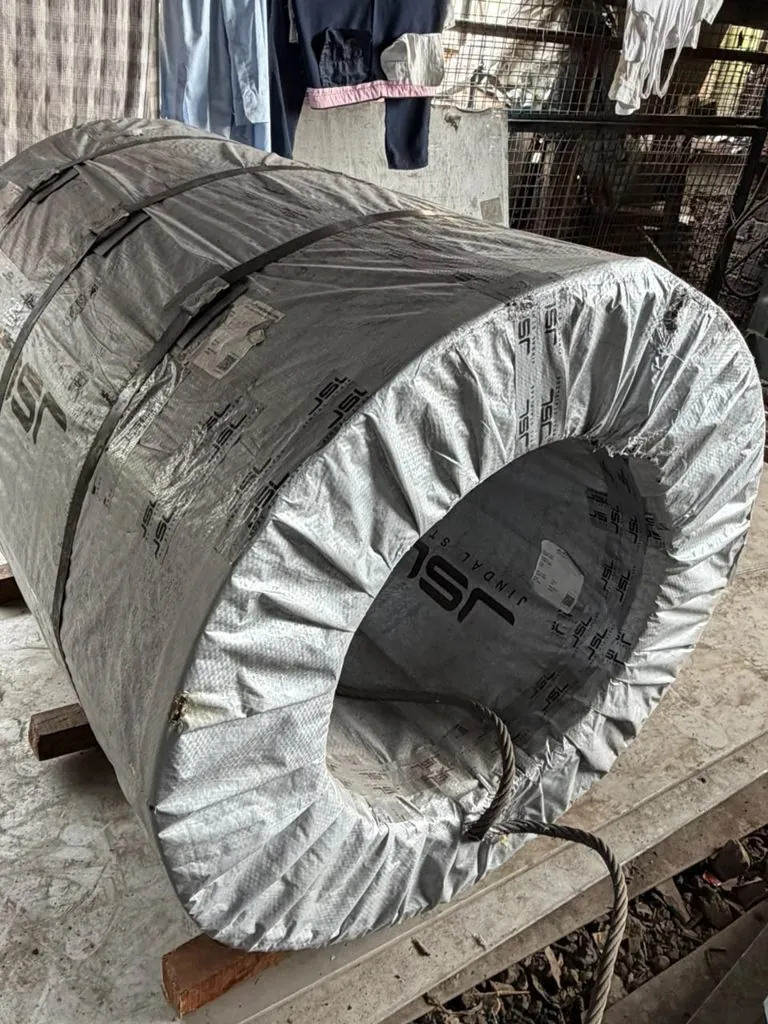
Key takeaways: 316 coil at a glance
- Grade identity: 316 (UNS S31600, Werkstoff 1.4401) is the molybdenum-bearing austenitic stainless steel, roughly 16-18% chromium, 10-14% nickel and 2-3% molybdenum.
- Corrosion ceiling: its PREN is ~24, one step up the pitting ladder from 304 (~18). Strong in chlorides, marine air and many acids; still susceptible to chloride stress-corrosion cracking.
- Coil form: this is the master mill coil / strip, the continuous flat input that is slit to width, re-coiled, or cut down to 316 sheet. Held in 2B and BA finish.
- Two decisions to respect: welded pharma, food or heavy sections held at 425-815 °C → step down in carbon to 316L; hot concentrated chlorides or sulfuric acid → step up to 904L.
- Traceable supply: genuine mill coil with an EN 10204 3.1/3.2 mill test certificate provided with every order, ex-stock for immediate dispatch.
What is 316 stainless steel coil?
316 belongs to the austenitic stainless steel family and shares the 304 backbone of chromium and nickel, with one defining addition: 2-3% molybdenum. Molybdenum strengthens the passive film against localized attack, which is the whole reason 316 exists as a distinct grade. The nickel keeps the structure austenitic and ductile, so the coil deep-draws, presses and roll-forms the same way 304 does.
Coil is the master form. Flat stainless begins life as hot-rolled band, is cold-reduced, annealed and finished on a continuous line, then shipped as a coil. That coil is the input to everything downstream: it is slit into narrower strip, re-coiled, or cut-to-length into sheet. Specifying 316 in coil form, rather than pre-cut sheet, is what you do when you are feeding a slitting line, a press shop, a roll-former or a tube mill and want the material in its continuous, as-rolled state. For the full grade authority and the other forms, see the 316 grade hub; for how coil relates to flat-cut product, see sheet vs plate vs coil.
Chemical composition
316 coil is supplied to the UNS S31600 / ASTM A240 chemistry below (weight %, balance iron).
| Element | Symbol | Min % | Max % |
|---|---|---|---|
| Carbon | C | - | 0.08 |
| Chromium | Cr | 16.0 | 18.0 |
| Nickel | Ni | 10.0 | 14.0 |
| Molybdenum | Mo | 2.00 | 3.00 |
| Manganese | Mn | - | 2.00 |
| Silicon | Si | - | 0.75 |
| Phosphorus | P | - | 0.045 |
| Sulfur | S | - | 0.030 |
| Nitrogen | N | - | 0.10 |
| Iron | Fe | Balance | |
The molybdenum is what you are buying
The single defining fact of 316 chemistry is the deliberate 2-3% molybdenum. Molybdenum is the element that buys chloride-pitting resistance, and it is the only material difference from 304. Because of it, the pitting resistance equivalent number, PREN = Cr + 3.3·Mo + 16·N, climbs to ~24, against ~18 for 304. The practical warning cuts both ways: buyers often pay for 316 where dry, indoor, non-chloride 304 would serve, and others under-spec 316 for hot concentrated chlorides where 904L or duplex is really needed. Match the molybdenum to the real pitting risk.
Mechanical properties
Minimum room-temperature properties for annealed 316 strip/coil per ASTM A240:
| Property | Minimum (annealed) |
|---|---|
| Tensile strength | ≥ 515 MPa (75 ksi) |
| Yield strength (0.2% offset) | ≥ 205 MPa (30 ksi) |
| Elongation (50 mm) | ≥ 40% |
| Hardness | ≤ 95 HRB / ≤ 217 HBW |
Cold-work tempers (¼-, ½- and full-hard strip)
Like all austenitics, 316 work-hardens as it is cold-rolled. Cold-rolled strip can be supplied in tempers, quarter-hard, half-hard and full-hard, that raise tensile and yield strength above the annealed minimums while cutting elongation. Specify the temper when the part relies on spring-back or surface hardness; specify annealed when it must be deep-drawn or roll-formed. Cold work also makes the surface slightly magnetic, even though annealed 316 is non-magnetic.
Physical properties
| Property | Typical value (annealed) |
|---|---|
| Density | 7.98-8.00 g/cm³ |
| Melting range | ~1375-1400 °C |
| Thermal conductivity (100 °C) | ~16.3 W/m·K |
| Mean coefficient of thermal expansion (0-100 °C) | ~16.0 µm/m·°C |
| Elastic modulus | ~193-200 GPa |
| Magnetic response | Non-magnetic (annealed); slightly magnetic after cold work |
The density figure is not academic for coil buyers; it is the number that drives the coil-weight calculation further down this page.
Corrosion behavior & PREN: what 316 coil resists and what it doesn't
This is where 316 earns its premium over 304. 316 resists chloride pitting far better than 304, along with marine and coastal atmospheres, many organic and some mineral acids, and general atmospheric and food service. It remains susceptible to two mechanisms every specifier should recognize.
Pitting & PREN ~24
With 2-3% molybdenum, 316 carries a PREN of ~24 and sits a clear rung above 304 on the pitting ladder: 304 (~18) < 316 (~24) < 904L (~34) < Duplex 2205 (~35). That is enough for marine air, splash-zone and moderately chlorinated process water, which is exactly where 304 pits. The ceiling is hot, concentrated chlorides and reducing acids: when the service runs past 316's limit, the answer is 904L or duplex, not more 316. See 904L vs 316L.
Chloride stress-corrosion cracking
Like every austenitic grade, 316 is susceptible to chloride stress-corrosion cracking, branching cracks under the combination of tensile stress, chlorides and warm temperatures (typically above ~50-60 °C). Molybdenum improves pitting resistance but does not cure SCC; it is a family trait of the austenitics, and it is why hot chloride service with stress moves to duplex or nickel alloys.
Intergranular corrosion & the 316L answer
Standard-carbon 316 (C ≤ 0.08%) can sensitize: held in the 425-815 °C range, most often in the heat-affected zone of a weld, chromium combines with carbon to precipitate chromium carbides at the grain boundaries, locally depleting chromium and opening the steel to intergranular corrosion. The fix is the low-carbon sibling: specify 316L (C ≤ 0.03%) for welded pharma and food work to keep the HAZ corrosion-resistant, or solution-anneal after welding. See 316 vs 316L for the full decision, and confirm freedom from sensitization with ASTM A262.
Equivalent grades & designations
| System | Designation |
|---|---|
| UNS | S31600 |
| Werkstoff (W.-Nr.) | 1.4401 |
| EN name | X5CrNiMo17-12-2 |
| JIS | SUS 316 |
| BS | 316S31 |
| AISI / common | 316 |
For a full cross-walk between systems, see the UNS / Werkstoff / JIS cross-reference.
316 coil vs the alternatives: when to choose it
vs 304: the chloride decision
304 is the same 18-8 austenitic without molybdenum, so its PREN is only ~18 and it pits in chloride service. Choose 304 for dry, indoor, food and architectural duty where it is the economical choice; choose 316 the moment chlorides, seawater or marine air enter the service. Paying for 316 where 304 would serve is the most common over-spec, and using 304 where chlorides are present is the most common failure. See 304 vs 316 and the 304 coil page.
vs 316L: the sensitization decision
316 and 316L share the same corrosion ceiling; the difference is carbon. 316L caps carbon at ≤0.03% so the weld heat-affected zone does not sensitize, at a small cost in strength. Choose 316L for welded fabrications that cannot be post-weld annealed, especially pharma and food work. See 316 vs 316L and 316L coil.
vs 904L: the hot-chloride and acid decision
When the service is hot concentrated chlorides or sulfuric acid, 316's PREN ~24 is no longer enough. 904L is a super-austenitic with ~4.5% molybdenum and copper (PREN ~34) built for sulfuric-acid and high-chloride duty. Do not keep specifying 316 past its limit; step up. See 904L vs 316L.
Coil finishes
Finish is the primary coil decision, it sets both appearance and the base condition for any downstream polishing. Nandini Steel supplies 316 coil in the two workhorse finishes below.
| Finish | Process | Appearance | Typical use |
|---|---|---|---|
| 2B | Cold-rolled, annealed, pickled, skin-passed | Smooth, uniform, lightly reflective | The default coil finish; general fabrication, chemical and food equipment |
| BA (bright annealed) | Cold-rolled, bright-annealed in protective atmosphere | Mirror-bright, highly reflective | Pre-polish base, pharma and hygienic surfaces, decorative panels |
Common finish-selection mistake
A recurring error from the stockyard: ordering 2B and then discovering the part needs a mirror polish. If the end result must be bright or polished, start from BA, polishing up from a 2B surface adds cost and time. Confirm the final surface requirement before the coil finish is locked. For the full breakdown, see stainless steel finishes: 2B, BA, No.4.
Forms, dimensions & slitting
316 coil is held as cold-rolled (CR) master coil in the 2B and BA finishes and slit to the width a job needs. Coil is supplied on standard inner diameters for mill handling, master-coil or slit, and can be cut down to strip or sheet. Cold-rolled coil covers the thinner gauges typical of slitting lines, press shops, roll-formers and tube mills.
Because dimensional availability moves with stock, the exact thickness, width and slit-width ranges held at any time are confirmed on inquiry, request current stock and tolerances with your RFQ.
Other 316 forms
Need flat-cut product rather than coil? See 316 sheet and 316 plate, or the full 316 grade hub.
Coil weight & how to calculate
Coil weight follows directly from the dimensions and the density of 316 (8.0 g/cm³). For a flat strip, weight per running meter is:
kg per meter = thickness (mm) × width (mm) × 8.0 ÷ 1000
Worked example, a 1.2 mm × 1250 mm coil:
- Multiply thickness by width: 1.2 × 1250 = 1500 mm².
- Multiply by density and divide by 1000: 1500 × 8.0 ÷ 1000 = 12.0 kg per meter.
- Multiply by coil length to get the full coil mass, e.g. a 500 m coil ≈ 6,000 kg.
To run your own dimensions, use the weight calculator.
Standards & specifications complied
316 coil is supplied to the recognized flat-product standards:
- ASTM A240, chromium and chromium-nickel stainless steel plate, sheet and strip for pressure vessels and general application (the primary specification for 316 flat product).
- ASME SA-240, the ASME Boiler & Pressure Vessel Code adoption of A240.
- ASTM A480, general requirements and dimensional tolerances for flat-rolled stainless.
- EN 10088-2, the European standard for stainless flat product for general use.
Testing, inspection & certification
Every 316 coil is shipped with an EN 10204 3.1/3.2 mill test certificate provided with every order, giving the heat/cast chemistry and mechanical results traceable to the melt. For welded and corrosion-critical work, intergranular-corrosion testing per ASTM A262 confirms the material is not sensitized, and PMI (positive material identification) verifies grade at receiving, a quick check that the coil genuinely carries its molybdenum. Surface and thickness inspection confirm the coil meets the ordered finish and tolerance. Learn more about EN 10204 3.1 mill test certificate levels and how we handle testing, MTC, NDT and PMI.
Applications of 316 coil by industry
316 coil is the default flat product wherever chlorides, acids or hygienic cleanliness rule out 304:
- Marine & coastal, fittings, enclosures and panels exposed to salt air and splash, where 304 would pit.
- Chemical processing, tanks, ducting and components in moderate acid and chloride streams.
- Pharmaceutical, hygienic vessels and surfaces, usually in BA finish and specified as 316L for welded work.
- Food & beverage, processing equipment that sees cleaning chemicals and chloride-bearing products.
The boundary above 316 is hot concentrated chlorides and sulfuric acid, where 904L or duplex takes over.
Welding & fabrication of 316 coil
316 is readily welded by TIG, MIG and resistance methods. The matching filler is ER316L, a low-carbon, molybdenum-bearing austenitic consumable whose weld metal retains the pitting resistance and resists heat-affected-zone sensitization. For welded sections that will sit in the 425-815 °C range without post-weld annealing, specify 316L to keep the HAZ corrosion-resistant. 316 forms and deep-draws well but work-hardens quickly, so it is "gummy" to machine and benefits from sharp tooling, positive feeds and interstage annealing on severe draws. See how to weld 316 and how to weld 316L.
Pricing & how we quote
316 coil is a commodity flat product whose price tracks the nickel and molybdenum surcharges and the LME daily, so we do not publish fixed price tables. We quote live against your exact finish, gauge, slit width and quantity. All stock is ex-stock and available for immediate dispatch; send your specification for a current quotation by RFQ or WhatsApp +91 99202 09184.
FAQ
Is 316 coil magnetic?
What is the difference between 304 and 316 coil?
When should I choose 316L instead of 316 coil?
What finishes does 316 coil come in?
How do I calculate 316 coil weight?
Can you slit 316 coil to width and supply a mill test certificate?
Request a quote for 316 stainless steel coil
Nandini Steel is an ISO 9001:2015-certified stockist and supplier, established in 2003, with 307+ projects delivered for 260+ clients across 36+ export countries over 20+ years. We hold genuine mill 316 coil ex-stock for immediate dispatch, slit to width, in 2B and BA finish, every order shipped with an EN 10204 3.1/3.2 mill test certificate.
- Phone: +91 22 43404600 · +91 9920209184
- WhatsApp: +91 99202 09184
- Email: reachus@nandinisteel.com
- Address: 25, Dreamland Building, 601, 6th Floor, Mama Parmanand Marg, Charni Road, Opera House, Girgaon, Mumbai, Maharashtra 400004, India
- GSTIN: 27ADJPA7240C1Z0
Send your finish, gauge, slit width and quantity for live pricing, request an RFQ.
Related grades to cross-shop
Part of our steel coil range and all stainless steel coil grades.