
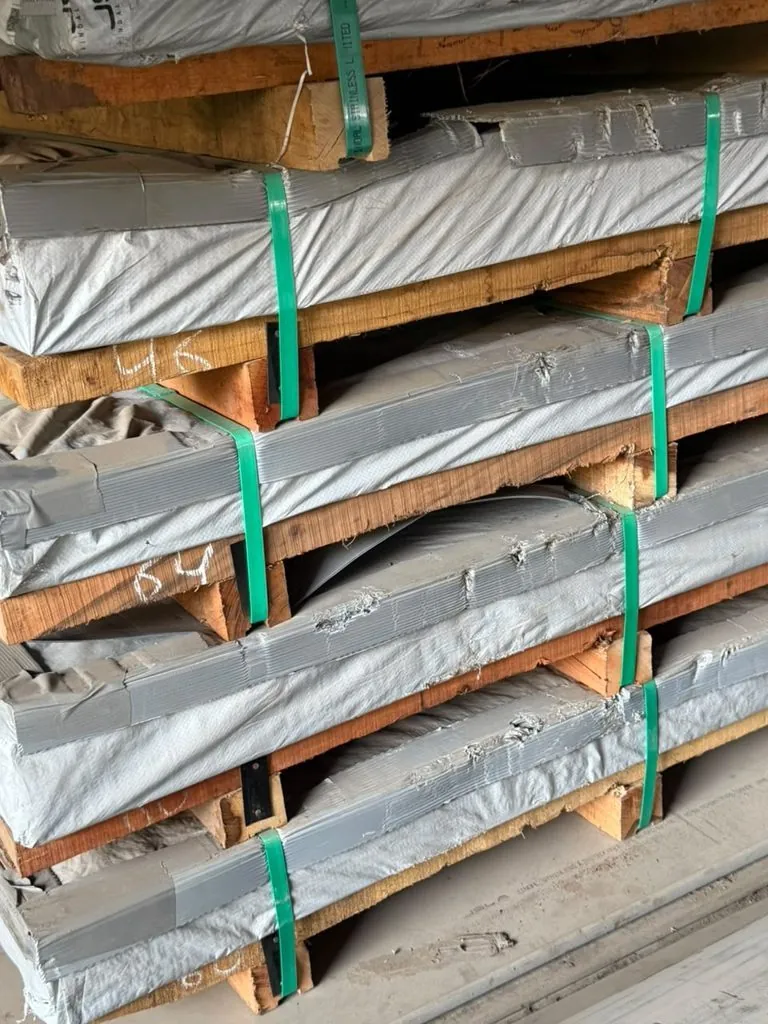
Key takeaways: 904L super-austenitic stainless steel at a glance
- Identity: 904L goes by UNS N08904 and Werkstoff 1.4539 (EN X1NiCrMoCu25-20-5). It's one specific grade, not a family of alloys.
- What makes it "super": the microstructure is fully austenitic, and it's deliberately over-alloyed with nickel, molybdenum, copper and nitrogen until pitting resistance pushes past the super-austenitic line.
- PREN ~34: a PREN of roughly 34 puts it well ahead of 316L, which sits around 24, on the corrosion-resistant-alloy scale.
- Copper is the signature: about 1.5% copper is what gives 904L its standout resistance to sulfuric acid and other reducing acids. That's the trait defining this grade.
- Beats 316L in chloride SCC: roughly 25% nickel lifts the chloride stress-corrosion-cracking threshold well past the point that trips up standard 316-type austenitics.
- Fully fabricable: 904L stays non-magnetic throughout, and it forms and welds like any austenitic stainless when you use an over-alloyed filler such as ER385.
What does "super-austenitic" mean?
Austenitic stainless steels, the 304 and 316 families, get their name from austenite, the face-centered-cubic phase that nickel stabilises at room temperature. That phase is what gives an austenitic stainless steel its toughness, formability, weldability and lack of magnetism. A grade earns the super-austenitic label once its alloy content is pushed far enough. High molybdenum, typically 4% or more, high nickel, and deliberate nitrogen additions push the pitting resistance equivalent (PREN) past roughly 33, all while the structure stays fully austenitic.
In other words, "super" is about how well the steel resists corrosion, not some different crystal structure. The grade holds onto the handling traits of austenitic steel, but picks up acid and chloride resistance that ordinary austenitics just can't match. 904L sits at the entry point of this class, and the broader super-austenitic stainless steel family stretches well past it, up to the 6% molybdenum grades.
What is 904L, specifically?
904L is a copper-bearing, high-nickel austenitic stainless steel designated UNS N08904 and Werkstoff 1.4539, with the EN name X1NiCrMoCu25-20-5 (legacy names include BS 904S13 and AISI 904L). The "L" stands for an extra-low carbon content, no more than 0.02%. That's lower than the carbon ceilings on 304L and 316L, and it keeps the weld heat-affected zone from sensitizing.
Sits between the standard austenitics and the nickel-base alloys, and that's exactly why people slap "nickel alloy" on 904L when they shouldn't. It's a stainless steel, plain and simple: iron-balanced, with roughly a quarter nickel content. Full form-level specifications, sizes and stock can be found on the 904L stainless steel grade hub.
Chemical composition (UNS N08904, ASTM A240, wt%)
| Element | Content (wt%) | What it does in 904L |
|---|---|---|
| Carbon (C) | ≤ 0.02 | Extra-low carbon resists sensitization and intergranular attack |
| Chromium (Cr) | 19.0–23.0 | Forms the passive film; base of pitting resistance |
| Nickel (Ni) | 23.0–28.0 | Stabilises austenite; raises chloride-SCC threshold |
| Molybdenum (Mo) | 4.0–5.0 | Drives pitting and crevice resistance (PREN) |
| Copper (Cu) | 1.0–2.0 | Signature element for sulfuric / reducing-acid resistance |
| Manganese (Mn) | ≤ 2.0 | Deoxidiser; minor austenite support |
| Silicon (Si) | ≤ 1.0 | Deoxidiser |
| Phosphorus (P) | ≤ 0.045 | Residual, controlled |
| Sulfur (S) | ≤ 0.035 | Residual, controlled for weldability |
| Iron (Fe) | Balance | Matrix |
How 904L achieves its corrosion resistance
904L's whole case rests on its chemistry. Each major addition goes after a specific failure mode, and together they push the grade a full step up the role of alloying elements scale.
- Molybdenum and nitrogen → pitting and crevice resistance. The ~4.5% molybdenum (with nitrogen) is what lifts the pitting resistance equivalent to ~34, resisting the chloride pitting corrosion and crevice corrosion that initiate where 316L's thinner molybdenum budget runs out.
- Copper → sulfuric and reducing-acid resistance. The ~1.5% copper is 904L's signature; it suppresses the active corrosion that reducing acids drive, giving the grade genuine sulfuric-acid resistance across a wide concentration-temperature window where plain austenitics corrode generally.
- High nickel (~25%) → chloride stress-corrosion-cracking resistance. Raising nickel to a quarter of the alloy lifts the threshold for chloride stress-corrosion cracking; this is the clearest reason 904L outperforms 316L in hot chloride service.
- Low carbon (≤0.02%) → resistance to sensitization. Keeping carbon below 0.02% starves chromium-carbide formation, so 904L resists sensitization and intergranular corrosion even after welding.
The alloying elements that make it "super"
Chromium lays down the passive film. Molybdenum and nitrogen multiply its resistance to pitting. Copper opens the door to reducing-acid service. Nickel buys immunity to stress-corrosion cracking. Low carbon keeps the whole alloy stable through the weld cycle. Read this way, the composition explains the "super" label directly.
The number PREN sums it up: multiply %Mo by 3.3, %N by 16, add %Cr, and you get the pitting resistance equivalent number. Run 904L's mid-range chemistry through that formula and the result lands near 34, a figure that puts it above standard austenitics and squarely into super-austenitic territory. Specifiers wanting a fuller treatment of the formula, and how to put it to use, should see the guide on PREN and pitting resistance.
Where 904L sits on the corrosion-resistant-alloy ladder
904L sits at a deliberate point on the scale: a step above the standard austenitics, roughly even with lean duplex when it comes to pitting, and still below the 6% molybdenum and nickel-base grades. The ladder below sorts the common grades by PREN and shows exactly when it's worth stepping further up.
PREN / CRA ladder
| Grade | Family | Approx. PREN | Step up when… |
|---|---|---|---|
| 304 / 304L | Austenitic | ~18 | Any real chloride exposure, move to 316 |
| 316 / 316L | Austenitic | ~24 | Hot or concentrated chlorides, reducing acids, move to 904L |
| 904L | Super-austenitic | ~34 | Sulfuric-acid and high-chloride duty within its iso-corrosion limits |
| Duplex 2205 | Duplex | ~35 | Higher strength / chloride-SCC margin with lower nickel cost |
| Incoloy 825 | Ni-Fe-Cr alloy | ~31–40 | Mixed reducing + oxidizing acids, sour service |
| Super-Duplex 2507 | Super-duplex | ~43 | Severe seawater / very aggressive chloride service |
904L vs 316L
316L carries 2–3% molybdenum and a PREN near 24. 904L nearly doubles the molybdenum, throws in copper, and triples the nickel. That's the comparison most buyers land on: 904L vs 316L. Once 316L runs out of margin in hot chlorides or sulfuric acid, 904L is the next logical step. In reducing acids, it's often the right call even where pricier alloys would be overkill.
904L vs duplex 2205, 254 SMO, Alloy 20 and Incoloy 825
Side-stepping up the ladder depends on the medium, not just the PREN number. Against duplex stainless steel such as 2205 (904L vs duplex 2205), 904L gives up some strength in exchange for better reducing-acid behavior and fabrication that's easier to manage. Against 254 SMO (S31254, ~6% Mo) and Alloy 20 (N08020), 904L is the cheaper entry grade. Move up only when chloride severity genuinely calls for 6% molybdenum. Where reducing and oxidizing acids show up together, or sour gas is in the picture, the nickel alloys take over. See Incoloy 825.
Is 904L the only super-austenitic? The family
904L sits at the entry point of a small, high-alloy class. The grades above it push molybdenum and nitrogen even higher for extra pitting margin, but you pay more for it.
| Grade | UNS | Approx. Mo (%) | Approx. PREN | Position |
|---|---|---|---|---|
| 904L | N08904 | ~4.5 | ~34 | Entry super-austenitic |
| 254 SMO | S31254 | ~6.1 | ~43 | 6Mo grade |
| AL-6XN | N08367 | ~6.3 | ~45 | 6Mo grade |
| Alloy 20 | N08020 | ~2.5 | ~30 | Acid-service, copper-bearing |
904L is a grade, not the whole story; "super-austenitic" is the class it sits inside. 904L marks where that class starts. The 6% molybdenum grades push further still, into the harshest chloride service.
Properties and fabrication at a glance
Mechanically, 904L acts like a tough austenitic stainless. The numbers below are indicative minimums for solution-annealed flat product. Full certified data comes with each order, and the form-level 904L plate and 904L sheet pages carry the complete tables.
| Property | Typical value |
|---|---|
| Density | 7.95 g/cm³ |
| Tensile strength | ≥ 490 MPa |
| Yield strength (0.2%) | ≥ 220 MPa |
| Elongation | ≥ 35% |
| Magnetic response | Non-magnetic (fully austenitic) |
Weldability
904L welds easily, but welders deliberately use an over-alloyed consumable to do it, typically ER385 (Avesta 904L) or a nickel-base filler. That way the weld metal matches or even beats the base alloy's pitting resistance instead of diluting it. For the broader principles, see welding stainless and nickel alloys. Step-by-step practice lives in the guide on how to weld 904L.
Solution annealing
904L gets its corrosion resistance from the solution-annealed condition. The process is simple in concept: heat it high, then quench it fast enough to keep alloying elements locked in solution and dissolve any precipitates that formed. Temperatures and the full mechanism are covered under solution annealing.
Standards 904L is supplied to
As a flat product, 904L comes under ASTM A240 and its ASME pressure-vessel counterpart, ASME SA-240, both of which set the chemistry and mechanical minimums noted above. The cross-reference below reconciles designations across the different systems.
- Flat-product chemistry and properties, ASTM A240 and ASME SA-240.
- UNS / Werkstoff equivalence, UNS / Werkstoff cross-reference.
Equivalents
| System | Designation |
|---|---|
| UNS | N08904 |
| Werkstoff (W.-Nr.) | 1.4539 |
| EN name | X1NiCrMoCu25-20-5 |
| BS | 904S13 |
| AISI | 904L |
| JIS | No direct equivalent |
What 904L is used for
904L earns its place wherever chlorides and reducing acids defeat 316L, but a full nickel alloy isn't yet required:
Sulfuric-acid plants and acid regeneration: the copper in the alloy stands up to reducing acids that would eat through ordinary grades, which is why it shows up in chemical processing and fertilizer and acid service.
Pharmaceutical process equipment: surfaces stay clean, weld well, and resist corrosion, exactly what pharmaceutical work demands.
Pulp and paper bleaching: it holds up in chloride-dioxide and brownstock environments found throughout pulp and paper plants.
- Flue-gas desulfurization (FGD) and scrubbers, wet, acidic, chloride-laden gas cleaning.
- Oil and gas processing, chloride and acid exposure in oil and gas streams.
Buyers at Nandini Steel Engineering often reach for Alloy 20, Inconel 625 or titanium when sulfuric-acid and high-chloride service is on the table. But 904L, with its PREN of roughly 34 and copper-bearing chemistry, already handles plenty of that duty at a lower cost. Before paying for the upgrade, check the acid concentration and temperature against the 904L iso-corrosion limits.
The flip side matters too: don't under-specify 904L in places where 6% molybdenum (254 SMO) or super-duplex is truly called for.
Which 904L form do you need?
Once the grade is settled, the choice is form and size. Nandini Steel stocks 904L as plate, sheet and coil, all ex-stock and available for immediate dispatch:
- 904L plate, vessels, tanks, tube sheets and heavy fabrication.
- 904L sheet, linings, ducting and lighter fabrication.
- 904L coil, continuous feedstock for cut-to-length and forming.
Not sure which grade or form you need? Try the grade selector and the weight calculator, or check out how to select a stainless grade.
How Nandini Steel proves a plate is genuine 904L
Since 904L looks like any other bright austenitic stainless, the "super-austenitic" claim only matters if you can trace it. Nandini Steel sources 904L from genuine mill plate, Aperam, Outokumpu, Jindal, POSCO, Nippon Steel and JFE, so the heat comes straight from the mill, not a re-stamped 316. Every order ships with an EN 10204 3.1/3.2 mill test certificate, and chemistry can be checked by PMI to confirm the molybdenum, copper and nickel that give the grade its super-austenitic status. Nandini Steel holds ISO 9001:2015 certification and specializes in 904L, Alloy 28, Incoloy 800 and Hastelloy. See our quality assurance, mill test certificate and certifications pages, or read about Nandini Steel.
FAQ: 904L super-austenitic stainless steel
Is 904L austenitic or duplex?
Is 904L magnetic?
Is 904L a nickel alloy?
Why is 904L more expensive than 316L?
What is the PREN of 904L?
Can you weld 904L?
Nandini Steel keeps 904L plate, sheet and coil ex-stock for immediate dispatch, each backed by a genuine mill test certificate to EN 10204 3.1/3.2. Looking for the real thing, not a substitute? Contact us for a request-for-quote with live pricing.