
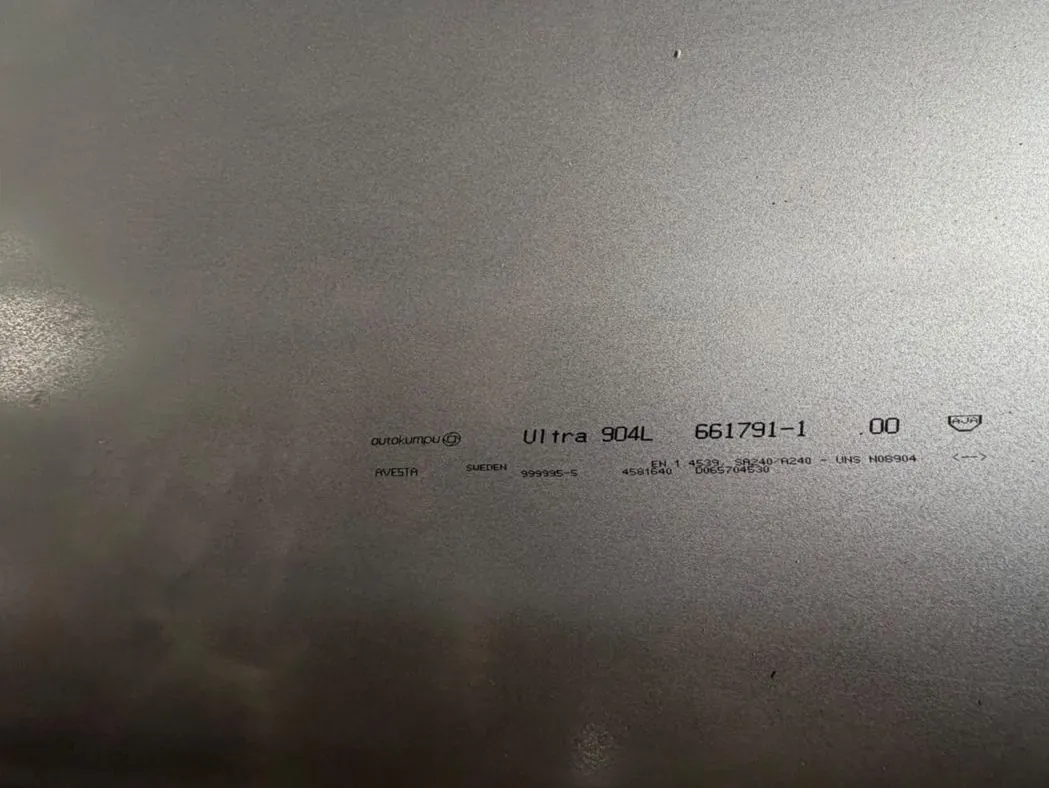
904L and Duplex 2205 have almost the same pitting resistance, PREN ~34 versus ~35, so the choice is not about chlorides, it is about acid and strength. Choose 904L for sulfuric and other reducing acids; choose Duplex 2205 when you need roughly double the yield strength, better chloride stress-corrosion-cracking resistance, and lower cost from its leaner nickel content.
Verdict: 904L vs Duplex 2205 at a Glance
| Attribute | 904L (UNS N08904) | Duplex 2205 (UNS S32205) | Choose when |
|---|---|---|---|
| Family | Super-austenitic SS | Ferritic-austenitic (duplex) SS | – |
| PREN | ~34 | ~35 | Near-equal, not the deciding factor |
| Yield strength (0.2% proof) | ≥220 MPa (32 ksi) | ≥450 MPa (65 ksi) | Duplex 2205, roughly double |
| Best-for medium | Sulfuric & reducing acids | Near-neutral chlorides / seawater | Acid → 904L; chloride-SCC → 2205 |
| Max service temperature | High (no sigma window) | ~300 °C ceiling | Above ~300 °C → 904L |
| Relative cost | Higher (~25% Ni + Cu) | Lower (~5% Ni) | Cost-sensitive → Duplex 2205 |
| Magnetic? | Non-magnetic (austenitic) | Magnetic (ferrite phase) | A legitimate identification tell |
Key Takeaways
- Pitting resistance is near-equal. 904L has a PREN of about 34, and Duplex 2205 sits at roughly 35. Don't pick the bigger number expecting more corrosion resistance.
- Duplex is roughly twice as strong. Yield strength tells the real story: Duplex 2205 comes in around 450 MPa against 904L's 220 MPa. That difference lets you specify thinner, lighter, cheaper sections.
- 904L owns reducing acids. Its copper-bearing chemistry, built around 4.5% molybdenum, makes it the natural choice for sulfuric and other reducing-acid service.
- Duplex owns chloride-SCC and cost. Thanks to its ferrite phase, the chloride stress-corrosion-cracking threshold sits well above fully-austenitic 904L. Nickel content of only about 5% keeps the price down considerably.
- Duplex is temperature-capped. Sigma-phase formation and 475 °C embrittlement hold Duplex 2205 to roughly 300 °C in service, while 904L can run hotter without the same penalty.
Chemical Composition Compared
Both grades conform to ASTM A240 / ASME SA-240 for flat product. The composition is where the two philosophies diverge: 904L leans on nickel and copper, Duplex 2205 on chromium, nitrogen and a balanced ferrite/austenite structure.
| Element (wt%) | 904L, N08904 | Duplex 2205, S32205 |
|---|---|---|
| Carbon (C) | ≤0.02 | ≤0.03 |
| Chromium (Cr) | 19.0–23.0 | 22.0–23.0 |
| Nickel (Ni) | 23.0–28.0 | 4.5–6.5 |
| Molybdenum (Mo) | 4.0–5.0 | 3.0–3.5 |
| Nitrogen (N) | – | 0.14–0.20 |
| Copper (Cu) | 1.0–2.0 | – |
| Manganese (Mn) | ≤2.0 | ≤2.0 |
| Silicon (Si) | ≤1.0 | ≤1.0 |
| Iron (Fe) | Balance | Balance |
Why the Chemistry Diverges: Nickel + Copper (904L) vs Nitrogen + Ferrite Balance (2205)
904L is an extra-low-carbon grade (C ≤0.02%) so it resists sensitization and intergranular corrosion without post-weld annealing. Its ~25% nickel keeps the structure fully austenitic, while the ~1.5% copper is what gives 904L its edge in sulfuric-acid resistance. Duplex 2205 instead runs a lean ~5% nickel with ~0.17% nitrogen, nitrogen stabilizes austenite and sharply raises strength, to hold a roughly 50/50 ferrite/austenite balance. That balance is the source of both its high yield strength and its superior chloride-SCC behavior.
Mechanical Properties Compared
The decisive difference, the one that has nothing to do with corrosion, comes down to strength. Measured as plate in the annealed condition per ASTM A240, Duplex 2205 delivers roughly double the yield of 904L.
| Property (plate, annealed) | 904L | Duplex 2205 |
|---|---|---|
| Tensile strength (min) | ≥490 MPa (71 ksi) | ≥620–655 MPa (90–95 ksi) |
| Yield strength, 0.2% proof (min) | ≥220 MPa (32 ksi) | ≥450 MPa (65 ksi) |
| Elongation (min) | ≥35% | ≥25% |
| Hardness | ≤90 HRB | ≤293 HBW (~31 HRC) |
What Double the Yield Buys You
Because Duplex 2205 yields near 450 MPa, a pressure vessel or tank shell can be built with a thinner wall than the same part made from 904L. Less wall thickness translates to less weight, less filler, shorter welding time, and a lower delivered cost per vessel. That alone often settles the commercial argument, before anyone even gets to the raw price-per-kilogram gap. 904L fights back with higher elongation and a fully-austenitic structure, which gives it easier deep-forming and better toughness at low temperatures.
Physical Properties & Temperature Limits
| Property | 904L | Duplex 2205 |
|---|---|---|
| Density | 7.95 g/cm³ | 7.80 g/cm³ |
| Thermal conductivity | ~11.5 W/m·K | ~15 W/m·K |
| Mean CTE | ~15.3 µm/m·°C | ~13.0 µm/m·°C |
| Elastic modulus | ~190 GPa | ~200 GPa |
| Magnetic response | Non-magnetic (austenitic) | Magnetic (ferrite phase) |
Unlike the 304-vs-316 case, a magnet actually works here on the shop floor: austenitic 904L is effectively non-magnetic, but the ferrite phase in Duplex 2205 makes it noticeably magnetic.
Duplex 2205's ~300 °C Ceiling: Sigma-Phase & 475 °C Embrittlement
Duplex 2205 is prone to sigma-phase formation and 475 °C embrittlement, brittle intermetallic and spinodal reactions that develop when ferrite sits in the roughly 475–950 °C range for too long. That's why Duplex 2205 is usually capped at around 300 °C for continuous service. 904L has no such embrittlement window. So when the medium runs hot, 904L simply beats Duplex 2205 on maximum service temperature.
Corrosion Resistance: 904L vs Duplex 2205
This is the differentiator, though not in the way the "higher PREN wins" shortcut suggests. Pitting puts the two alloys near-equal. The real gaps show up in stress-corrosion cracking and in acid chemistry.
Pitting & Crevice / PREN ~34 vs ~35 (Near-Equal)
PREN works out to %Cr + 3.3×%Mo + 16×%N. Run that formula and 904L lands around 34, with Duplex 2205 close behind at about 35. Statistically, that's the same pitting and crevice resistance. Line up the whole family and you get 304 (~18), then 316 (~24), then 904L (~34) ≈ Duplex 2205 (~35), then super-duplex 2507 (~43), with Incoloy 825 (~31–40) overlapping that same middle band. For the details, see pitting and crevice corrosion and the derivation behind PREN. Need more than this band can give you because of chlorides? Then super-duplex is the next real step up, not a swap between these two.
Chloride Stress-Corrosion Cracking (Duplex's Ferrite Phase Wins)
Fully-austenitic alloys are the most vulnerable to chloride stress-corrosion cracking. The ferrite phase in Duplex 2205 interrupts crack propagation, so Duplex 2205 outperforms 904L on chloride-SCC resistance. For hot chloride service under tensile stress, brine tanks, seawater heat exchangers, this is often the single reason to specify duplex over a super-austenitic grade of similar PREN.
Sulfuric & Reducing Acids (904L's Copper Wins)
Where the medium is reducing, sulfuric acid, phosphoric acid, many process liquors, the copper and high nickel in 904L give it a clear advantage. 904L resists sulfuric-acid attack across concentration/temperature ranges where lean-nickel duplex grades are attacked. For reducing-acid duty, 904L outperforms Duplex 2205.
Equivalents & Designations
| System | 904L | Duplex 2205 |
|---|---|---|
| UNS | N08904 | S32205 (also S31803) |
| Werkstoff (W.-Nr.) | 1.4539 | 1.4462 |
| EN | X1NiCrMoCu25-20-5 | X2CrNiMoN22-5-3 |
| BS / AISI | 904S13 / AISI 904L | – |
| JIS | – | SUS329J3L |
Full cross-references live in the UNS / Werkstoff cross-reference table. That's the one to check when a drawing calls out 1.4539 or 1.4462 instead of using the common names.
When to Choose 904L vs Duplex 2205
| Service condition | Recommended grade |
|---|---|
| Sulfuric / reducing acid | 904L |
| Near-neutral chloride (seawater, brine) | Duplex 2205 (better chloride-SCC) |
| High mechanical load / thin sections | Duplex 2205 (~2× yield) |
| Service above ~300 °C | 904L (no sigma / 475 °C window) |
| Cryogenic / low-temperature toughness | 904L (austenitic) |
| Cost-sensitive, same pitting band | Duplex 2205 (leaner nickel) |
| Chlorides beyond PREN ~35 | Step up to super-duplex 2507 / 254 SMO / Alloy 20 |
Picture a ladder, not a hierarchy: 316L steps up to either 904L (the acid path) or Duplex 2205 (the strength/SCC path), and only past a PREN of roughly 35 do you jump to super-duplex 2507, 254 SMO, or Alloy 20. That entry decision on the ladder gets covered on 904L vs 316L.
Forms, Sizes & Stock
Nandini Steel holds certification as a specialist in 904L, stocking it ex-stock for immediate dispatch as 904L plate, 904L sheet and 904L coil. All of it conforms to ASTM A240 / ASME SA-240, and the flat product also meets ASTM B625 / SB-625. The material is genuine mill plate from authorized producers: Aperam, Outokumpu, Jindal, POSCO, Nippon Steel and JFE. Every order ships with an EN 10204 3.1/3.2 mill test certificate. For the full grade authority on 904L super-austenitic stainless steel, visit the 904L super-austenitic stainless steel hub. Need Duplex 2205 (UNS S32205 / 1.4462)? Send an RFQ, and the team will confirm what can be sourced.
| Form | 904L availability | Standard |
|---|---|---|
| Plate | Ex-stock | ASTM A240 / ASME SA-240 |
| Sheet | Ex-stock | ASTM A240 / B625 |
| Coil | Ex-stock | ASTM A240 |
Welding & Fabrication Compared
The two grades don't weld the same way at all. You weld 904L with over-alloyed austenitic filler (ER385 or a Ni-base), and it benefits from a post-weld solution anneal; the details are in the how to weld 904L guide. Duplex 2205, on the other hand, takes a matching 2209 duplex filler (ER2209). It also demands disciplined heat-input control and nitrogen backing gas, both needed to keep the ferrite/austenite balance in range once welding is done. Get the heat input wrong on duplex and you lose the strength and SCC resistance you picked it for in the first place.
Solution-annealing conditions differ too. 904L runs around 1070–1150 °C, while Duplex 2205 sits around 1020–1100 °C with a rapid quench afterward. That's covered under solution annealing.
Standards & Specifications
Both grades are supplied as plate to ASTM A240 / ASME SA-240. 904L flat product also conforms to ASTM B625 / SB-625; Duplex 2205 pipe and tube additionally fall under ASTM A790 / A789. Intergranular corrosion is verified by ASTM A262 practice, and sensitization is controlled by the low-carbon chemistry and solution annealing.
Testing, MTC & Traceability
Every order ships with an EN 10204 3.1/3.2 mill test certificate carrying full heat and cast traceability. Beyond the MTC, typical verification includes positive material identification (PMI), intergranular corrosion testing per ASTM A262, and, specific to duplex, a ferrite-number / phase-balance check to confirm the ferrite/austenite ratio after fabrication. These reports can be provided on request against the heat supplied.
Cost Difference: Why 904L Costs More
904L and Duplex 2205 aren't priced apart because of branding; the gap comes straight from what's in the alloy. 904L carries roughly 25% nickel plus copper. Duplex 2205 runs on about 5% nickel. Nickel is what drives the surcharge, so 904L ends up well above Duplex 2205 per kilogram. Duplex's higher strength also means you can use less material to begin with. Pricing isn't published as a fixed table; it gets quoted live against the current alloy surcharge. Ask for a quote based on the grade, form, and size you actually need.
Applications by Industry
904L is used in sulfuric-acid plants, pharmaceutical processing, pulp & paper bleaching, flue-gas desulfurization and broader chemical / acid processing and acid-regeneration service. Duplex 2205 is used in offshore oil & gas, marine / desalination, chloride-bearing pressure vessels, tanks and heat exchangers, anywhere high strength and chloride-SCC resistance matter more than reducing-acid resistance.
From the Nandini Steel Engineering Team: the classic field error is reaching for a nickel-base alloy, super-duplex or titanium for high-chloride or sulfuric-acid duty when 904L's copper-bearing ~4.5% Mo chemistry (PREN ~34) already covers it at lower cost. Check the acid concentration and temperature against the 904L iso-corrosion limits before paying for an upgrade. The mirror error runs the other way: specifying Duplex 2205 purely for its attractive price and strength on a reducing-acid line, where its lean nickel content leaves it under-protected. Match the grade to the medium first. Only then weigh the mechanical and cost case.
FAQ
What is the difference between 904L and Duplex 2205?
Which is stronger, 904L or Duplex 2205?
Which has higher PREN, 904L or Duplex 2205?
Is 904L or Duplex 2205 better for sulfuric acid?
Is 904L or Duplex 2205 better for seawater and chlorides?
Which is cheaper, 904L or Duplex 2205?
What is the temperature limit of Duplex 2205?
When should I upgrade from 316L, to 904L or to 2205?
Get a Quote
Nandini Steel has supplied corrosion-resistant and PVQ steel since 2003, over 20 years, across 307+ projects, 260+ clients and 36+ export countries, as an ISO 9001:2015-certified stockist and supplier. For 904L plate, sheet or coil, or to discuss a 904L-versus-Duplex-2205 selection for your service, request a quote with your grade, form, size and quantity, or try the grade selector and weight calculator.
- Address: 25, Dreamland Building, 601, 6th Floor, Mama Parmanand Marg, Charni Road, Opera House, Girgaon, Mumbai, Maharashtra 400004, India
- Phone: +91 22 43404600 · +91 9920209184 · +91 8097948249 · +91 9769380812
- WhatsApp: +91 99202 09184
- Email: reachus@nandinisteel.com
- GSTIN: 27ADJPA7240C1Z0
- Quality: certified to ISO 9001:2015 (Cert No. 1283438, Unitas Certification Services UCS-UK, valid through 11 January 2028). Every order ships with an EN 10204 3.1/3.2 mill test certificate.