
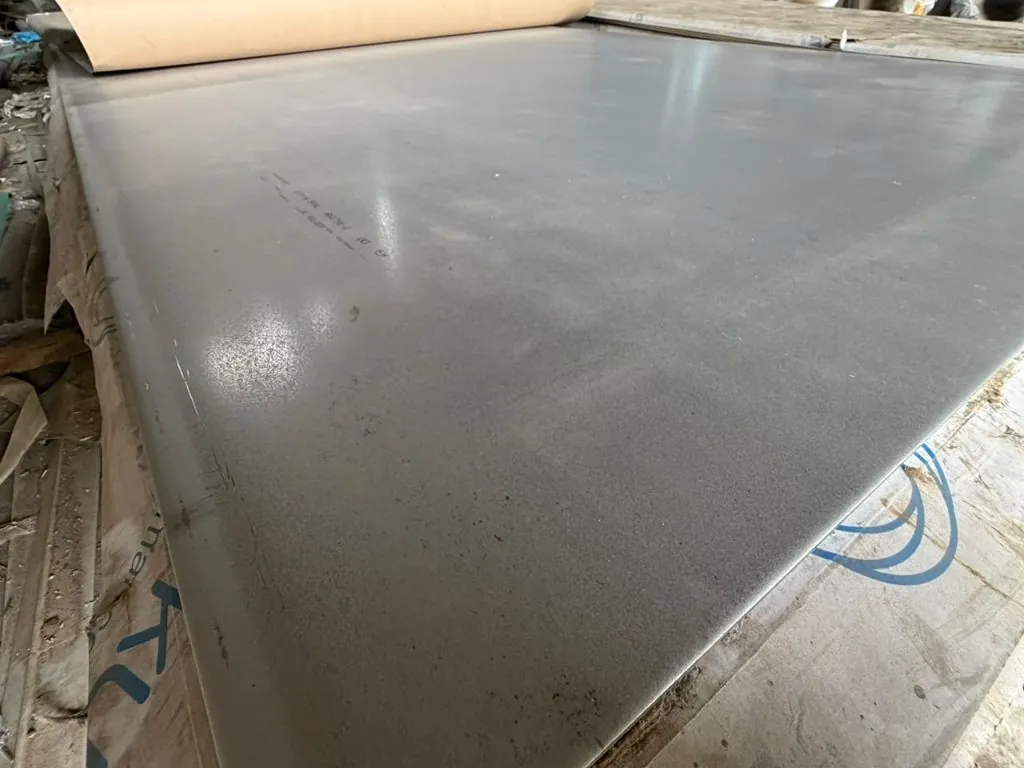
316Ti stainless steel at a glance
- Designation: UNS S31635, Werkstoff 1.4571, EN X6CrNiMoTi17-12-2, JIS SUS316Ti, the titanium-stabilized 316.
- Chemistry: molybdenum-bearing (Mo 2.0–3.0%) with titanium at 5×C to 0.70% for stabilization.
- Corrosion: PREN (pitting resistance equivalent) ~24, equal to 316, better pitting resistance than 304.
- Signature strength: intergranular corrosion is where this alloy earns its keep, it resists sensitization from 425 °C up to 815 °C, so welding and sustained high-heat service don't leave it prone to weld decay.
- Supply: ASTM A240 flat product alongside pipe, bar and fittings, all ex-stock, with an EN 10204 3.1/3.2 mill test certificate on every order.
What is 316Ti stainless steel?
316Ti is a chromium-nickel-molybdenum austenitic stainless from the wider stainless steel family, the same Mo-bearing 316 base, with a deliberate titanium addition. In an unstabilized 316 held in the 425–815 °C band, chromium combines with carbon to precipitate chromium carbides (Cr₂₃C₆) at the grain boundaries, depleting the adjacent metal of chromium and leaving it open to intergranular corrosion. Titanium has a stronger affinity for carbon than chromium does, so it forms titanium carbides (TiC) first and spares the grain-boundary chromium. That stabilization is why you reach for 316Ti over 316L whenever a part must survive hot service or heavy welded sections, low carbon alone protects a weld but does not hold creep strength at temperature, while titanium stabilization blocks sensitization even during sustained high-temperature exposure. See our guide on how to prevent sensitization for the full mechanism.
Chemical composition
Element ranges for UNS S31635 flat product to ASTM A240 (weight %):
| Element | Symbol | Composition (wt %) |
|---|---|---|
| Carbon | C | ≤ 0.08 |
| Manganese | Mn | ≤ 2.00 |
| Silicon | Si | ≤ 0.75 |
| Phosphorus | P | ≤ 0.045 |
| Sulfur | S | ≤ 0.030 |
| Chromium | Cr | 16.0–18.0 |
| Nickel | Ni | 10.0–14.0 |
| Molybdenum | Mo | 2.0–3.0 |
| Titanium | Ti | 5 × C (min) to 0.70 (max) |
| Nitrogen | N | ≤ 0.10 |
| Iron | Fe | Balance |
Why titanium is added
The titanium minimum is set at 5 × C because its whole purpose is to grab every carbon atom and lock it up as stable TiC before chromium gets the chance to form Cr₂₃C₆. Once carbon is out of the picture, chromium can stay in solution at the grain boundaries, right where it's needed for corrosion resistance. That's the whole point of stabilization: protection against weld decay and high-temperature sensitization.
Mechanical properties
Minimum room-temperature properties for solution-annealed 316Ti plate to ASTM A240:
| Property | Value |
|---|---|
| Tensile strength, min | 515 MPa (75 ksi) |
| Yield strength (0.2% offset), min | 205 MPa (30 ksi) |
| Elongation in 50 mm, min | 40% |
| Hardness, max | 217 HBW / 95 HRB |
Physical properties
| Property | Value |
|---|---|
| Density | ~8.0 g/cm³ |
| Melting range | ~1370–1400 °C |
| Thermal conductivity (20 °C) | ~16.3 W/m·K |
| Mean coefficient of thermal expansion (20–100 °C) | ~16.5 µm/m·°C |
| Elastic modulus | ~193 GPa |
| Magnetic response | Non-magnetic (austenitic) |
Corrosion and temperature behavior
316Ti keeps the same 2–3% molybdenum found in 316, which pushes its resistance to chloride pitting up to a PREN of about 24 (Cr + 3.3 × Mo). That's well above 304's roughly 18. Titanium's job here is stability, not pitting resistance, so don't expect 316Ti to beat 316 on that front. When chlorides get aggressive and concentrated, reach for a super-austenitic grade like 904L instead.
Like every austenitic grade, 316Ti remains susceptible to chloride stress-corrosion cracking under tensile stress in warm chloride environments, stabilization does not change that family trait.
Where 316Ti earns its keep is the 425–815 °C sensitization window. Carbon gets locked up as TiC instead of Cr₂₃C₆, so both the heat-affected zone of a weld and the body of a part in sustained hot service hang on to their grain-boundary chromium. That resists weld decay, and it does it without a post-weld solution anneal.
Equivalent grades and designations
| System | Designation |
|---|---|
| UNS | S31635 |
| Werkstoff (W.-Nr.) | 1.4571 |
| EN | X6CrNiMoTi17-12-2 |
| JIS | SUS316Ti |
| BS | 320S31 |
| AISI | 316Ti |
For cross-system matching on the purchase order and MTC, see the UNS / W.-Nr. / JIS cross-reference.
316Ti vs 316L vs 321
All three beat sensitization, just by different paths. Pick among them based on temperature, how much molybdenum you need, and the condition of the weld:
| Grade | Stabilization route | Molybdenum | PREN | Best for |
|---|---|---|---|---|
| 316Ti (S31635) | Titanium-stabilized | 2.0–3.0% | ~24 | Hot, welded, chloride-bearing service needing Mo pitting resistance |
| 316L (S31603) | Low carbon (≤0.03%) | 2.0–3.0% | ~24 | Cold or moderate-temperature welded fabrication with Mo |
| 321 (S32100) | Titanium-stabilized | None | ~18 | Hot, welded service where chlorides are low and Mo is not required |
Reach for 316L when the part is welded but runs cool, the low carbon is enough and the grade is more widely stocked (see the 316 vs 316L comparison). Step to 316Ti when that same Mo-bearing part also runs through or sits in the sensitization range. If molybdenum is not needed, 321 (titanium-stabilized 304) or the 347 niobium-stabilized grade cover hot non-chloride service at lower cost.
Available forms, sizes and standards
Nandini Steel supplies 316Ti ex-stock for immediate dispatch across flat and long product, each to its applicable standard:
| Form | Applicable standard | Availability |
|---|---|---|
| Plate / sheet / coil | ASTM A240 / ASME SA-240 | Ex-stock |
| Pipe & tube | ASTM A312 | Ex-stock |
| Round bar | ASTM A276 / A479 | Ex-stock |
| Forged fittings & flanges | ASTM A182 / ASME B16.11 / B16.5 | Ex-stock |
Material's genuine mill plate, sourced from producers like Aperam, Outokumpu, Jindal, POSCO, Nippon Steel and JFE. Give us your form, thickness or OD, and quantity on an RFQ, and we'll confirm exact stock sizes and dispatch.
Applications
316Ti gets the nod wherever 316's molybdenum pitting resistance has to survive heat or welding without sensitization.
- Petrochemical and refinery: welded piping, exchangers and vessel internals that cycle through the sensitization range.
- Chemical and acid processing: reactor and column components sitting in warm chloride-bearing media, where a stabilized Mo grade is called for.
- Elevated-temperature plant: expansion joints, bellows and exhaust components held at temperature, conditions where low carbon by itself won't hold creep strength.
Engineers often default to 316L for a Mo-bearing part, but if it runs continuously at 500–700 °C, that's the wrong call. Low carbon protects the weld, sure. It just won't hold up under sustained hot service. Titanium-stabilized 316Ti is what the job actually needs. Before picking between 316 variants, confirm the real service temperature.
Testing, MTC and how to order
Every 316Ti order ships with an EN 10204 3.1/3.2 mill test certificate (MTC) for full material traceability. On request, we add positive material identification (PMI) and intergranular-corrosion testing to ASTM A262 to verify the stabilized condition, plus matching stabilized weld filler (ER318 / ER316L) guidance drawn from our note on weld filler selection. Nandini Steel is an ISO 9001:2015-certified stockist and supplier (Cert No. 1283438, Unitas Certification Services UCS-UK, valid to 11-Jan-2028). Founded in 2003, the company supplies 316Ti against RFQ for live pricing. Send your specification to reachus@nandinisteel.com, call +91 22 43404600, or WhatsApp +91 99202 09184 for a quote.