
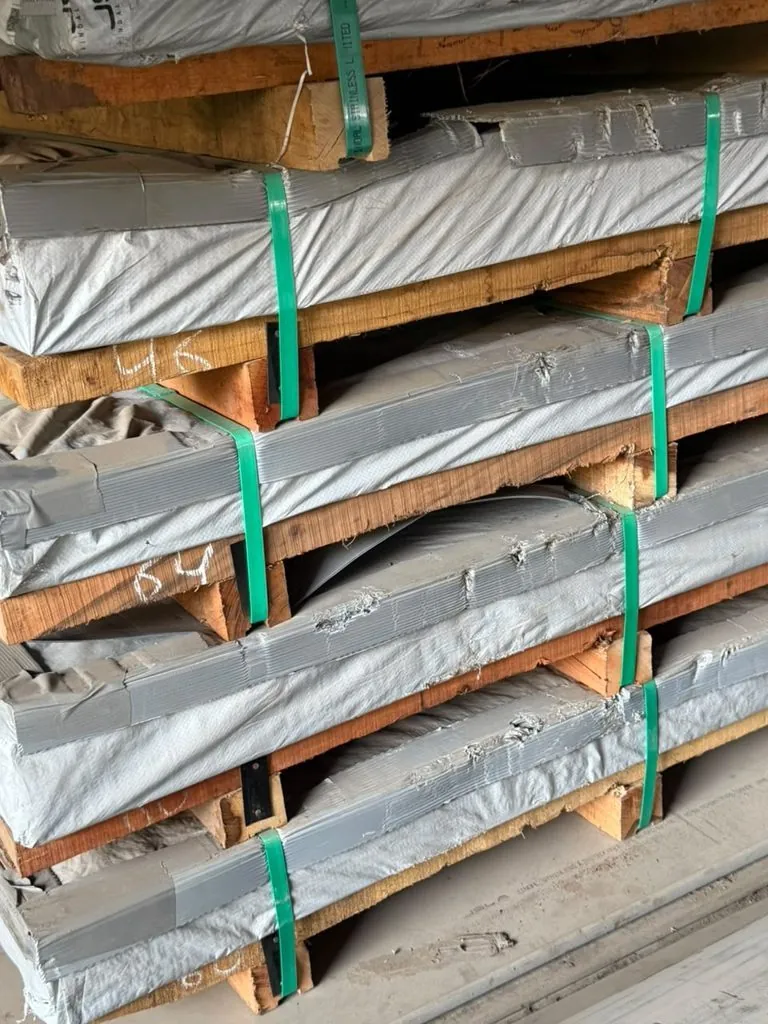
Importing corrosion-resistant steel is a documentation problem before it's ever a logistics problem. The Incoterm settles who pays and where risk passes; the mill test certificate is what makes the metal acceptable, not merely delivered. This guide runs the transaction in order, pairing every commercial action with the document that proves it, from the standpoint of a certified stockist-supplier shipping traceable stainless, nickel-alloy and PVQ steel to 36+ countries.
What You'll Need Before You Order Steel
Before requesting a quotation, pull together the inputs an supplier needs to price and certify the order correctly the first time. A complete brief cuts out the back-and-forth that delays dispatch, and it closes off the ambiguities that lead to disputes at receiving inspection.
- Grade, form and standard, e.g. 904L plate to ASTM A240, 316/316L stainless sheet, Incoloy 825, or A516 Gr 70 pressure-vessel plate. Give the UNS or Werkstoff number too, so there's no doubt about identity once it crosses the border.
- Quantity and dimensions, tonnage, thickness, width, length or OD/schedule, and tolerance.
- Destination, port and country of discharge, plus the delivery point you want.
- Required MTC level, EN 10204 3.1 (mill-certified) or 3.2 (independently witnessed).
- Importer registration, you'll need an Import Export Code (IEC) in India, or whatever the equivalent is in your country, before customs will release the consignment.
- Payment method, letter of credit, telegraphic transfer (advance/balance), or documents-against-payment.
- End-use requirements, any NACE MR0175 sour-service, PED, or third-party-inspection (TPI) condition. These add documents to the set.
Step 1: Specify the Material and Request an RFQ
Begin an RFQ (request for quotation) straight from the drawing or specification. Nandini Steel only quotes live pricing against an RFQ, so the quote is only as good as the RFQ itself. A complete one spells out the grade and UNS designation, the governing standard, the form, dimensions and tonnage, the MTC level you need, the destination port, and the Incoterm.
If you're still weighing grades, start by reading selecting the right stainless grade and the corrosion background it covers before you lock in the spec. Stepping up a grade costs far less than a failed part, or worse, a rejected consignment.
All Nandini products sit ex-stock, ready for immediate dispatch, and are made from genuine mill material sourced from Aperam, Outokumpu, Jindal, POSCO, Nippon Steel and JFE. Send your RFQ by email to reachus@nandinisteel.com or via WhatsApp at +91 99202 09184.
Step 2: Choose the Right Incoterm (2020)
What Incoterms Are
Incoterms® 2020 are the International Chamber of Commerce (ICC) rules that spell out, for each sale, who arranges and pays for carriage, who covers insurance, and the exact point where risk for the goods passes from seller to buyer. They don't settle title, payment, or which party clears customs beyond what each rule assigns. Agree the Incoterm and the named place in writing, "CIF Rotterdam" or "FOB (Indian port)." That named place is where the rule actually bites.
The Incoterms That Matter for Steel
| Term | Transport mode | Who pays freight | Who pays insurance | Risk transfers at | Best when |
|---|---|---|---|---|---|
| EXW (Ex Works) | Any | Buyer | Buyer | Seller's premises | Buyer has strong logistics at origin and handles export clearance |
| FCA (Free Carrier) | Any / container | Buyer | Buyer | Handover to buyer's carrier at the named place | Containerized/multimodal shipments; the modern replacement for FOB on FCL cargo |
| FOB (Free On Board) | Sea / inland waterway | Buyer | Buyer | Goods on board the vessel at the named port of shipment | Break-bulk or bulk sea freight where the buyer controls the ocean leg |
| CFR (Cost and Freight) | Sea / inland waterway | Seller | Buyer | Goods on board the vessel at the port of shipment | Seller books ocean freight but the buyer arranges its own marine insurance |
| CIF (Cost, Insurance and Freight) | Sea / inland waterway | Seller | Seller (minimum cover) | Goods on board the vessel at the port of shipment | Buyer wants the seller to arrange both freight and marine insurance to destination |
| CPT (Carriage Paid To) | Any / container | Seller | Buyer | Handover to the first carrier | Container equivalent of CFR for multimodal moves |
| CIP (Carriage and Insurance Paid To) | Any / container | Seller | Seller (all-risk cover) | Handover to the first carrier | Container equivalent of CIF, with higher default insurance cover |
| DAP (Delivered At Place) | Any | Seller | Seller (de facto) | Named destination, goods ready for unloading | Buyer wants delivery to its site but will handle import clearance and duty |
| DPU (Delivered at Place Unloaded) | Any | Seller | Seller | Named destination, after unloading | Seller is to unload at destination |
| DDP (Delivered Duty Paid) | Any | Seller | Seller | Named destination, import duties paid | Buyer wants fully landed delivery; the seller accepts import-clearance and duty liability |
How to Choose
Pick on three questions. First, mode: for containerized plate and fittings, FCA, CPT, and CIP describe risk more accurately than FOB, CFR, or CIF, which were written for goods crossing a ship's rail. Second, who controls freight: choose CIF when you want the supplier to arrange freight and marine insurance; go with FOB or FCA when your forwarder gets better ocean rates. Third, customs capability: avoid EXW unless you can clear export at origin. Treat DDP with care too, since it puts foreign import duty and clearance on the seller.
Step 3: Agree Price, Payment and the Proforma Invoice
Proforma vs Commercial Invoice
A proforma invoice is the supplier's formal offer: grade, quantity, unit and total price, Incoterm, payment terms and validity. It goes out before the order is confirmed, and a buyer relies on it to open a letter of credit or line up financing. The commercial invoice is different, it's the definitive document issued after shipment, the one customs uses to value the consignment. Description, quantity and value need to match across both. If they don't, clearance stalls.
Payment Terms
International deals usually run on one of three terms: an irrevocable letter of credit (L/C), telegraphic transfer with advance and balance against documents (TT), or documents-against-payment or acceptance (DP/DA). On large first orders, or when you're dealing with a new partner, the L/C earns its bank charges. It ties payment directly to presentation of conforming documents. TT advance/balance works better once trust is built between the parties, and it costs less. Whatever you choose, nail down the exact terms, currency and price basis in the proforma before committing.
Step 4: Confirm the Documentation Set
This is the core of the transaction. The document set has to do two jobs at once: clear customs and prove the metal matches what the drawing demands. Nandini Steel furnishes an EN 10204 3.1/3.2 mill test certificate with every order, alongside the commercial document package.
| Document | Issued by | What it proves | Needed for |
|---|---|---|---|
| Proforma invoice | Supplier | The agreed offer: grade, price, Incoterm, terms | Opening an L/C, arranging finance |
| Commercial invoice | Supplier | Final transaction value and goods description | Customs valuation and duty |
| Packing list | Supplier | Piece count, weights, package/bundle marks | Reconciliation at discharge; clearance |
| EN 10204 3.1 / 3.2 mill test certificate (MTC) | Mill / independent inspector | Chemical composition, mechanicals and heat number against the ordered standard | Traceability and material acceptance |
| Certificate of origin (CO) | Chamber of commerce / authority | Country where the steel was produced | Duty assessment and preferential tariffs |
| Bill of lading / air waybill | Carrier / line | Receipt of goods and contract of carriage; title (B/L) | Taking delivery; L/C negotiation |
| Insurance certificate | Insurer | Marine cover for the consignment | Required under CIF / CIP |
| Third-party inspection report | TPI body (SGS, Bureau Veritas, TÜV SÜD, DNV, ABS) | Independent witness of material/dimensions | Orders demanding witnessed inspection |
| PMI / NDT report | Mill / inspector | Positive material identification; UT/RT results | Grade confirmation and soundness where specified |
| HS-code declaration | Supplier / importer | Tariff classification of the product | Customs clearance and duty rate |
MTC: 3.1 vs 3.2: Which to Demand
The EN 10204 3.1 mill test certificate is the default for most corrosion-resistant and PVQ orders; a 3.2 is required when a second party or the end client must independently witness and counter-sign the results. Learn to read one with our guide on how to read a mill test certificate, and see the full picture of MTC, PMI, UT and RT testing.
| Level | Certified / validated by | Independent of production? | When to demand |
|---|---|---|---|
| EN 10204 3.1 | The manufacturer's authorized inspection representative, independent of the production department | Internal to the mill | Standard requirement for most CRA and PVQ orders |
| EN 10204 3.2 | The mill's representative and an independent inspector (or the purchaser's agent), both signing | Yes, a second party witnesses | Critical service, client-mandated TPI, or regulated pressure equipment |
The MTC certifies the heat against a standard such as ASTM A240 / ASME SA-240 for stainless flat products, ASTM B424 for nickel-alloy sheet and plate, or ASTM A516 / ASME SA-516 for pressure-vessel plate. Where the end-use is sour, cite NACE MR0175 sour-service requirements on the order so the heat is supplied in the qualified condition.
Step 5: Classify the Steel (HS / HSN Code) and Understand Duty
The HS code is how the World Customs Organization classifies a product, with the first six digits set internationally; importing countries then tack on further digits of their own (an HSN, in India's case). That code decides the duty rate, pulls in any anti-dumping measures, and shapes the paperwork, get the classification vague or wrong and you're looking at duty disputes and clearance delays. The importer carries final responsibility for the declaration in its own country, but the supplier still owes it a consistent code across the invoice and packing list. Stainless flat products, nickel-alloy products and PVQ carbon plate land in different chapters entirely, so classification has to account for material and form both.
| Product | Indicative HS chapter / heading | Note |
|---|---|---|
| Stainless steel flat products (sheet, plate, coil) | Chapter 72, headings 7219 / 7220 | By width and whether hot- or cold-rolled |
| Stainless steel long products (bar, wire) | Chapter 72, headings 7221 / 7222 / 7223 | By form and finish |
| Nickel-alloy products (Incoloy, Inconel, Hastelloy) | Chapter 75, headings 7505 / 7506 | Classified as articles of nickel, not steel |
| PVQ / carbon-steel plate (A516 Gr 70) | Chapter 72, headings 7208 / 7225 | By alloy content and thickness |
Treat these figures as indicative only. Confirm the exact code and duty with your own customs broker before you commit, since national sub-headings and tariff concessions vary. Nandini Steel's GSTIN is 27ADJPA7240C1Z0.
Step 6: Inspection, Dispatch and Shipping
With documents agreed, the order moves to inspection and dispatch. If the specification calls for third-party inspection, nominate the body (SGS, Bureau Veritas, TÜV SÜD, DNV or ABS) and state whether it's a witness point or a review point before dispatch. Confirm that each plate or bundle is marked and heat-number stamped. That stamp has to be reconciled to the MTC later, and this is the backbone of heat-number traceability. Agree on packing suited to sea freight: seaworthy crates or bundles, edge protection, moisture control. Decide too whether the move is full-container (FCL) or less-than-container (LCL). The carrier then issues the bill of lading or air waybill, and you track the consignment to the port of discharge.
Common Pitfalls and Warnings
Mismatch the Incoterm to the party who can actually perform it, and trouble follows. Accepting DDP shifts foreign import-duty and clearance liability onto a party that may not even be registered to bear it. Agree to EXW instead, and the buyer can end up unable to clear export at origin.
Then there's the certificate swap. A 3.1 isn't a 3.2. Regulated or witnessed work calls for an independently witnessed certificate, and a mill-only one simply won't do, no matter how official it looks.
Heat numbers matter too. If the stamp on the plate doesn't reconcile to the heat or cast number on the MTC, the material isn't traceable. The paperwork can say whatever it wants. And a vague HS code is its own trap: an imprecise classification invites a duty dispute and holds the consignment at customs.
No certificate of origin? That alone can forfeit preferential duty, and missing or incorrect papers will often stall clearance entirely.
Then there's the letter of credit problem. Banks only pay against documents that match, exactly. If the invoice, bill of lading, and packing list don't agree on description or quantity, payment stalls.
Watch out, too, for a "mill TC" that's actually just a trader's retype. Insist on the genuine mill certificate tied to the heat. A re-keyed summary isn't traceable material.
How to Verify What You Received
When the steel lands, check it off in this order before you sign off:
- Match the stamp to the certificate. Reconcile the heat or cast number stamped on the plate against the number listed on the MTC.
- Check composition and mechanicals. Confirm the MTC values sit within the ordered standard, A240/SA-240, B424, A516/SA-516, whichever applies.
- Run PMI on arrival. Positive material identification confirms the grade actually matches what was ordered, and it's what catches a substituted or mislabelled heat before it goes further.
- Check origin and classification, confirm the certificate of origin and the HS code match the consignment.
- Reconcile the paperwork, packing list against bill of lading against the physical count.
For the detail behind each step, see how to read a mill test certificate and MTC, PMI, UT and RT testing.
What This Looks Like at Nandini
Nandini Steel has stocked, supplied and exported corrosion-resistant and PVQ steel since 2003, more than 20 years now, with 307+ projects delivered for 260+ clients across 36+ export countries. The company holds ISO 9001:2015 certification as a specialist in 904L, Alloy 28, Incoloy 800 and Hastelloy plate (Certificate No. 1283438, issued by Unitas Certification Services (UCS-UK), valid to 11 January 2028). Every order ships from ex-stock material, and each comes with an EN 10204 3.1/3.2 mill test certificate traceable to its heat.
Buyers routinely order "Inconel 825" when what they actually need is Incoloy / Alloy 825 (UNS N08825), a Ni-Fe-Cr alloy. It's an avoidable mix-up. Get the designation right on the purchase order, the MTC and the HS declaration, and you sidestep a receiving-inspection argument along with a customs classification query. The identity has to read the same on every document, full stop, before anyone cuts the heat.
Grades You Can Import This Way
- 904L plate, a super-austenitic, copper-bearing grade built for sulfuric acid service and high-chloride environments
- 316/316L stainless, the molybdenum-bearing workhorse for moderate chloride service
- Incoloy 825, a Ni-Fe-Cr alloy built for mixed-acid and sour-gas service. People often get the name wrong and call it "Inconel 825."
- A516 Gr 70 pressure-vessel plate, PVQ carbon plate. For sour service, there's NACE HIC-tested plate.
End-use often decides what extra documents you'll need. Fertilizer/acid-service, pharmaceutical and pulp & paper duties each come with their own certification triggers.
FAQ
FOB or CIF, which is better for importing steel?
Do I need a letter of credit to import steel?
What is the difference between an EN 10204 3.1 and a 3.2 certificate?
What HS code applies to stainless steel plate?
How much import duty will I pay on steel?
Is there a minimum order quantity for export?
Request a Quotation
Nandini Steel's Engineering Team will send you a quotation and the full document set once you share your grade, form, standard, dimensions, tonnage, destination port, required Incoterm, and MTC level. Every order ships ex-stock for immediate dispatch, drawn from genuine mill material, and comes with an EN 10204 3.1/3.2 mill test certificate.
- Email: reachus@nandinisteel.com
- Phone: +91 22 43404600 · +91 9920209184
- WhatsApp: +91 99202 09184
- Address: 25, Dreamland Building, 601, 6th Floor, Mama Parmanand Marg, Charni Road, Opera House, Girgaon, Mumbai, Maharashtra 400004, India
- GSTIN: 27ADJPA7240C1Z0