
The practical rule that organizes this page: you do not buy "a stainless steel", you buy resistance to a specific named mechanism. Identify the mechanism your service environment will throw at the metal, and the grade follows. Every section below names a mechanism, explains how it attacks, lists the factors that drive it, maps it to the grades that fail and resist, and routes you to the deep page and the standard that proves the choice.
What is corrosion in stainless steel and nickel alloys?
Stainless steels and nickel alloys aren't inert. They're passive. Chromium (and, in nickel alloys, chromium paired with nickel and molybdenum) reacts with oxygen to form a thin, self-healing chromium-oxide layer called the passive film. That film, not the bulk metal, does the work of resisting attack. A "type of corrosion" is just a particular way a service environment beats that film: chlorides punch through it (pitting, crevice), tensile stress tears it open under chloride exposure (SCC), heat strips chromium away from grain boundaries (sensitization), a dissimilar metal drains it electrochemically (galvanic), or a strong acid dissolves it faster than it can rebuild (general/acid attack).
Because the film is a chromium-oxide barrier, corrosion resistance comes down to composition. More chromium, molybdenum, nitrogen, copper and nickel gives you a tougher, more stable film. That's why grade selection is corrosion engineering, not a side detail. For how each element contributes, see the role of alloying elements. For the family structure behind it, check stainless steel metallurgy. And for how the film forms and gets restored, there's the passive film.
The main types of corrosion at a glance
This table sets the course for the entire corrosion cluster. Find the mechanism matching your environment, check the at-risk and resistant grades, then follow the deep-dive link.
| Corrosion type | How it attacks | Trigger environment | Most at-risk grade | Grade that resists | Deep dive |
|---|---|---|---|---|---|
| Pitting | Chlorides puncture the passive film at discrete points, boring narrow holes | Chloride solutions, seawater, heat | 304 (PREN ~18) | 904L, Incoloy 825 | pitting corrosion |
| Crevice | Same chloride chemistry as pitting, concentrated inside a shielded gap | Gaskets, flange faces, lap joints, deposits | 304, 316 | 904L, Incoloy 825 | crevice corrosion |
| Stress-corrosion cracking (SCC) | Tensile stress + chloride + heat crack the metal through the passive film | Hot chloride service under load | 304, 316 (austenitic) | 904L, Incoloy 825, duplex | stress-corrosion cracking (SCC) |
| Intergranular (IGC) / sensitization | Chromium carbides precipitate at grain boundaries, starving them of chromium | Welding or holding at 425–815 °C | 304, 316 (standard-carbon) | 304L / 316L, stabilized 321 / 347 | intergranular corrosion & sensitization |
| Galvanic | A dissimilar, less-noble metal is sacrificed to protect the more-noble one | Two metals + an electrolyte in contact | The less-noble metal in the couple | Isolate, match, or choose the noble metal | galvanic corrosion |
| General / uniform & acid attack | Even, predictable film loss across the whole surface | Strong reducing acids (e.g. sulfuric) | 304, 316 | 904L (Cu-bearing), Incoloy 825 | sulfuric-acid resistance |
| Sour-service (H2S) cracking | Hydrogen from H2S embrittles and cracks the metal (SSC / HIC) | Wet H2S, sour oil & gas | Hard or non-qualified steels | Incoloy 825, A516 Gr 70 HIC plate | sour-service corrosion |
Localized vs general corrosion
The first split an engineer should make is between general and localized attack. Risk profiles for the two couldn't be more different.
General / uniform corrosion eats away metal evenly across the surface. You can see it, measure it, and predict it, which means you can estimate a corrosion allowance and design around the problem. The usual culprit is acid attack on a grade that was under-specified from the start.
Localized corrosion is a different animal. Pitting, crevice attack, SCC, intergranular corrosion, galvanic corrosion, these concentrate on tiny spots while the rest of the surface stays bright and looks fine. This is where corrosion-resistant alloys really get into trouble. A component might lose only a few grams of metal, yet still perforate, crack straight through the wall, or fail outright. Bulk weight loss won't give you any warning.
For stainless and nickel alloys, most unexpected field failures trace back to localized attack. Chloride-driven pitting, crevice corrosion and SCC are the usual suspects. The rest of this page works through each mechanism in that order.
Pitting corrosion
Definition. Pitting is localized attack that bores narrow, deep holes through an otherwise intact passive film. Mechanism. Chloride ions adsorb at weak points in the chromium-oxide film, break it down locally, and set up a self-sustaining acidic micro-cell inside the growing pit. Driving factors: chloride concentration, temperature, low pH, and the grade's molybdenum content (captured by PREN). Grades. 304 is susceptible to pitting because its PREN is only ~18 and it carries no molybdenum; 316 stainless resists pitting better thanks to 2–3% Mo (PREN ~24); 904L super-austenitic (PREN ~34) and Incoloy 825 resist chloride pitting in service where austenitics fail. The common field error is defaulting to 304 for chloride-adjacent or coastal duty, where it pits, confirm the actual service chlorides before choosing 304 over 316.
Go deeper into the mechanism and the test data in pitting corrosion, and look at how resistance gets scored in pitting resistance equivalent (PREN).
Crevice corrosion
Crevice corrosion is driven by the same chloride attack as pitting, but it starts in shielded gaps instead: under gaskets, at flange faces, in lap joints, beneath deposits or biofilm. Oxygen inside the gap gets used up and nothing replaces it. The trapped electrolyte turns acidic and chloride-rich, and the passive film gives way inside that pocket. Several things push it along: how tight the crevice is (tighter means worse), chloride levels, temperature, and stagnant conditions. The environment inside a crevice is harsher than the open surface, so this kind of attack kicks in at a lower temperature than pitting does on the same grade.
304 and even 316 can suffer crevice attack in warm chloride service. Moving up to 904L or Incoloy 825, and designing out tight gaps altogether, pushes that threshold higher.
See crevice corrosion for gap-geometry effects and gasket-selection guidance.
Stress-corrosion cracking (SCC)
Sudden cracking that branches as it goes, that's SCC, and it needs three things at once: sustained tensile stress, chlorides, and heat (usually above roughly 50–60 °C). The mechanism is straightforward enough. Chloride attacks the crack tip, tensile stress pulls it open, whether that stress came from service loads or got baked in by welding, forming, or bolt-up, and the crack works its way through the wall while the surface keeps looking bright and untouched. Three things govern how fast this happens: how much tensile stress is present, how concentrated the chlorides are, and the temperature.
Standard austenitics don't hold up well here. 304 and 316 are both prone to chloride-SCC; it's the textbook failure mode for austenitic stainless in hot chloride environments. Nickel content changes the picture, though. Push it higher and the SCC threshold rises with it, which is why 904L holds up better than 316L against chloride-SCC. When chloride cracking is a real possibility, the usual moves are Incoloy 825, thanks to its high nickel content, or one of the duplex stainless steels.
Deep dive, including the stress/temperature thresholds, in stress-corrosion cracking (SCC).
Intergranular corrosion and sensitization (IGC)
Definition. Intergranular corrosion is preferential attack along grain boundaries once the steel's been sensitized. Mechanism. Hold standard-carbon austenitic stainless in the 425–815 °C range, most often inside the weld heat-affected zone, and chromium combines with carbon to precipitate chromium carbides at the grain boundaries. The metal right next to those boundaries ends up depleted in chromium, dropping below the roughly 11% needed for passivity, and it corrodes selectively. In the HAZ this shows up as weld decay. Driving factors: carbon content, time at temperature, and cooling rate. Prevention (preventedBy): specify a low-carbon L grade (304L / 316L, C ≤ 0.03%). Or pick a stabilized grade (321 / 347), where titanium or niobium ties up the carbon as carbides instead. Another option: restore the microstructure through solution annealing.
For welded fabrication held or cycled through that range, specify 304L or 316L to dodge sensitization without post-weld annealing. The mechanism and the fix each get their own writeup: see intergranular corrosion & sensitization and the solution annealing remedy. Filler-metal strategy is covered separately in weld decay. Verification comes down to one test: ASTM A262.
Galvanic corrosion
Definition. Galvanic corrosion happens when two dissimilar metals get electrically connected in a shared electrolyte, forming what's called a galvanic couple. Mechanism. The more noble metal, the cathode, comes out protected. The less noble one, the anode, corrodes faster than it would on its own. The bigger the potential difference and the smaller the anode area, the worse the damage gets. Driving factors: the potential gap between the two metals, the area ratio (a small anode paired with a large cathode is the dangerous setup), and how conductive the electrolyte is. Control: Avoid pairing metals that are too far apart. Isolate dissimilar metals electrically using gaskets, sleeves, or coatings. Keep the anode large relative to the cathode, or pick materials that sit close together on the galvanic series. Stainless steel and nickel alloys are usually the noble partner in a couple, so the real danger tends to fall on whatever metal is bolted or welded to them: carbon steel, aluminum.
Full galvanic-series guidance in galvanic corrosion.
General / uniform corrosion and acid attack
Definition. General corrosion is near-uniform metal loss across the whole wetted surface. For corrosion-resistant alloys it matters most as acid attack, where a reducing acid dissolves the passive film faster than it can reform. Mechanism. In strong reducing acids such as sulfuric, the chromium-oxide film is not stable and the metal thins evenly. Driving factors: acid type, concentration and temperature. Grades. 304 and 316 have limited acid resistance; 904L adds ~1.5% copper to its ~4.5% Mo chemistry, which specifically improves resistance to sulfuric acid, and Incoloy 825 resists both reducing and oxidizing acids, the reason it is chosen over 316L/904L in mixed-acid duty. The classic error is reaching for Alloy 20, 625 or titanium when 904L already covers the acid concentration/temperature at lower cost; check the service against the 904L iso-corrosion limits first.
Acid-specific selection in sulfuric-acid resistance.
Sour-service (H2S) corrosion and cracking
Definition. Sour service is any wet environment containing hydrogen sulfide (H2S), typical of sour oil and gas. The risks are sulphide stress cracking (SSC) and hydrogen-induced cracking (HIC). Mechanism. H2S drives atomic hydrogen into the steel, where it embrittles the lattice (SSC in hard microstructures) or blisters and cracks at inclusions (HIC). Driving factors: H2S partial pressure, pH, chlorides, temperature and material hardness. Control standard: NACE MR0175 / ISO 15156 governs the qualified materials and maximum hardness for sour service. Grades. Incoloy 825 resists sour service and conforms to NACE MR0175/ISO 15156; for pressure-vessel plate, the A516 Gr 70 HIC plate variant resists hydrogen-induced cracking and requires HIC testing per NACE TM0284 (not plain Gr 70). Cite NACE MR0175 / ISO 15156 on the order so the heat is supplied in the qualified condition.
Full sour-service selection in sour-service corrosion.
How corrosion resistance is measured and specified
Resistance to chloride pitting and crevice attack is measured with a single figure: the Pitting Resistance Equivalent Number, or PREN.
PREN = %Cr + 3.3 × %Mo + 16 × %N
Higher PREN means a more stable passive film in chlorides. The ladder below is the hub's central comparison asset. It's why moving up the grade range buys measurable chloride resistance.
| Grade | Approx. PREN | Resists | Typical service |
|---|---|---|---|
| 304 / 304L | ~18 | Mild, non-chloride environments | General fabrication, architectural, food/dairy |
| 316 / 316L | ~24 | Moderate chlorides (2–3% Mo) | Marine, chemical, pharma, food |
| Duplex 2205 | ~35 | Chloride pitting + SCC (high strength) | Tanks, piping, chloride service under load |
| 904L | ~34 | Chloride pitting/crevice + sulfuric acid | Sulfuric-acid plants, pharma, pulp & paper, FGD |
| Incoloy 825 | ~31–40 | Reducing & oxidizing acids + sour service | Sour oil & gas, mixed-acid, pollution control |
| Super-Duplex 2507 | ~43 | Severe chloride pitting/crevice | Seawater, offshore, high-chloride process |
PREN only ranks chloride resistance. It says nothing about acid attack, the SCC threshold, or sour-service suitability; for those you need the acid iso-corrosion data, the chloride-SCC limit, and NACE MR0175, respectively. Intergranular susceptibility gets checked on its own, through the ASTM A262 practice. These alloys are specified in the grade standards ASTM A240 / ASME SA-240, covering stainless sheet, plate, and coil, and ASTM B424, which covers Incoloy 825. A516 pressure-vessel plate falls under ASTM A516. For the full PREN method, see pitting resistance equivalent (PREN); for the plain-English version, there's the PREN explained guide.
Grade × corrosion-mechanism matrix
| Grade | Pitting | Crevice | Chloride SCC | IGC (as-welded) | Acid (sulfuric) | Sour (H2S) |
|---|---|---|---|---|---|---|
| 304 | Susceptible | Susceptible | Susceptible | Susceptible | Limited | Not for sour |
| 316 | Better than 304 | Susceptible (warm Cl⁻) | Susceptible | Susceptible | Limited | Not for sour |
| 316L | Better than 304 | Susceptible (warm Cl⁻) | Susceptible | Resists (C ≤ 0.03%) | Limited | Not for sour |
| 904L | Resists (PREN ~34) | Resists | Outperforms 316L | Resists (low C) | Resists (Cu-bearing) | Project-specific |
| Incoloy 825 | Resists | Resists | Resists (high Ni) | Resists (Ti-stabilized) | Resists (reducing + oxidizing) | Resists, NACE MR0175 |
| A516 Gr 70 HIC | n/a (carbon steel) | n/a | n/a | n/a | n/a | Resists HIC, NACE TM0284 |
Matching corrosion type to the right grade
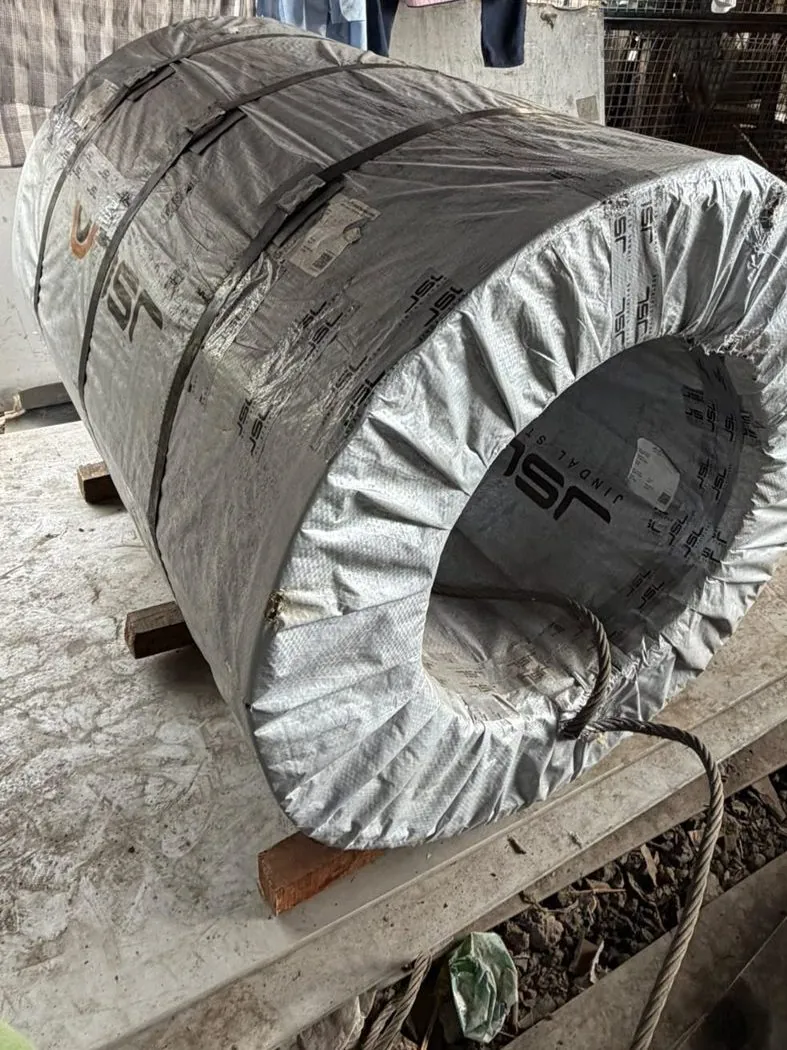
This is the conversion step: environment turns into mechanism, which turns into the grade and form Nandini Steel holds ex-stock to beat it, backed by the standard and mill certificate that prove it. Every grade listed below is genuine mill plate from Aperam, Outokumpu, Jindal, POSCO, Nippon Steel or JFE. Each order ships with an EN 10204 3.1 mill test certificate.
| Service environment | Mechanism to defeat | Recommended grade + form | Standard |
|---|---|---|---|
| Mild, dry, non-chloride | General only | 304 / 304L plate | ASTM A240 |
| Moderate chlorides, marine atmosphere | Pitting, crevice | 316 / 316L plate | ASTM A240 |
| Hot / concentrated chlorides, seawater | Pitting, crevice, SCC | 904L super-austenitic (plate / coil) | ASTM A240 |
| Sulfuric and mixed acids | General / acid attack | 904L or Incoloy 825 | A240 / B424 |
| Sour oil & gas (wet H2S) | SSC / sour cracking | Incoloy 825 (plate / coil) | ASTM B424 + NACE MR0175 |
| Sour pressure-vessel plate | Hydrogen-induced cracking | A516 Gr 70 HIC plate | ASTM A516 + NACE TM0284 |
Not sure which mechanism governs your service? Work it through with the grade selector, or walk through the step-by-step how to select a stainless grade guide. From there, match the grade to its end use through the oil & gas, chemical processing, marine and pressure vessels application hubs.
Preventing corrosion: design, grade and fabrication
Prevention comes down to four levers. Skip one of them, and that's usually where field failures come from.
- Step up the grade ladder to match the mechanism, not the budget. Match PREN and chemistry to the real chloride, acid or sour load, 304 → 316 → 904L → Incoloy 825, instead of defaulting to the cheapest austenitic.
- Beat sensitization at the weld. Pick a low-carbon L grade or a stabilized 321/347, or solution-anneal after fabrication, so the HAZ keeps its chromium. See how to prevent sensitization.
- Design out crevices and galvanic couples. Get rid of tight gaps, use full-penetration welds rather than lap joints, and electrically isolate dissimilar metals.
- Restore the passive film. Pickle and passivate after fabrication. This strips embedded iron and rebuilds a clean chromium-oxide layer.
FAQ
What is the difference between pitting and crevice corrosion?
Does 304 stainless steel rust or corrode?
What is the most corrosion-resistant stainless or nickel grade?
How do you prevent stress-corrosion cracking in stainless steel?
What is PREN and why does it matter?
Explore the corrosion cluster: pitting corrosion · crevice corrosion · stress-corrosion cracking · intergranular corrosion & sensitization · galvanic corrosion · PREN · sulfuric-acid resistance · sour-service corrosion
Nandini Steel is an ISO 9001:2015-certified stockist and supplier (established 2003) with the corrosion-resistant grades above held ex-stock for immediate dispatch and supplied with an EN 10204 3.1/3.2 mill test certificate on every order. Identify your mechanism, then request a quote for live pricing or run the grade selector.