
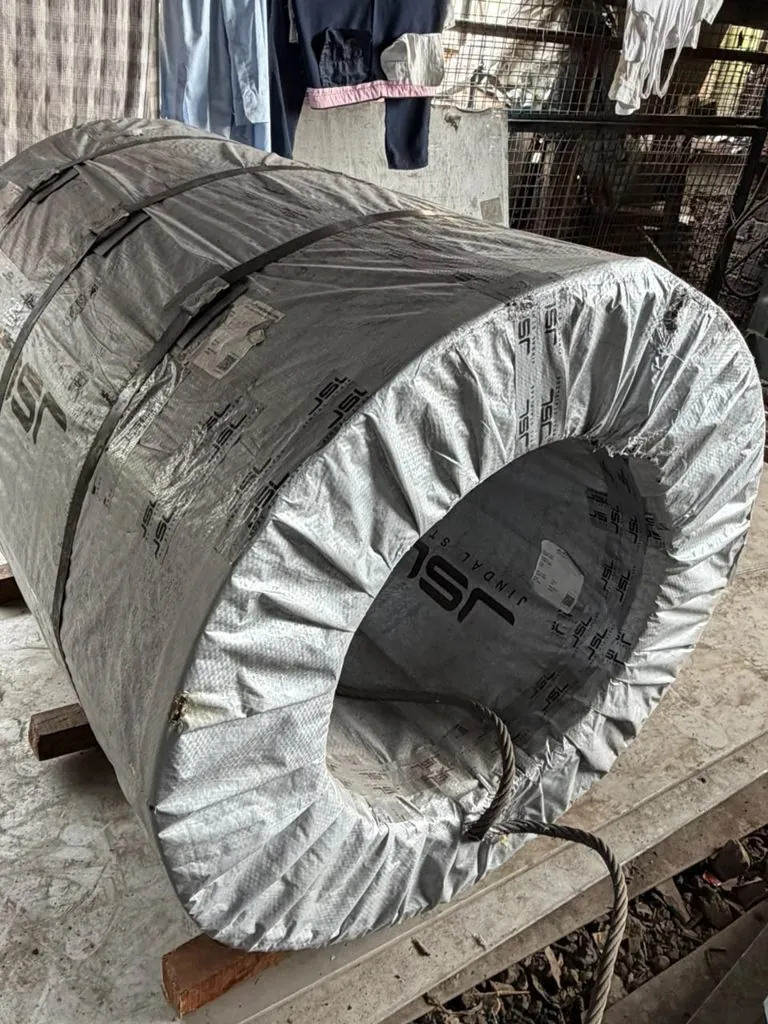
Key takeaways: Incoloy 825 coil at a glance
- Designation: UNS N08825 / W.-Nr. 2.4858, often mis-ordered as "Inconel 825"; it's a nickel-iron-chromium alloy, not stainless steel.
- Why it exists: This titanium-stabilized Ni-Fe-Cr chemistry stands up to sour service (H₂S) per NACE MR0175 / ISO 15156, and it shrugs off both reducing and oxidizing acids too. That's a step beyond what super-austenitic 904L or 316L can manage.
- Standard: ASTM B424 / ASME SB-424 covers Ni-Fe-Cr-Mo-Cu strip. Keep in mind, ASTM A240 doesn't cover N08825.
- Coil reality: 825 coil and strip aren't warehouse commodities. They come as a limited form, re-rolled or slit strip supplied for welded tube, re-roll, and lining feedstock. Most buyers end up wanting Incoloy 825 sheet or Incoloy 825 plate instead.
- Traceability: EN 10204 3.1/3.2 mill test certificate provided with every order.
"Inconel 825" vs Incoloy 825: clearing the name
Buyers routinely call this grade "Inconel 825," but no such alloy exists: it's Incoloy / Alloy 825 (UNS N08825), a Ni-Fe-Cr alloy. Inconel is a different family of nickel-chromium alloys entirely, 600, 625, 718. The mix-up has real commercial consequences. Get the designation right on the purchase order and the mill test certificate, and you'll avoid receiving-inspection disputes when the heat shows up stamped N08825. Weighing the two families against each other? See Incoloy 825 vs Inconel 625 and the grade overview, what is Incoloy 825.
What is Incoloy 825, and why in coil form?
Incoloy 825 is a titanium-stabilized nickel-iron-chromium (Ni-Fe-Cr) alloy built for harsh chemical and sour-gas service. The nickel content, around 42%, keeps chloride stress-corrosion cracking at bay. Chromium handles oxidizing acids. Molybdenum and copper cover reducing acids, sulfuric in particular, and that pairing is rare in a single alloy. Titanium stabilization ties up carbon, so the material stays resistant to sensitization once welded.
In coil and strip form the grade is specialized. Unlike stainless coil, which is a bulk commodity, N08825 strip is produced in limited quantities, typically re-rolled or slit to a specific gauge, and bought as feedstock for welded tube, re-roll and lining programs rather than off a stock rack. For most flat requirements, Incoloy 825 sheet or plate is the practical form; see the difference between sheet, plate and coil and the Incoloy 825 grade hub for the full form range.
Chemical composition (UNS N08825)
| Element | Symbol | Composition (wt %) |
|---|---|---|
| Nickel | Ni | 38.0–46.0 |
| Iron | Fe | ≥ 22.0 (balance) |
| Chromium | Cr | 19.5–23.5 |
| Molybdenum | Mo | 2.5–3.5 |
| Copper | Cu | 1.5–3.0 |
| Titanium | Ti | 0.6–1.2 |
| Carbon | C | ≤ 0.05 |
| Manganese | Mn | ≤ 1.0 |
| Silicon | Si | ≤ 0.5 |
| Sulfur | S | ≤ 0.03 |
| Aluminum | Al | ≤ 0.2 |
The role of molybdenum, copper and titanium
Molybdenum and copper drive the acid resistance here. Molybdenum deepens resistance to pitting and to reducing acids, and copper is what carries Incoloy 825 through sulfuric and phosphoric service that would eat through plain austenitic stainless. Titanium does a different job: it's the stabilizer. It ties up carbon as titanium carbide so chromium stays in solution, which keeps sensitization / intergranular corrosion from setting in at the weld heat-affected zone.
Mechanical properties (strip, annealed: ASTM B424)
| Property | Minimum (annealed strip) |
|---|---|
| Tensile strength | ≥ 586 MPa (85 ksi) |
| Yield strength (0.2% offset) | ≥ 241 MPa (35 ksi) |
| Elongation in 2 in. | ≥ 30% |
| Hardness | typ. ≤ 90 HRB |
For sour-service orders, confirm the hardness cap required by NACE MR0175 / ISO 15156 on the purchase order. That way the heat gets supplied and documented in the qualified condition.
Physical properties
| Property | Value |
|---|---|
| Density | 8.14 g/cm³ |
| Melting range | ~1370–1400 °C |
| Thermal conductivity (RT) | ~11.1 W/m·K |
| Mean CTE (20–100 °C) | ~14.0 µm/m·°C |
| Elastic modulus | ~196 GPa |
| Magnetic response | Non-magnetic (annealed) |
Corrosion behavior and suitability: why Incoloy 825 coil exists
Incoloy 825 gets the nod when the environment stacks hazards that would defeat any single lower-grade alloy. The real payoff is breadth: one chemistry that holds up in sour gas and across mixed acids alike.
Sour service and NACE MR0175
The alloy's high nickel content holds off sulfide stress cracking, and mills routinely supply it to NACE MR0175 / ISO 15156 for oil-and-gas work where H₂S is present. Cite the standard on the order. That way the strip arrives qualified, with hardness held to spec.
Acid resistance: sulfuric and phosphoric, reducing and oxidizing
Incoloy 825 owes its signature trait to copper and molybdenum working together: resistance to both reducing and oxidizing acids. That combination shows up in sulfuric-acid resistance service, and also in phosphoric-acid and fertilizer-regeneration duty, where chromium by itself (oxidizing) or molybdenum by itself (reducing) wouldn't hold up. It's this dual resistance that leads engineers to pick 825 over 316L or 904L for mixed-acid and sour-gas applications.
Pitting, crevice and chloride SCC
With a PREN of roughly 31–40, Incoloy 825 resists chloride pitting and crevice corrosion at a level comparable to 904L and duplex. Its real advantage over austenitic stainless is nickel-driven resistance to chloride stress-corrosion cracking, which limits 316L and 304 in hot chloride service. For 825, the sour-service and mixed-acid story matters more than raw PREN.
Sensitization resistance via titanium stabilization
Titanium ties up the carbon in Incoloy 825, so the alloy resists chromium-carbide precipitation through the 425–815 °C sensitization range. Welds and heat-affected zones stay corrosion-resistant, and there's no need for a post-weld solution anneal on every joint.
Equivalent grades and designations
| System | Designation |
|---|---|
| UNS | N08825 |
| Werkstoff (W.-Nr.) | 2.4858 |
| EN | NiCr21Mo |
| DIN | 2.4858 |
| BS | NA16 |
| JIS | NCF 825 |
| Common (mis)name | "Inconel 825" |
Full cross-reference is on the UNS / Werkstoff cross-reference.
Incoloy 825 vs the alternatives: when to choose it
Choose Incoloy 825 when sour service meets mixed acids and a super-austenitic stainless has reached its limit, but a full Ni-base alloy would be overkill for the job.
| Grade | PREN (approx.) | Choose when |
|---|---|---|
| 316L | ~24 | Moderate chloride / general chemical duty |
| 904L | ~34 | Sulfuric acid and high chloride, cost-sensitive |
| Incoloy 825 | ~31–40 | Sour service (H₂S) + mixed reducing/oxidizing acids |
| Alloy 20 | ~30 | Concentrated sulfuric acid specialization |
| Inconel 625 | ~50+ | Severe duty where 825 is outmatched |
vs Inconel 625
Inconel 625 carries far more molybdenum and a much higher PREN, so it wins out in the most severe pitting and high-temperature duty. That said, the cost premium often makes it overkill when 825 would do the job. See the full Incoloy 825 vs Inconel 625 comparison.
vs 904L, Alloy 20 and 316L
Against 904L and Alloy 20, Incoloy 825 is the choice when sour service (H₂S) is added to the acid exposure; against 316L it is a decisive step up in both chloride SCC and acid breadth. It also sits one rung above its sister grade, Incoloy 800, in wet corrosion.
Coil and strip: forms, gauges and supply reality
Incoloy 825 comes as sheet and plate; coil and strip exist too, but only in limited form. Strip gets produced to a specific gauge, re-rolled or slit for fabrication rather than kept as bulk stock.
| Attribute | Typical range |
|---|---|
| Strip thickness | ~0.3–3.0 mm (re-rolled / slit to order) |
| Strip width | Slit to requirement, up to mill width |
| Edge | Slit edge or mill edge |
| Supply basis | Feedstock for welded tube, re-roll and lining, supplied to order |
Other Incoloy 825 forms
For most flat requirements, order Incoloy 825 sheet or Incoloy 825 plate, both held ex-stock, or start at the Incoloy 825 grade hub.
Coil weight and how to calculate
Strip weight comes straight from density, 8.14 g/cm³. Here's what that means per running meter:
kg/m = thickness (mm) × width (mm) × 8.14 × 10⁻³
Full coil weight = kg/m × coil length (m).
| Thickness (mm) | Width (mm) | Weight (kg/m) |
|---|---|---|
| 1.0 | 500 | 4.07 |
| 1.5 | 600 | 7.33 |
| 2.0 | 1000 | 16.28 |
Use the coil weight calculator for exact figures, or check the grade selector to confirm the grade.
Finishes and temper
Incoloy 825 strip comes in a few forms: annealed and pickled, bright-annealed for clean welded-tube feedstock, or as-rolled when re-rolling happens downstream. Make sure your inquiry spells out the temper and surface you need, so the condition lines up with your forming or tube-mill process.
Standards and specifications complied
Incoloy 825 coil/strip conforms to ASTM B424 / ASME SB-424 (Ni-Fe-Cr-Mo-Cu plate, sheet and strip) and, for sour duty, to NACE MR0175 / ISO 15156.
Why ASTM A240 does not apply to N08825
ASTM A240 covers chromium and chromium-nickel stainless plate, sheet and strip. Incoloy 825 is a nickel alloy, not a stainless steel, so it is specified to the B-series (B424), not A240, a common spec error worth catching before the order is placed.
Testing, inspection and certification
Every order comes with an EN 10204 3.1/3.2 mill test certificate, covering heat chemistry and mechanical results and traced back to the producing heat. Ask, and we'll add intergranular-corrosion testing per ASTM A262, PMI to confirm Ni/Mo/Cu, eddy-current examination for strip, and NACE MR0175 hardness documentation for sour service work. For more, see testing, MTC, NDT and PMI, along with our MTC and quality assurance and mill test certificate process pages.
Applications of Incoloy 825 coil by industry
- Sour oil and gas service, downhole and surface tubing, liners and components for wells carrying H₂S.
- Petrochemical, heat-exchanger and process strip in mixed-acid streams.
- Chemical and acid processing, sulfuric and phosphoric acid handling.
- Fertilizer and acid-regeneration service, pickling-acid recovery and phosphoric-acid plants.
Welding and fabrication of Incoloy 825 strip
Incoloy 825 gets welded with the matching over-alloyed filler ERNiFeCr-1 (FM 65), which keeps corrosion resistance intact across the joint. When a stress-relief or stabilize anneal is called for, it's done near 940 °C. That's different from the solution anneal used for austenitic stainless; see stabilize annealing for more. This alloy work-hardens, so forming and slitting need to be planned with that in mind. For the full procedure, check how to weld Incoloy 825 and welding nickel alloys.
How we quote
Incoloy 825 coil and strip gets quoted to spec on request; we don't publish price bands, since gauge, width, edge, temper and test scope all shift the number. Send your thickness, width, standard (ASTM B424, plus NACE MR0175 if the application is sour), temper and quantity, and you'll get a firm offer. Nandini Steel has held ISO 9001:2015 certification since it was founded in 2003, and the numbers speak for themselves: 307+ projects delivered to 260+ clients across 36+ export countries. Every order ships as genuine mill material with full heat traceability and an EN 10204 3.1/3.2 certificate attached. Third-party certification also covers 904L, Alloy 28, Incoloy 800 and Hastelloy, the same Ni-Fe-Cr and nickel-base territory where Incoloy 825 lives.
Frequently asked questions
Is Inconel 825 the same as Incoloy 825?
Do you supply Incoloy 825 in coil form?
What standard covers Incoloy 825 strip?
Is Incoloy 825 suitable for sour service?
What is the PREN of Incoloy 825?
What filler is used to weld Incoloy 825?
Request a quotation. Send your Incoloy 825 coil/strip specification to reachus@nandinisteel.com, call +91 22 43404600 or WhatsApp +91 99202 09184 for a firm offer with EN 10204 3.1/3.2 certification. GSTIN 27ADJPA7240C1Z0. More: about Nandini Steel, certifications, contact.
Related grades to cross-shop
Part of our steel coil range.