Goal: What a Good Incoloy 825 Weld Must Achieve
The weld is the weakest link in an Incoloy 825 fabrication. A sound joint isn't enough. The weld metal and the heat-affected zone have to survive the same medium as the base metal does, sour gas and mixed acids, without turning into the first spot where the equipment gives out.
Define success up front. A good 825 weld is:
- Crack-free and fully fused, no hot cracking, porosity or lack of fusion (verified by LP and RT/UT).
- Corrosion-matched, the weld and HAZ retain Incoloy 825's resistance to reducing and oxidizing acids, with no sensitization or weld decay.
- Sour-service qualified, hardness and condition conform to NACE MR0175 / ISO 15156 where the equipment is in sour service.
- Chemically identical where it counts, positive material identification (PMI) confirms the deposited filler is genuinely nickel-iron-chromium, not a cheaper substitute.
Everything after this is about protecting that corrosion resistance at the weld line.
Why Incoloy 825 Welds Differently From Stainless Steel
Incoloy 825 is a Ni-Fe-Cr alloy (nickel 38–46%), not an austenitic stainless steel, and at the arc it shows. The weld pool runs sluggish and thick; it won't wet out and flow the way a 304 or 316 pool does, so joint geometry and bead placement demand real care. There's less chromium in the mix than stainless carries, and more nickel, and that shifts both the filler choice and the cracking risk.
Two metallurgical facts drive the whole procedure:
Incoloy 825 is titanium-stabilized. That ties up carbon and resists intergranular corrosion (sensitization) during welding, which is exactly why post-weld heat treatment usually isn't needed.
Nickel alloys also crack hot when restraint and heat run high. The fix is simple: weld cold and clean. Low heat input, low interpass temperature, stringer beads.
For the broader mechanism, see welding nickel alloys. There's a common mix-up worth flagging: buyers routinely ask for "Inconel 825", but that's not the correct name. The proper designation is Incoloy / Alloy 825 (UNS N08825, Werkstoff 2.4858). Get this right on the PO and the MTC. Doing so keeps receiving inspection from kicking back disputes.
Prerequisites & Inputs
Base Metal: Incoloy 825 Plate & Sheet
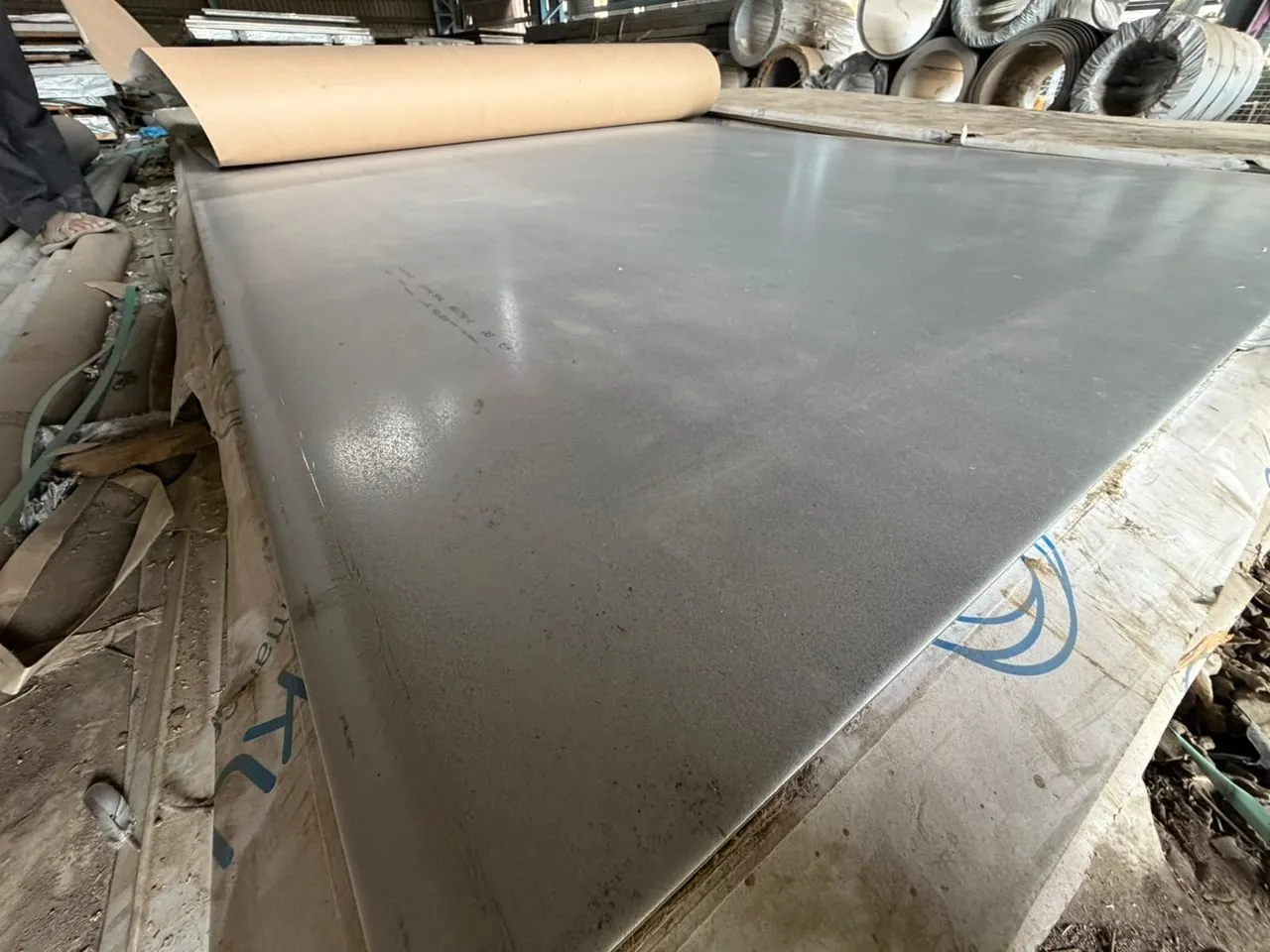
Start with genuine, solution-annealed Incoloy 825 flat product to ASTM B424 / ASME SB-424. Confirm the heat arrives in the correct condition, and make sure an EN 10204 3.1/3.2 mill test certificate comes with it. Nandini Steel includes a mill test certificate with every order, drawn straight from genuine mill plate. You can source the base metal as Incoloy 825 plate or 825 sheet from the Incoloy 825 grade hub.
Abbreviated composition (wt %, per ASTM B424 / N08825) is shown here only to explain hot-cracking risk and titanium stabilization. The full specification lives on the grade hub.
| Element | Ni | Cr | Fe | Mo | Cu | Ti | C |
|---|---|---|---|---|---|---|---|
| Range (wt %) | 38–46 | 19.5–23.5 | ≥ 22 | 2.5–3.5 | 1.5–3.0 | 0.6–1.2 | ≤ 0.05 |
The copper and molybdenum let 825 stand up to mixed acids. The titanium handles sensitization resistance. Both need to survive the weld intact.
Filler Metal: ERNiFeCr-1 (Filler Metal 65)
The matching filler for Incoloy 825 is ERNiFeCr-1, usually sold under the name Filler Metal 65 (FM 65). It's a nickel-iron-chromium wire, and it deposits weld metal that sits chemically close to the base alloy. Use it for GTAW and GMAW. If SMAW calls for a covered electrode instead, go with the nickel-base ENiCrMo-3 classification. Curious why you'd match the filler rather than over-alloy it? That reasoning is laid out in weld decay and filler selection.
| Process | AWS classification | Common trade name | Form | Use case |
|---|---|---|---|---|
| GTAW / GMAW | ERNiFeCr-1 (AWS A5.14) | Filler Metal 65 (FM 65) | Bare wire / rod | Matching filler for Incoloy 825 |
| SMAW | ENiCrMo-3 (AWS A5.11) | Inconel-625-class electrode | Covered electrode | Where a rod is not used; tolerant of dilution |
| Dissimilar (825 → CS/SS) | ERNiCrMo-3 (A5.14) / ENiCrMo-3 (A5.11) | 625-class | Wire / electrode | High-dilution joints to carbon or stainless steel |
Process & Shielding
GTAW handles the root and thin sections best; GMAW and SMAW take over for fill work on heavier plate. Shield with argon, a touch of helium helps fluidity on thick sections, and run an argon back-purge on root passes. Don't use an oxidizing shielding gas. CO₂ or oxygen additions will strip out the reactive elements and ruin the deposit.
Consumables & PPE
- Stainless-steel wire brushes dedicated to nickel alloys only (never previously used on carbon steel).
- Clean acetone or an approved degreaser, lint-free wipes.
- Purge dams, soluble purge film and an oxygen meter for the back-purge.
- Grinding discs reserved for CRA work.
Step-by-Step: How to Weld Incoloy 825
- Design the joint. Open the included angle wider than for stainless (roughly 70–75°) with a generous root opening, the viscous pool will not flow into a tight groove.
- Clean the joint. Degrease with acetone and remove all oxide for at least 25 mm each side of the joint. Grind out any thermally cut or oxidized metal back to bright material. A dirty joint is the number-one cause of porosity and weld decay.
- Set up the purge and fit-up. Fit purge dams and establish the argon back-purge on the root. Make tack welds with filler added, not autogenously.
- Preheat, none. Incoloy 825 needs no preheat. Warm the plate only enough to drive off moisture or condensation (around 15 °C minimum, surface dry).
- Run the root pass. GTAW with filler added, never autogenous, using a stringer bead and the back-purge live until several passes cover the root.
- Fill with low heat input. Keep heat input low, use stringer beads or at most a slight weave, and let the joint cool so interpass temperature stays at or below 150 °C. Keeping the interpass low is what keeps the HAZ from sensitizing.
- Clean between every pass. Grind or brush each bead and remove oxide before depositing the next pass. Do not let oxide become an inclusion.
- Cap and final clean. Deposit the cap, then remove all heat tint by pickling and passivating or by mechanical cleaning, residual tint is a corrosion site.
Welding Parameters at a Glance
| Parameter | Recommendation for Incoloy 825 |
|---|---|
| Processes | GTAW (root/thin), GMAW, SMAW |
| Filler metal | ERNiFeCr-1 / FM 65 (GTAW·GMAW); ENiCrMo-3 (SMAW) |
| Shielding gas | Argon (small He addition on thick section); no oxidizing gas |
| Back-purge | Argon on root passes, mandatory |
| Heat input | Low, minimize to limit HAZ time in the sensitization band |
| Interpass temperature | ≤ 150 °C (let the joint cool between passes) |
| Preheat | None, warm only to remove moisture (~15 °C, surface dry) |
| Bead technique | Stringer beads; slight weave at most; convex beads |
| PWHT | None normally; solution anneal only for severe service |
Pitfalls & Warnings: How Incoloy 825 Welds Fail
Hot Cracking
High restraint and high heat input together drive centerline and crater hot cracks in the nickel-rich weld metal. Weld cold to prevent it: low heat input, stringer beads, slightly convex bead profiles, good crater fill. Don't try to bridge gaps with a hot, slow weave.
Weld Decay & HAZ Corrosion
Though Incoloy 825 carries titanium stabilization against sensitization, that protection has limits. Push the HAZ through the 425–815 °C range too long, say from excessive heat input or high interpass temperatures, and chromium carbides can still precipitate out. The zone is then open to intergranular corrosion (sensitization).
The remedy isn't metallurgical. It's procedural. Keep the interpass temperature low and the heat input down. For more on this, see prevent sensitization.
Porosity & Oxide Inclusions
A dirty joint, a lost shielding envelope, or an inadequate purge will trap gas and oxide right in the deposit. So clean obsessively. Keep the arc short. And guard against drafts at every turn.
Heat Tint & Sugaring
An inadequate root back-purge lets the root oxidize, a condition welders call "sugaring," and it wipes out corrosion resistance right where the medium touches the weld. Keep the argon purge running until the root is covered and oxygen drops below a few hundred ppm. Strip any heat tint afterward.
| Defect | Cause | Fix |
|---|---|---|
| Hot cracking | High restraint + high heat input | Low heat, stringer, convex beads, fill craters |
| Porosity | Dirty joint, lost shielding | Degrease, short arc, draft protection |
| Weld decay / IGC | HAZ held in 425–815 °C band | Low heat input, interpass ≤ 150 °C |
| Heat tint / sugaring | Inadequate root back-purge | Argon purge until root covered; pickle/passivate |
Do You Need PWHT or Solution Annealing?
For most Incoloy 825 fabrications, no post-weld heat treatment is needed. Titanium stabilization, paired with a low-heat-input procedure, keeps the HAZ sound as-welded. A solution anneal (roughly 925–980 °C followed by rapid cooling) comes into play only for severe service conditions, or to restore properties after heavy cold forming; see solution annealing. Solution annealing a full component after welding is rarely practical once the equipment is fabricated. That's one more reason welding cold and clean matters so much.
Verification & Acceptance
Close the loop with testing that proves soundness and corrosion resistance alike.
- Visual and liquid penetrant (LP/PT) on every weld; RT or UT on pressure-retaining joints.
- PMI on the weld deposit and the filler wire to confirm the chemistry is genuinely ERNiFeCr-1.
- ASTM A262 intergranular-corrosion testing on a welded coupon to confirm the HAZ has not sensitized.
- NACE MR0175 / ISO 15156 hardness survey across the weld and HAZ for sour service / NACE MR0175.
For the full test regime and documentation, see PMI and NDT testing. Nandini Steel ships every order with an EN 10204 3.1/3.2 mill test certificate for the base plate. That gives you a traceable starting point for your weld-qualification records.
Dissimilar Welds: Incoloy 825 to Carbon or Stainless Steel
When joining Incoloy 825 to carbon or stainless steel, iron from the lower alloy dilutes the weld metal, and that dilution can starve the deposit of corrosion resistance. Use an over-alloyed nickel-base filler (ERNiCrMo-3 / 625-class) instead of the matching ERNiFeCr-1. The extra molybdenum and chromium tolerate dilution and keep the joint sound. Match the filler to the diluted chemistry, not to either base metal alone. For more on this, see weld decay and filler selection.
Related Grades & Where to Source
Incoloy 825 sits a step beyond the super-austenitic stainless grades on the pitting-resistance ladder. PREN climbs from 304 (~18) to 316 (~24) to 904L (~34), while Incoloy 825 lands around 31–40, a nickel-alloy move meant for combined acid and sour-gas duty. Its weldability, and the filler it takes, differs from its stainless cousins for that reason.
| Grade | Family | Matching filler | Key weld precaution |
|---|---|---|---|
| 316 / 316L | Austenitic SS | ER316L | Use L grade / low heat to avoid sensitization |
| 904L | Super-austenitic SS | ER385 / Ni-base (over-alloyed) | Over-match filler; control heat input |
| Incoloy 825 | Ni-Fe-Cr alloy | ERNiFeCr-1 (FM 65) | Interpass ≤ 150 °C; argon purge; no PWHT |
Welding a stainless grade instead? Check out how to weld 904L and welding 316 stainless. For the base metal itself, Nandini Steel keeps Incoloy 825 ex-stock and ready to ship, sold as Incoloy 825 plate and sheet. It's genuine mill plate too, with an EN 10204 3.1/3.2 mill test certificate on every order. Buyers pick Incoloy 825 for oil & gas (sour service), fertilizer / acid service and pulp & paper because it stands up to both reducing and oxidizing acids. The weld needs to carry that same rating. Request an RFQ for live pricing on 825 plate and sheet.
FAQ
What filler metal is used to weld Incoloy 825?
Is "Inconel 825" the same as Incoloy 825?
Do you need to preheat Incoloy 825 before welding?
Does Incoloy 825 need post-weld heat treatment?
How do you keep an Incoloy 825 weld's corrosion resistance?
What tests confirm a sound Incoloy 825 weld?
Nandini Steel has been working as an ISO 9001:2015-certified stockist and supplier of stainless, nickel-alloy and PVQ products since 2003. The company holds certified specialist status in 904L, Alloy 28, Incoloy 800 and Hastelloy plate. Need Incoloy 825 plate or sheet, along with matching documentation? Request an RFQ for live pricing. Reach the team by email at reachus@nandinisteel.com, on WhatsApp at +91 99202 09184, or in person in Mumbai, India.