
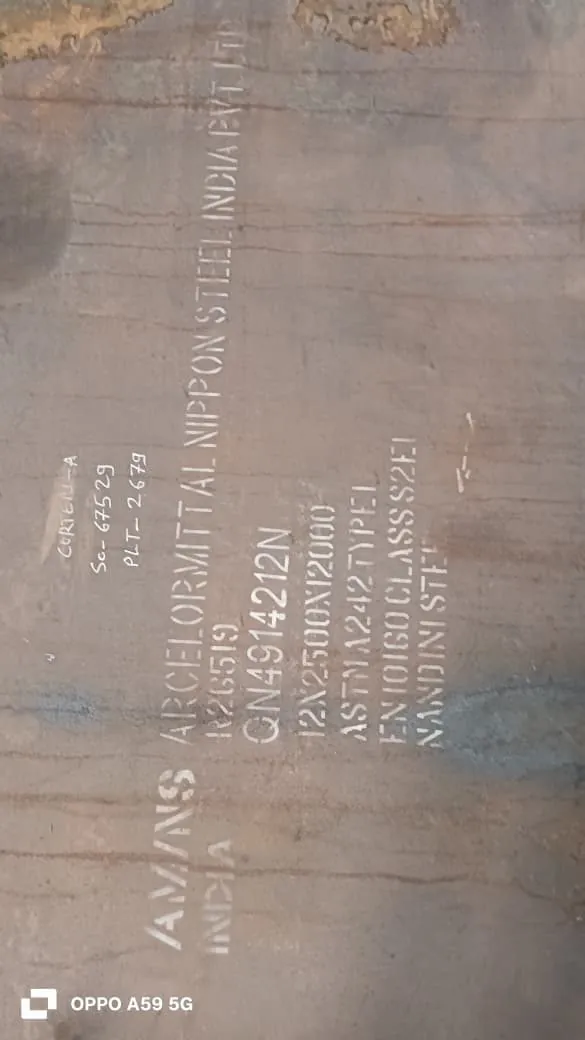
Scope: what ASTM B575 covers
ASTM B575 is the flat-product rulebook for the low-carbon Ni-Mo-Cr alloy family, the alloys most people know by the Hastelloy C trade names. It governs plate, sheet and strip supplied in the solution-annealed condition. Three things get pinned down here, and a buyer needs to agree with the mill on each: the chemical composition of every heat, the mechanical minima for the annealed product, and the test regime that proves out corrosion resistance. Cite B575 on a purchase order and the mill, the mill test certificate and the inspector all read from the same rules.
B575 is a product specification, not a grade name. It defines the form, not the bar, forging, pipe or fitting. For those, sibling ASTM specs apply; see the form map below.
Which UNS numbers B575 lists
The specification covers a cluster of low-carbon Ni-Mo-Cr alloys. The two most commonly ordered as plate and sheet are UNS N10276 (Hastelloy C-276) and UNS N06022 (Hastelloy C-22). B575 also lists related alloys in the same family, including UNS N06200 (Hastelloy C-2000), along with N06059, N06686 and N10362. All share a low carbon ceiling and a high molybdenum content, which together give the family its resistance to reducing and oxidizing media at once.
The alloys B575 governs: Hastelloy C-276 and C-22
Both C-276 and C-22 belong to the Ni-Mo-Cr branch of the nickel alloys. C-276 is the long-serving workhorse, a nickel-molybdenum-chromium alloy with tungsten added, built for the most aggressive reducing acids and wet-chlorine service. C-22 carries more chromium, which broadens its reach into strongly oxidizing media while keeping excellent resistance to localized attack. Where austenitic stainless or even 904L runs out of room, these alloys keep going.
Their defining trait is versatility across mixed media. They resist pitting and crevice corrosion far beyond any stainless grade, shrug off chloride stress-corrosion cracking, and hold up in both reducing acids and oxidizing ones. That is why a process engineer reaches for them when a single alloy has to survive an upset that swings between acid types. For the full grade detail, see Hastelloy C-276 and Hastelloy C-22.
Key requirements of ASTM B575
Chemical composition
B575 sets the element ranges below. Molybdenum and chromium do the heavy lifting on corrosion resistance, while the low carbon ceiling, backed by solution annealing, keeps grain boundaries free of chromium-carbide sensitization. Confirm the exact limits against the current revision when you place the order.
| Element | Min | Max |
|---|---|---|
| Nickel (Ni) | Balance | |
| Molybdenum (Mo) | 15.0 | 17.0 |
| Chromium (Cr) | 14.5 | 16.5 |
| Iron (Fe) | 4.0 | 7.0 |
| Tungsten (W) | 3.0 | 4.5 |
| Cobalt (Co) | - | 2.5 |
| Manganese (Mn) | - | 1.0 |
| Vanadium (V) | - | 0.35 |
| Carbon (C) | - | 0.01 |
| Silicon (Si) | - | 0.08 |
| Element | Min | Max |
|---|---|---|
| Nickel (Ni) | Balance | |
| Chromium (Cr) | 20.0 | 22.5 |
| Molybdenum (Mo) | 12.5 | 14.5 |
| Iron (Fe) | 2.0 | 6.0 |
| Tungsten (W) | 2.5 | 3.5 |
| Cobalt (Co) | - | 2.5 |
| Manganese (Mn) | - | 0.5 |
| Vanadium (V) | - | 0.35 |
| Carbon (C) | - | 0.015 |
| Silicon (Si) | - | 0.08 |
Mechanical properties
B575 sets the following minima for solution-annealed flat product. Check the exact figures against the current revision when you place the order, since minima can shift with product and section.
| Property | C-276 (N10276) | C-22 (N06022) |
|---|---|---|
| Tensile strength (min) | ≥ 100 ksi (690 MPa) | ≥ 100 ksi (690 MPa) |
| Yield strength 0.2% offset (min) | ≥ 41 ksi (283 MPa) | ≥ 45 ksi (310 MPa) |
| Elongation in 2 in. (min) | ≥ 40% | ≥ 45% |
Required condition and heat treatment
B575 flat product ships in the solution-annealed condition. The anneal dissolves intermetallic and carbide phases that would otherwise reduce corrosion resistance, then a rapid quench locks the structure in. Specify the solution-annealed condition explicitly on the order; it is a requirement of the spec, not an extra. For the metallurgy behind this, see solution annealing.
Dimensional tolerances and finish
Thickness, width, flatness and edge tolerances follow B575 and the general tolerance rules referenced for the product. Sheet and strip hold tighter gauge tolerances than plate does. State the mill finish and edge condition, mill, slit or sheared, on the order.
Forms and thickness ranges covered
B575 splits products by shape: flat forms fall under it, long or hollow ones do not. Plate is the heavy flat product, sheet is the thinner gauge, and strip is the narrow coiled version. Bar, forgings, tube, pipe and fittings sit outside B575's scope and get handed off to sibling product specs.
| Form | Specification | Use when |
|---|---|---|
| Plate, sheet, strip | ASTM B575 / ASME SB-575 | Flat product for vessels, liners, trays, scrubbers |
| Rod and bar | ASTM B574 | Machined parts, shafts, fasteners |
| Forgings | ASTM B564 | Flanges, forged fittings, bodies |
| Seamless pipe / tube | ASTM B622 | Heat-exchanger, condenser, process lines |
| Welded pipe / tube | ASTM B619 / B626 | Welded process piping |
| Wrought fittings | ASTM B366 | Buttweld elbows, tees, reducers |
| Flat form | Typical thickness | Nandini availability |
|---|---|---|
| Plate | ≥ 3/16 in. (4.76 mm) | Ex-stock, immediate dispatch |
| Sheet | < 3/16 in. down to light gauge | Ex-stock, immediate dispatch |
| Strip | Narrow coiled product | Ex-stock / indent per size |
Testing, inspection and certification to B575
Nandini Steel proves conformance to B575 through testing, and the mill test certificate is the document that carries that evidence. Every order ships with an EN 10204 3.1 / 3.2 mill test certificate, giving full heat and cast traceability. Details on certificate levels sit on the EN 10204 mill test certificate page, and a broader look at testing, MTC, NDT and PMI is available in the explainer.
| Test | Method | Requirement / purpose | When required |
|---|---|---|---|
| Tension test | ASTM B575 / E8 | Meets annealed tensile, yield, elongation minima | Every heat / lot |
| Intergranular corrosion (IGC) | ASTM G28 Method A / B | No intergranular attack after sensitizing exposure | Corrosion / acid service, when specified |
| Positive material identification | PMI (XRF / OES) | Confirms N10276 / N06022 chemistry | On request |
| Hardness | HRB / HRC | Within NACE MR0175 hardness limit | Sour service |
| Mill test certificate | EN 10204 3.1 / 3.2 | Documents conformance and traceability | Every order |
The IGC check for this family runs to ASTM G28, which uses a boiling ferric-sulfate or mixed-acid test rather than the ASTM A262 practices used for austenitic stainless. Call it out on the order and it is documented on the accompanying mill test certificate. Because these alloys are welded on nearly every job, review welding stainless and nickel alloys so the filler and heat input keep the as-welded corrosion resistance intact.
Sour-service add-on: NACE MR0175 / ISO 15156
B575 does not by itself qualify material for sour service. For wet-H2S duty, call out NACE MR0175 / ISO 15156 on the order so the heat is supplied in the qualified hardness condition. The cracking mechanisms this controls are covered in sour service. The Ni-Mo-Cr family is a frequent choice here precisely because it clears these limits where leaner alloys cannot.
ASME SB-575 and equivalent standards
The ASME Boiler & Pressure Vessel Code picks up B575 under the designation ASME SB-575 (Section II, Part B). When you are working on code vessels, cite SB-575. The chemistry and testing requirements do not change; they match ASTM B575 exactly. Designation systems vary, and the two lead UNS numbers map across them as shown below. For the complete table, see the UNS / Werkstoff / JIS cross-reference.
| System | Hastelloy C-276 | Hastelloy C-22 |
|---|---|---|
| UNS | N10276 | N06022 |
| Werkstoff / W.-Nr. | 2.4819 | 2.4602 |
| EN | NiMo16Cr15W | NiCr21Mo14W |
| ASME | SB-575 | SB-575 |
The flat-product analogue for stainless grades is ASTM A240 / ASME SA-240, a useful contrast when a project spans both stainless and nickel-alloy flat product. For A240 itself see ASTM A240. Neighboring nickel-alloy flat-product specs include ASTM B443 (Inconel 625) and ASTM B409 (Incoloy 800/825).
B575 vs B574 vs B564: one alloy family, different product specs
The same C-276 and C-22 chemistry shows up across several ASTM specs, divided by form. Order the wrong one, say B574 (bar) when plate is what you actually need, and that is a frequent reason material gets rejected at receiving. Match the spec to the form: B575 for flat product, B574 for bar, B564 for forgings, B622 for seamless pipe and tube, and B366 for wrought fittings.
Why engineers specify to ASTM B575
The Ni-Mo-Cr alloys get the call when one material has to stand up to more than one kind of attack. C-276 and C-22 resist both reducing and oxidizing acids, handle wet chlorine and hypochlorite, and shrug off the chloride stress-corrosion cracking that trips up austenitic stainless. Their pitting resistance sits far above any stainless grade, which is what keeps them serviceable in hot, high-chloride and mixed-acid streams. Specifying to B575 locks in the chemistry and the solution-annealed condition that make all of this possible. That is what gets the plate to arrive service-ready, not just Hastelloy-grade in name.
How to order Hastelloy plate and sheet to ASTM B575
Use this line-item checklist on the purchase order so nothing gets left to guesswork:
- Specification - ASTM B575 (or ASME SB-575 for code work).
- Grade / UNS - Hastelloy C-276 (N10276) or C-22 (N06022).
- Form - plate, sheet or strip.
- Dimensions - thickness x width x length (and finish/edge).
- Condition - solution-annealed.
- Test level - IGC per ASTM G28; NACE MR0175 hardness if sour service.
- MTC level - EN 10204 3.1 or 3.2.
- Marking - heat/cast number for traceability.
Request quotes against the grade hubs built to this family: Hastelloy C-276, Hastelloy C-22 and Hastelloy C-2000. For related forms we stock, see Hastelloy pipes, Hastelloy flanges, Hastelloy forged fittings and Hastelloy round bars. For flat-product mass the weight calculator does the job, and if you are still narrowing a corrosion-resistant alloy, try the grade selector.
From the Nandini Steel Engineering Team: on B575 orders, two spec gaps show up more than any others. The first is leaving the solution-annealed condition unstated, which matters most on welded fabrications where the as-welded corrosion resistance is on the line. The second is skipping the NACE MR0175 / ISO 15156 citation for sour duty, so the heat may not arrive in the qualified condition. Call both out on the PO, and if the service is acidic, name the ASTM G28 IGC test too.
Applications ordered to B575 flat product
Hastelloy C-276 and C-22 flat product to B575 covers the most aggressive acid, chloride and mixed-media duty.
- Chemical / acid processing - reactors, heat-exchanger plate, acid coolers.
- Pollution control and FGD - scrubber internals, ducting, wet-flue-gas liners.
- Oil and gas sour service - sour-gas internals and liners.
- Fertilizer / acid-regeneration service - phosphoric and sulfuric circuits.
- Pulp and paper - bleach-plant and chlorine-dioxide equipment.
FAQ
Is ASTM B575 the same as Hastelloy C-276?
What is the ASME equivalent of ASTM B575?
What is the difference between Hastelloy C-276 and C-22?
Does ASTM B575 cover bar or pipe?
Is NACE MR0175 required by ASTM B575?
Ready to specify? Request a quote for Hastelloy C-276 or C-22 plate, sheet or strip to ASTM B575 / ASME SB-575, supplied ex-stock with an EN 10204 3.1 / 3.2 mill test certificate. Call +91 22 43404600 or +91 99202 09184, message WhatsApp +91 99202 09184, email reachus@nandinisteel.com, or send your line-item checklist through the contact page. Nandini Steel is an ISO 9001:2015-certified stockist and supplier based in Mumbai, India, certified for Hastelloy plates. Founded in 2003, the company has more than 20 years of track record, with 307+ projects completed across 260+ clients in 36+ export countries.