
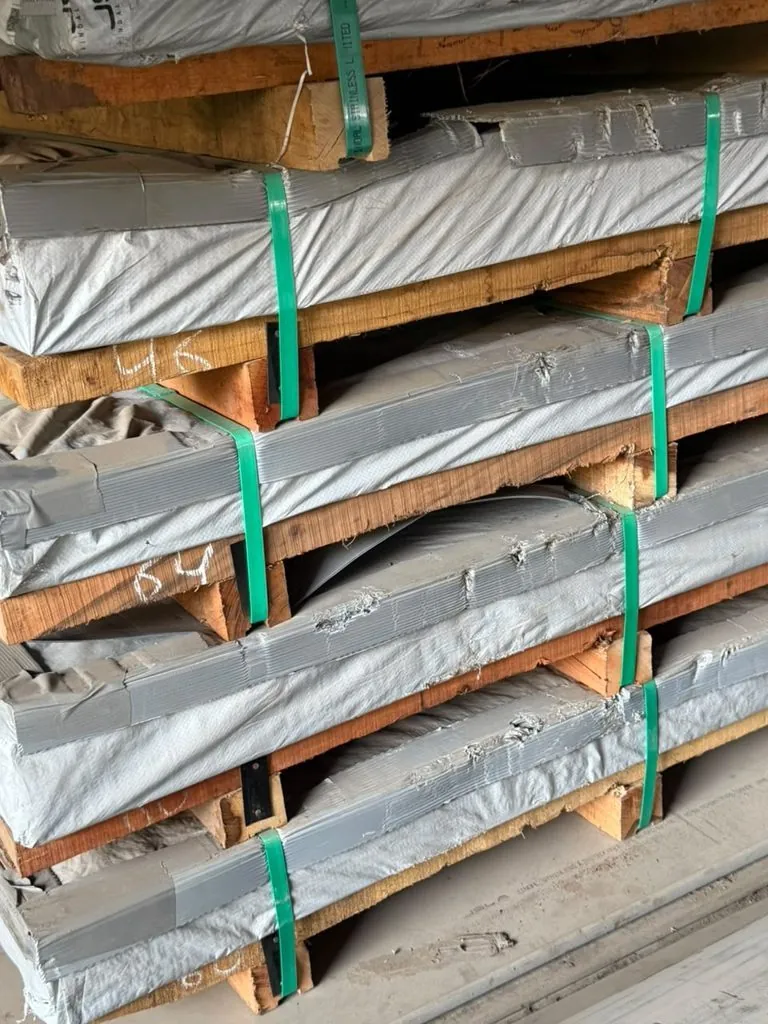
What ASTM B409 Covers
ASTM B409 is the flat-rolled product specification for nickel-iron-chromium alloys of the Incoloy 800 type, covering 800, 800H and 800HT only. It defines the requirements for plate, sheet and strip, including chemical composition, mechanical property minimums, the solution-annealed delivery condition, and permissible dimensions and tolerances. Buyers cite B409 on the purchase order and the mill test certificate so that receiving inspection can confirm the heat was supplied to the correct chemistry and condition.
These are Ni-Fe-Cr alloys, a family that sits between the austenitic stainless grades and the higher-nickel Inconel alloys. The 800-series variants are chosen mainly for high-temperature strength and oxidation resistance. The related alloy Incoloy 825, chosen for its combined resistance to reducing and oxidizing acids and to sour service, is a different plate, sheet and strip specification: ASTM B424, not B409. For the forged and fitting equivalents of the 800-series, the same chemistry is ordered under companion nickel-alloy specifications rather than B409.
Scope and Product Forms
| Attribute | ASTM B409 |
|---|---|
| Product forms | Plate, sheet and strip (hot and cold rolled) |
| Alloy family | Nickel-iron-chromium (Ni-Fe-Cr) alloy |
| Grades (typical) | Incoloy 800, 800H and 800HT |
| Delivery condition | Solution annealed |
| Primary use | High-temperature strength, acid and sour-service corrosion resistance |
| Companion plate spec | ASTM B424 / ASME SB-424 for Incoloy 825 |
Nandini Steel is a certified specialist in Incoloy 800, and every plate, sheet and strip order ships ex-stock for immediate dispatch. See the dedicated Incoloy 825 plate, Incoloy 825 sheet and Incoloy 800 alloy pages for sizes and finishes.
Grades and Designations
The three B409 grades share a Ni-Fe-Cr base but serve progressively hotter duty. Incoloy 800 is a general high-temperature grade. 800H has a controlled higher carbon range and grain size for creep strength, and 800HT adds a tighter titanium-plus-aluminum control for sustained service above about 600 degrees C. The related alloy Incoloy 825 is a different, titanium-stabilized grade alloyed with molybdenum and copper for aqueous corrosion resistance, and it is specified under ASTM B424, not B409.
A common ordering error is calling Alloy 825 "Inconel 825." The correct designation is Incoloy, or Alloy 825, under UNS N08825, ordered under ASTM B424. Getting the name and the spec number right on the purchase order and the mill certificate avoids receiving-inspection disputes.
| Grade | Family | UNS | Werkstoff | Primary driver |
|---|---|---|---|---|
| Incoloy 800 | Ni-Fe-Cr alloy | N08800 | 1.4876 | High-temperature strength and oxidation resistance |
| Incoloy 800H | Ni-Fe-Cr alloy | N08810 | 1.4958 | Creep and rupture strength |
| Incoloy 800HT | Ni-Fe-Cr alloy | N08811 | 1.4959 | Sustained high-temperature strength (tighter Ti+Al control) |
Incoloy 800-Series Chemical Composition
Incoloy 800, 800H and 800HT owe their performance to a nickel-iron-chromium matrix with controlled carbon, aluminum and titanium. The high nickel and chromium content gives resistance to oxidation and carburization at elevated temperature, while 800H and 800HT add tighter carbon, grain-size and aluminum-plus-titanium control for creep and rupture strength. The related alloy Incoloy 825, with its titanium-stabilized, molybdenum-and-copper-bearing chemistry for aqueous acid resistance, is specified separately under ASTM B424.
| Element | Role | Content |
|---|---|---|
| Nickel (Ni) | Austenite stability, high-temperature strength | 30–35% |
| Chromium (Cr) | Oxidation and carburization resistance | 19–23% |
| Carbon (C) | Creep strength (higher and controlled in 800H/800HT) | 0.05–0.10% (800H/800HT) |
| Aluminum + Titanium (Al+Ti) | Precipitate control for creep/rupture strength | 0.30–1.20% combined (grade dependent) |
| Iron (Fe) | Base element | Balance (min. ~39.5%) |
Corrosion and High-Temperature Performance
Incoloy 825 resists both reducing and oxidizing acids, which is why it is chosen over 316L or 904L in mixed-acid, fertilizer, acid-regeneration and sour-gas duty. It also resists sour service and conforms to NACE MR0175 / ISO 15156 when the heat is supplied in the qualified condition. For sour wells, cite NACE MR0175 on the order alongside ASTM B424, the plate, sheet and strip spec for 825, so the material arrives correctly certified.
The Incoloy 800 grades are selected where the service is dominated by heat rather than wet corrosion: heat exchangers, furnace components, pigtails and process piping held at elevated temperature. 800H and 800HT extend that capability with their controlled carbon and grain-size requirements for creep and rupture strength.
How the PREN Compares
Pitting resistance equivalent number (PREN) places these alloys relative to the common stainless grades. Incoloy 825 sits well above 316 and near the super-austenitic and duplex grades.
| Grade | Approx. PREN |
|---|---|
| 304 | ~18 |
| 316 | ~24 |
| 904L | ~34 |
| Incoloy 825 | ~31–40 |
| Duplex 2205 | ~35 |
| Super-Duplex 2507 | ~43 |
For the underlying method, see our guide to PREN and pitting resistance and the knowledge pages on sulfuric-acid resistance and sour service and NACE MR0175.
Welding and Fabrication
B409 material is supplied solution annealed and should be kept in that condition through fabrication. The 800-series alloys are typically welded with a matching Ni-Fe-Cr filler, with low interpass temperature and clean, oxide-free joints to preserve high-temperature performance. The related alloy Incoloy 825 (ASTM B424) is welded with a matching nickel-base filler such as ERNiFeCr-1 (filler metal 65) to preserve corrosion resistance across the weld; its titanium stabilization helps protect the heat-affected zone. The full procedure for 825 is covered in our guide on how to weld Incoloy 825.
For background on this alloy family and where it fits against the austenitic and Inconel grades, see nickel alloys explained and what is Incoloy 825.
Forms, Testing and Certification
Every B409 order from Nandini Steel is supplied with an EN 10204 3.1 or 3.2 mill test certificate that records the heat chemistry, mechanical results and the solution-annealed condition. Positive material identification, dye-penetrant and ultrasonic testing can be arranged on request, and third-party inspection by agencies such as TÜV SÜD, Bureau Veritas, DNV, SGS and ABS is accommodated.
As a firm established in 2003 and certified to ISO 9001:2015 (certificate 1283438, Unitas Certification Services UCS-UK, valid to 11 January 2028), Nandini Steel holds Incoloy 800 among its certified specialty alloys. All material is held ex-stock for immediate dispatch across 36+ export countries.
Learn how to read the paperwork in our guide to the mill test certificate and the EN 10204 MTC standard.
Related Standards and Grades
| Need | Reference |
|---|---|
| Incoloy 825 plate, sheet and strip spec | ASTM B424 |
| Inconel 625 plate, sheet and strip | ASTM B443 |
| Hastelloy C-276 / C-22 plate, sheet and strip | ASTM B575 |
| Nickel-alloy forgings | ASTM B564 |
| Wrought nickel-alloy buttweld fittings | ASTM B366 |
| UNS, Werkstoff and JIS cross-reference | Cross-reference |
For a direct material comparison, see Incoloy 825 vs Inconel 625, and for duty selection see oil and gas, chemical processing and fertilizer and acid service.
Frequently Asked Questions
What alloys does ASTM B409 cover?
Is Incoloy 825 the same as Inconel 825?
What is the difference between Incoloy 800, 800H and 800HT?
Which standard covers Incoloy 825 plate specifically?
Does ASTM B409 material come with mill test certificates?
Is Incoloy 825 suitable for sour service?
Request a Quote
For live pricing, stock sizes and certificates on ASTM B409 Incoloy 800, 800H or 800HT plate, sheet and strip, contact Nandini Steel at reachus@nandinisteel.com, call +91 22 43404600, or message WhatsApp +91 99202 09184. Material is ex-stock for immediate dispatch. Send your specification through the contact page for a same-day response.