Key takeaways: Incoloy 825 sheet at a glance
- Designation: UNS N08825 / W.-Nr. 2.4858, frequently mis-ordered as "Inconel 825"; it is a nickel-iron-chromium alloy, not a stainless steel.
- Why it exists: a titanium-stabilized Ni-Fe-Cr chemistry, molybdenum and copper bearing, that handles sour service (H₂S) to NACE MR0175 / ISO 15156 and both reducing and oxidizing acids, the step beyond what 904L or 316L hold.
- Standard: ASTM B424 / ASME SB-424 Ni-Fe-Cr-Mo-Cu sheet; ASTM A240 does not cover N08825 because it is a nickel alloy, not stainless.
- PREN: roughly 31–40, comparable to 904L and duplex, but the sour-service and mixed-acid resistance, not the pitting number, is the reason to specify it.
- Supply: held ex-stock for immediate dispatch, with an EN 10204 3.1/3.2 mill test certificate provided with every order.
"Inconel 825" vs Incoloy 825: clearing up the name
Buyers routinely call this grade "Inconel 825," but there's no such alloy. It's Incoloy / Alloy 825 (UNS N08825), a Ni-Fe-Cr alloy. "Inconel" names a separate family of nickel-chromium alloys (600, 625, 718). The distinction matters commercially. Get the designation right on the purchase order and the mill test certificate, and you avoid receiving-inspection disputes when the heat shows up stamped N08825. A large share of the 825 inquiries we see come in written as "Inconel 825." We quote and certify against N08825 anyway, so the paperwork matches the material. Weighing the two families? See Incoloy 825 vs Inconel 625 and the grade overview, what is Incoloy 825.
What is Incoloy 825 sheet?
Incoloy 825 is a titanium-stabilized nickel-iron-chromium (Ni-Fe-Cr) alloy built for harsh chemical exposure and sour-gas service. The nickel content, roughly 42%, keeps chloride stress-corrosion cracking at bay. Chromium handles oxidizing acids. Molybdenum and copper together take care of reducing acids, sulfuric acid included, a combination most single alloys can't match. Titanium does the stabilizing work here: it locks up carbon so chromium stays in solution, which means the alloy resists sensitization even after welding.
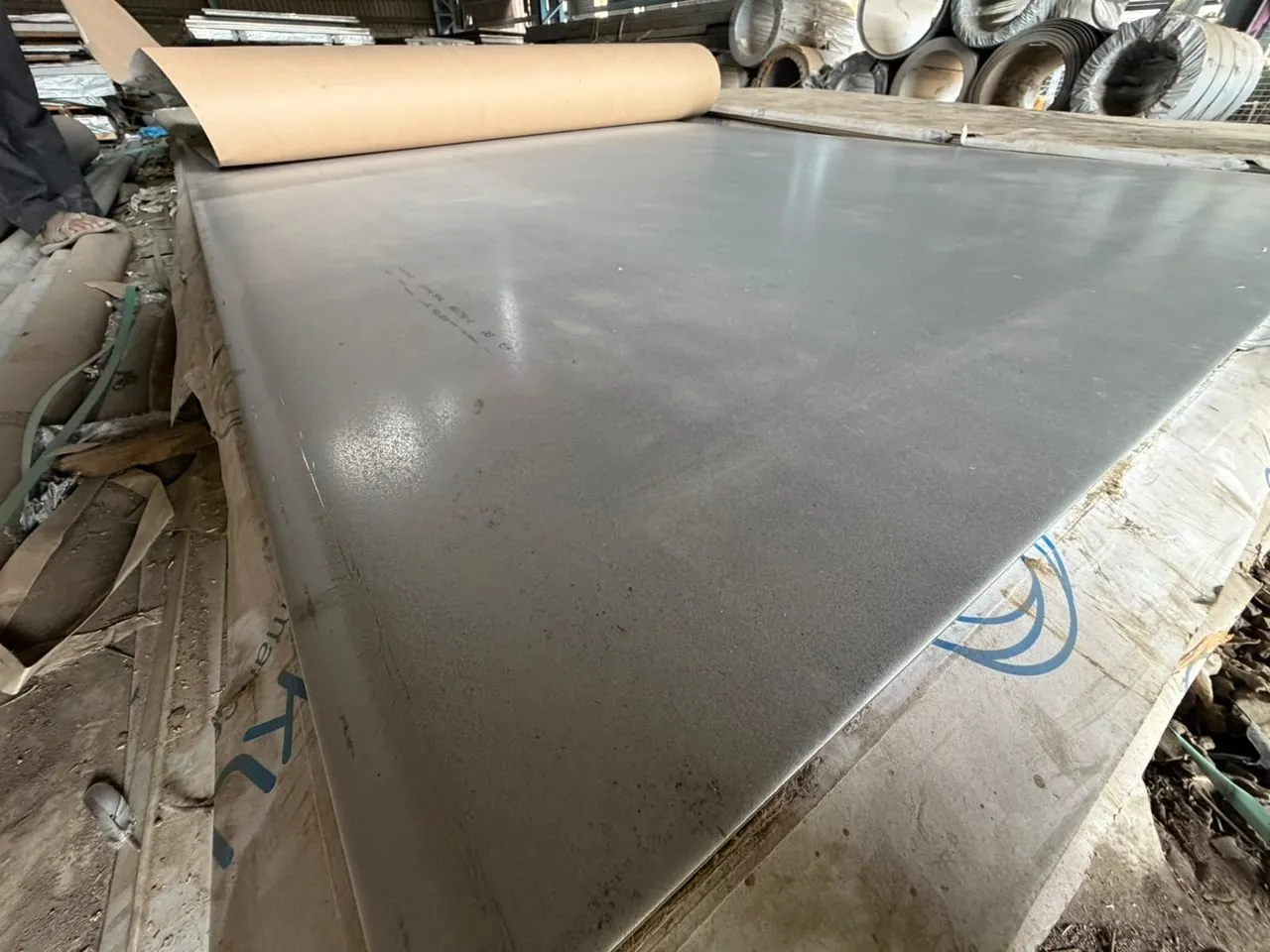
In sheet form the grade is the practical, most-ordered flat product for fabricated corrosion-resistant components, vessel and tank linings, trays, baffles, ducting and formed parts. For heavier sections order Incoloy 825 plate; for welded-tube and re-roll feedstock see Incoloy 825 coil. Start at the Incoloy 825 grade hub for the full form range.
Chemical composition (UNS N08825)
| Element | Symbol | Composition (wt %) |
|---|---|---|
| Nickel | Ni | 38.0–46.0 |
| Iron | Fe | ≥ 22.0 (balance) |
| Chromium | Cr | 19.5–23.5 |
| Molybdenum | Mo | 2.5–3.5 |
| Copper | Cu | 1.5–3.0 |
| Titanium | Ti | 0.6–1.2 |
| Carbon | C | ≤ 0.05 |
| Manganese | Mn | ≤ 1.0 |
| Silicon | Si | ≤ 0.5 |
| Sulfur | S | ≤ 0.03 |
| Aluminum | Al | ≤ 0.2 |
The role of titanium, molybdenum and copper
Titanium does the stabilizing work: it locks up carbon as titanium carbide so chromium doesn't get pulled out as chromium carbide. That's the mechanism behind resistance to intergranular corrosion / sensitization in the weld heat-affected zone, the same principle behind stabilized stainless grades 321 and 347. Molybdenum adds resistance to pitting and to reducing acids. Copper is what gets Incoloy 825 through sulfuric and phosphoric service that would eat through plain austenitic stainless. Between the three, 825 holds up against both reducing and oxidizing acids.
Mechanical properties (sheet, annealed: ASTM B424)
| Property | Minimum (annealed sheet) |
|---|---|
| Tensile strength | ≥ 586 MPa (85 ksi) |
| Yield strength (0.2% offset) | ≥ 241 MPa (35 ksi) |
| Elongation in 2 in. | ≥ 30% |
| Hardness | typ. ≤ 90 HRB |
For sour-service orders, confirm the hardness cap required by NACE MR0175 / ISO 15156 on the purchase order. That way the heat gets supplied and documented in the qualified condition.
Physical properties
| Property | Value |
|---|---|
| Density | 8.14 g/cm³ |
| Melting range | ~1370–1400 °C |
| Thermal conductivity (RT) | ~11.1 W/m·K |
| Mean CTE (20–100 °C) | ~14.0 µm/m·°C |
| Elastic modulus | ~196 GPa |
| Magnetic response | Non-magnetic (paramagnetic, permeability ~1.005) |
That density of 8.14 g/cm³ drives the sheet weight calculation below.
Corrosion behavior: why Incoloy 825 sheet exists
Incoloy 825 gets the nod when the environment stacks up hazards that would defeat any single lower alloy. Its strength lies in breadth: one chemistry that holds up in sour gas and across mixed acids, covering the gap between where 904L runs out and where a solid-nickel alloy such as Inconel 625 would be overkill.
Sour service and NACE MR0175
The alloy's high nickel content resists sulfide stress cracking, and suppliers routinely deliver it for sour service (NACE MR0175) in H₂S-bearing oil-and-gas duty. Cite the standard on the order. That way the sheet arrives in the qualified, hardness-controlled condition, with documentation to back it up.
Acid resistance: sulfuric and phosphoric, reducing and oxidizing
Incoloy 825 gets its signature trait, resistance to both reducing and oxidizing acids, from its copper-and-molybdenum chemistry. It's used in sulfuric-acid resistance service, as well as in phosphoric-acid and fertilizer-regeneration duty, where chromium alone (oxidizing) or molybdenum alone (reducing) wouldn't cut it. That combined resistance is the main reason engineers choose 825 over 316L or 904L for mixed-acid and sour-gas work.
Pitting, crevice and chloride SCC
With a PREN of roughly 31–40, Incoloy 825 resists chloride pitting and crevice corrosion at a level comparable to 904L and duplex 2205. Its decisive advantage over austenitic stainless is nickel-driven resistance to chloride stress-corrosion cracking, which limits 316L and 304 in hot chloride service. For this grade, the sour-service and mixed-acid story matters more than raw PREN.
Equivalent grades and designations
| System | Designation |
|---|---|
| UNS | N08825 |
| Werkstoff (W.-Nr.) | 2.4858 |
| EN | NiCr21Mo |
| DIN | 2.4858 (X5NiCrMoCuTi) |
| BS | NA16 |
| JIS | NCF 825 |
| Common (mis)name | "Inconel 825" |
The trade name "Incoloy 825" belongs to Special Metals; "Inconel 825" is a common misnomer for the same N08825 alloy. The full cross-reference lives on the UNS / Werkstoff cross-reference page.
Incoloy 825 sheet vs the alternatives: when to choose it
Sour service combined with mixed acids calls for Incoloy 825, especially once a super-austenitic stainless can't keep up. At that point, jumping straight to a solid Ni-base alloy would mean paying for performance the job doesn't actually need.
| Grade | PREN (approx.) | Choose when |
|---|---|---|
| 316L | ~24 | Moderate chloride / general chemical duty |
| 904L | ~34 | Sulfuric acid and high chloride, cost-sensitive |
| Incoloy 825 | ~31–40 | Sour service (H₂S) + mixed reducing/oxidizing acids |
| Alloy 20 | ~30 | Concentrated sulfuric acid specialization |
| Inconel 625 | ~50+ | Severe pitting / high-temperature duty where 825 is outmatched |
vs Inconel 625
Inconel 625 carries far more molybdenum and a much higher PREN, so it wins out in the most severe pitting and high-temperature service. But that comes at a cost premium, and Incoloy 825 often makes the extra expense unnecessary when the real problem is H₂S and mixed acids rather than extreme chlorides. See the full Incoloy 825 vs Inconel 625 comparison.
vs 904L, Alloy 20 and 316L
Put Incoloy 825 up against 904L super-austenitic and Alloy 20, and it wins out once sour service (H₂S) gets added to the acid exposure. Against 316L, the gap widens further still: chloride SCC resistance and acid breadth both jump a clear notch, the kind of jump the 904L vs 316L ladder shows one rung below. Incoloy 825 also beats its sister grade, Incoloy 800, when it comes to wet corrosion.
Forms, sizes and thickness ranges
Incoloy 825 comes as sheet and plate, with coil and strip available only in limited form. The table lists typical sheet dimensions, but you should confirm exact gauge, width and length when you enquire, since 825 is supplied against your cutting list.
| Attribute | Typical range |
|---|---|
| Thickness (sheet) | ~0.5–6.0 mm (heavier = plate) |
| Width | 1000 / 1219 / 1250 mm |
| Length | 2000 / 2500 / 3000 mm (or cut to size) |
| Condition | Solution/stabilize annealed, descaled/pickled |
Other Incoloy 825 forms
For heavier gauges, order Incoloy 825 plate. Need welded-tube or re-roll feedstock instead? Check Incoloy 825 coil. Not sure which flat product suits your job, read the difference between sheet, plate and coil.
Sheet weight and how to calculate
Sheet weight comes straight from density, 8.14 g/cm³. For a full sheet:
Kg/sheet = thickness (mm) × width (m) × length (m) × 8.14
| Thickness (mm) | Width (m) | Length (m) | Weight (kg) |
|---|---|---|---|
| 1.0 | 1.0 | 2.0 | 16.28 |
| 2.0 | 1.219 | 2.5 | 49.61 |
| 3.0 | 1.25 | 3.0 | 91.58 |
Use the weight calculator to get exact figures for any size. If you need to confirm 825 is the right grade for your service, check the grade selector.
Finishes
Incoloy 825 sheet ships in a few finish options to match your fabrication needs. 2B is cold-rolled, annealed, pickled and skin-passed, the standard smooth matte look. No. 1 is hot-rolled, annealed and pickled, suited to thicker gauges and high-temperature service. There's also cold-rolled annealed-and-pickled, for jobs that call for a uniform surface before forming.
State the finish on your inquiry. That way the surface matches whatever comes next, whether it's welding, forming or cleaning. For more on this, see stainless and nickel-alloy finishes.
Standards and specifications complied
Incoloy 825 sheet meets ASTM B424 / ASME SB-424 (Ni-Fe-Cr-Mo-Cu plate, sheet and strip). For sour service, it also meets NACE MR0175 / ISO 15156.
ASTM B424 / ASME SB-424 for N08825: and why A240 does not apply
ASTM A240 covers chromium and chromium-nickel stainless plate, sheet and strip. Incoloy 825 is a nickel alloy, not a stainless steel, so N08825 sheet is specified to the B-series (B424 / SB-424), not A240, a common spec error worth catching before the order is placed.
Testing, inspection and certification
Every order ships with an EN 10204 3.1/3.2 mill test certificate reporting heat chemistry and mechanical results, traced to the producing heat. On request we add intergranular-corrosion testing per ASTM A262 / ASTM G28, PMI confirming Ni/Mo/Cu, and NACE MR0175 hardness documentation for sour service. See testing, MTC, NDT and PMI, our quality assurance process and the mill test certificate overview.
Applications of Incoloy 825 sheet by industry
- Oil & gas (sour) service, linings, trays and formed components for H₂S-bearing streams, supplied to NACE MR0175.
- Chemical and acid processing, handles sulfuric and phosphoric acid, including mixed reducing/oxidizing duty.
- Petrochemical, heat-exchanger and process sheet in corrosive service.
- Fertilizer and acid-regeneration service, phosphoric-acid plants and pickling-acid recovery. We also handle pollution control / FGD flue-gas-desulfurization equipment.
Welding and fabrication of Incoloy 825 sheet
Incoloy 825 sheet gets welded with the matching over-alloyed filler ERNiFeCr-1 (FM 65), which keeps the weld metal corrosion-resistant across the joint. When a stabilize anneal is called for, it's done near 940 °C, a different target from the solution anneal used for austenitic stainless; see solution and stabilize annealing. This alloy work-hardens, so shearing, forming and bending need to be planned with that in mind. For full procedure guidance, check how to weld Incoloy 825 and welding stainless and nickel alloys.
How we quote
Incoloy 825 sheet gets quoted to specification on request; we don't publish price bands, since gauge, width, length, finish and test scope all shift the number. Send your thickness, width, length, standard (ASTM B424, plus NACE MR0175 if sour), finish and quantity, and you'll get a firm offer. Nandini Steel is an ISO 9001:2015-certified stockist and supplier founded in 2003. Over 20+ years we've delivered 307+ projects to 260+ clients across 36+ export countries, and we supply genuine mill material from mills including Aperam, Outokumpu, Jindal, POSCO, Nippon Steel and JFE. Full heat traceability comes standard, and every order ships with an EN 10204 3.1/3.2 certificate. Our third-party-certified specialty covers 904L, Alloy 28, Incoloy 800 and Hastelloy. That's the same Ni-Fe-Cr and nickel-base competence Incoloy 825 sits beside.
Frequently asked questions
Is Inconel 825 the same as Incoloy 825?
What standard covers Incoloy 825 sheet?
Is Incoloy 825 sheet suitable for sour service?
What is the PREN of Incoloy 825?
What filler is used to weld Incoloy 825 sheet?
What finishes are available for Incoloy 825 sheet?
Request a quotation. Send your Incoloy 825 sheet specification to reachus@nandinisteel.com, call +91 22 43404600 or WhatsApp +91 99202 09184 for a firm offer with EN 10204 3.1/3.2 certification. All products are held ex-stock for immediate dispatch. GSTIN 27ADJPA7240C1Z0. More: about Nandini Steel, certifications, contact.
Related grades to cross-shop
Part of our steel sheet range.