
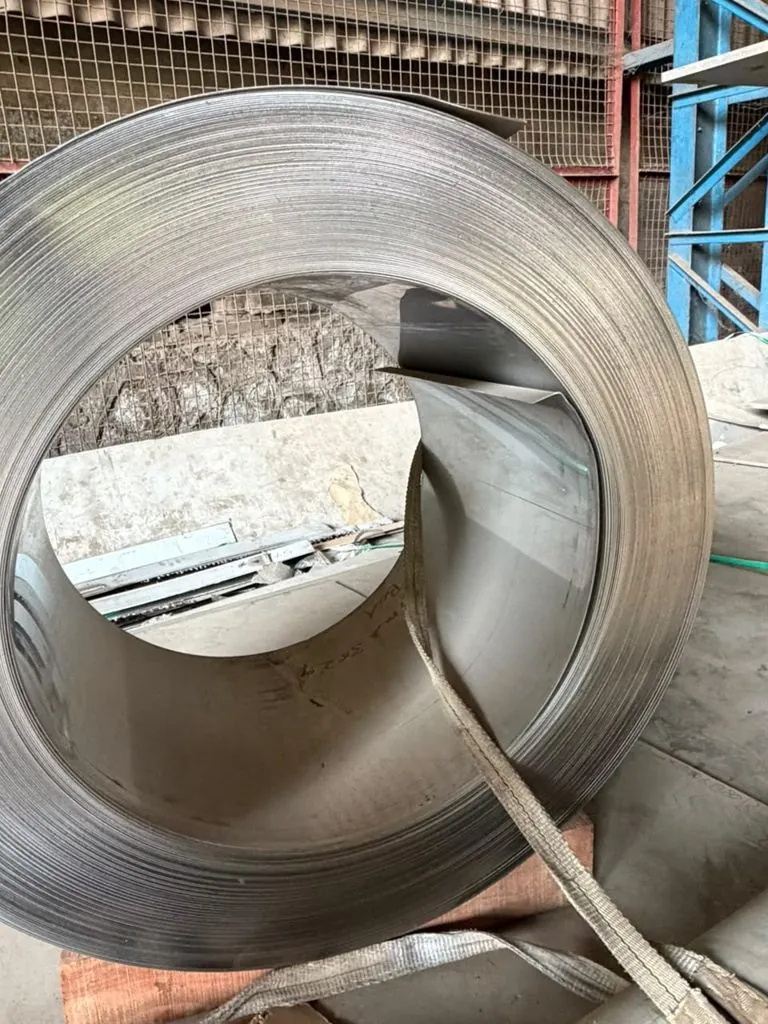
Incoloy 800 at a glance
- Designation: UNS N08800, Werkstoff 1.4876, a solid-solution austenitic Ni-Fe-Cr heat-resistant alloy, with high-temperature variants 800H (N08810) and 800HT (N08811).
- Why it exists: chromium plus aluminum gives the alloy its resistance to high-temperature oxidation, carburization and nitriding. That's what makes it the step up from 310S stainless for furnace and reformer service.
- Chloride-SCC resistance: nickel content near 32% pushes the stress-corrosion-cracking threshold well above austenitic stainless steels such as 304 and 316.
- Not a pitting alloy: Incoloy 800 carries no molybdenum. It's specified for heat and structural stability, not aqueous chloride pitting resistance. That job falls to its Mo/Cu-bearing cousin Incoloy 825.
- Supply: stock on hand in plate, sheet, pipe, tube, round bar, forged fittings, flanges and fasteners to ASTM B409/B407/B408, each backed by an EN 10204 3.1/3.2 mill test certificate.
Incoloy 800 plate shows up right on Nandini Steel's ISO 9001:2015 certificate scope (Certificate No. 1283438, Unitas Certification Services UCS-UK, valid to 11 January 2028). It's not pulled from some general catalog, this is a third-party-certified specialty item.
Grades & designations: 800 vs 800H vs 800HT
Standard 800 (N08800), 800H (N08810) and 800HT (N08811) share a common base chemistry, but the 800 family splits into three UNS numbers that differ in carbon, aluminum-plus-titanium and grain size. That distinction is what governs creep-rupture strength at high temperature. Standard 800 is the general heat-resistant grade. 800H is controlled for carbon and coarse grain. 800HT goes further, adding a tighter Al+Ti window for the strongest sustained high-temperature service.
| Variant | UNS | Carbon (wt %) | Aluminum + Titanium (wt %) | Grain / service intent |
|---|---|---|---|---|
| Incoloy 800 | N08800 | ≤ 0.10 | 0.30 – 1.20 (Al 0.15–0.60, Ti 0.15–0.60) | General heat-resistant service |
| Incoloy 800H | N08810 | 0.05 – 0.10 | 0.30 – 1.20 | Coarse grain for creep strength above ~593 °C (1100 °F) |
| Incoloy 800HT | N08811 | 0.06 – 0.10 | 0.85 – 1.20 | Maximum creep-rupture strength at sustained high temperature |
For continuous service above roughly 593 °C (1100 °F), specify 800H or 800HT in the solution-annealed condition, not standard 800. The controlled carbon content and coarse grain size are what give it the creep-rupture life it needs.
Chemical composition
Element ranges for UNS N08800, a nickel-iron-chromium alloy, in weight percent (per ASTM B409).
| Element | Symbol | Composition (wt %) |
|---|---|---|
| Nickel | Ni | 30.0 – 35.0 |
| Chromium | Cr | 19.0 – 23.0 |
| Iron | Fe | ≥ 39.5 (balance) |
| Carbon | C | ≤ 0.10 |
| Aluminum | Al | 0.15 – 0.60 |
| Titanium | Ti | 0.15 – 0.60 |
| Manganese | Mn | ≤ 1.50 |
| Silicon | Si | ≤ 1.00 |
| Copper | Cu | ≤ 0.75 |
| Sulfur | S | ≤ 0.015 |
The aluminum and titanium additions stabilise the alloy and support the adherent oxide scale. In 800H and 800HT, these elements and carbon are held to tighter windows for strength at high temperature.
Mechanical properties
Typical minimums for annealed plate and sheet to ASTM B409 (solution-annealed condition).
| Property | Value (metric) | Value (imperial) |
|---|---|---|
| Tensile strength | ≥ 520 MPa | ≥ 75 ksi |
| Yield strength (0.2% offset) | ≥ 205 MPa | ≥ 30 ksi |
| Elongation in 2 in. | ≥ 30% | ≥ 30% |
Physical properties
| Property | Value |
|---|---|
| Density | 7.94 g/cm³ |
| Melting range | 1357 – 1385 °C |
| Thermal conductivity (at 20 °C) | ~ 11.5 W/m·K |
| Mean coefficient of thermal expansion (20–100 °C) | ~ 14.4 µm/m·°C |
| Modulus of elasticity | ~ 196 GPa |
| Magnetic response | Austenitic, essentially non-magnetic |
The density of 7.94 g/cm³ determines how heavy plates and bars turn out. Pair it with our plate weight guide when you're estimating shipping and fabrication masses.
Corrosion & high-temperature behavior
Incoloy 800 earns its keep through heat and structural stability, not resistance to aqueous corrosion. Chromium in the alloy forms a tough oxide scale, and aluminum and titanium back it up, which lets the alloy stand up to high-temperature oxidation, carburization and nitriding in furnace, reformer and heat-exchanger atmospheres. Austenitic 304 and 310 lose strength and scale under those same conditions. This is a solid-solution alloy. It ships solution-annealed and can't be hardened by heat treatment. For 800H/800HT, creep-rupture life comes specifically from the coarse-grain, solution-annealed condition.
Its nickel content near 32% raises the threshold against chloride stress-corrosion cracking well above that of 304/316 austenitic stainless steels. Incoloy 800 is not, however, a pitting-selected grade, it carries no molybdenum, so it has a low pitting-resistance equivalent (PREN) and should not be chosen for wet-chloride pitting or crevice duty.
Incoloy 800 vs 825: heat vs wet-acid service
This is the distinction buyers most often get wrong. Incoloy 825 is a molybdenum- and copper-bearing Ni-Fe-Cr alloy built for aqueous corrosion, reducing and oxidizing acids and sour (H₂S) service, a different job from Incoloy 800. Choose 800 (or 800H/800HT) when the service is hot gas: oxidation, carburization and sustained high temperature. Choose 825 when the service is wet acid or sour rather than hot gas. The high-temperature siblings are Inconel 600 and the aluminum-bearing Inconel 601, while 310 / 310S stainless is the austenitic grade Incoloy 800 steps up from when heat strength or carburization resistance becomes the governing limit.
For welding, shops join Incoloy 800 using GTAW, GMAW and SMAW, pairing it with matching nickel-alloy consumables. ERNiCr-3 (filler metal 82) is the usual choice for bare-wire processes. This work happens in the solution-annealed condition.
Equivalent grades & designations
| Standard / system | Designation |
|---|---|
| UNS | N08800 (800H N08810 · 800HT N08811) |
| Werkstoff (W.Nr.) | 1.4876 |
| DIN | X10NiCrAlTi32-20 |
| BS | NA15 |
| JIS | NCF 800 |
| Common name | Incoloy alloy 800 / Alloy 800 |
For cross-referencing systems on a purchase order, see our UNS / W.Nr / JIS cross-reference.
Available forms, sizes & standards
Incoloy 800 comes in both flat and long product forms, each made to its governing ASTM specification, with the matching ASME SB- designation. Every form ships ex-stock for immediate dispatch, and we can cut it or supply it cut-to-length on request.
| Form | Specification |
|---|---|
| Plate / sheet / strip | ASTM B409 (ASME SB-409) |
| Seamless pipe / tube | ASTM B407 (ASME SB-407) |
| Welded pipe / tube | ASTM B514 / B515 (ASME SB-514 / SB-515) |
| Rod / round bar | ASTM B408 (ASME SB-408) |
| Forgings | ASTM B564 (ASME SB-564) |
| Fittings | ASTM B366 (ASME SB-366) |
| Flanges / fasteners | Machined from bar to ASTM B408 |
Material comes from genuine mill plate and bar sourced from producers like Aperam, Outokumpu, Jindal, POSCO, Nippon Steel and JFE, with full heat and cast traceability.
Applications of Incoloy 800
Radiant tubes, muffles, retorts, baskets and fixtures in heat-treatment and furnace hardware all depend on Incoloy 800H/800HT. The alloy holds up against oxidation and carburization, and it gives the creep strength needed for continuous furnace service.
Steam-reformer and ethylene pyrolysis tubes rely on the alloy's resistance to carburization and its strength at sustained high temperatures, conditions under which carbon-rich process gas would eat away at stainless steel.
Heat exchanger and steam generator tubing relies on Incoloy 800 because it holds up at high temperatures and resists chloride stress-corrosion cracking on the water side.
Testing, inspection & MTC
Every order of Incoloy 800 ships with an EN 10204 3.1/3.2 mill test certificate (MTC), reporting chemistry and mechanical results against the applicable ASTM specification, along with full heat and cast traceability. Before dispatch, positive material identification (PMI) confirms the grade. Intergranular corrosion testing to ASTM A262 and ultrasonic testing are available on request; for 800H/800HT creep service, grain size and solution-annealed condition are verified too. To see what the document contains, read how to interpret the EN 10204 3.1 MTC.
Nandini Steel is an ISO 9001:2015-certified stockist and supplier (Certificate No. 1283438, Unitas Certification Services UCS-UK, valid to 11 January 2028). The company was founded in 2003, and over more than 20 years it has delivered 307+ projects to 260+ clients across 36+ export countries. Incoloy 800 sits within our certified-scope specialty plates, right alongside 904L, Alloy 28 and Hastelloy. Every grade is held ex-stock, ready for immediate dispatch. We don't publish price tables; instead, we quote live pricing by RFQ.
FAQ
What is the difference between Incoloy 800, 800H and 800HT?
What is the maximum service temperature of Incoloy 800?
Is Incoloy 800 the same as Incoloy 825?
Is Incoloy 800 corrosion resistant?
To order, send your form, dimensions, quantity and specification for a quotation. Incoloy 800 is one of our nickel alloys held ex-stock for immediate dispatch.
- Phone: +91 22 43404600 · +91 99202 09184
- WhatsApp: +91 99202 09184
- Email: reachus@nandinisteel.com
- GSTIN: 27ADJPA7240C1Z0