
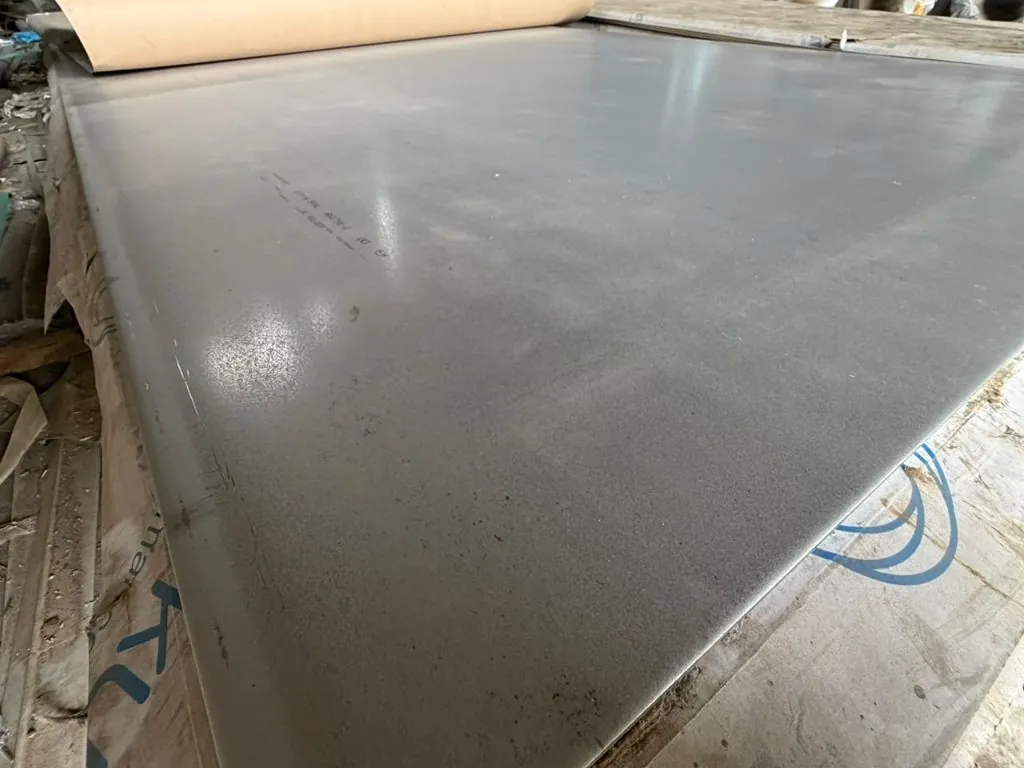
Alloy steel grades at a glance
Low-alloy chromium-molybdenum (Cr-Mo) steel, ferritic/bainitic, with Grade 91 in the tempered-martensite condition. This isn't a stainless steel, and it's no corrosion-resistant alloy (CRA) either.
- Grades: P1, P11, P22, P5, P9 and P91, the Cr-Mo "ladder" from ~0.5% Mo carbon-moly up to 9Cr-1Mo-V.
Forms & standards: ASTM/ASME A335/SA-335 pipe, A387/SA-387 plate, A182/SA-182 forging and A234 fitting. All of it's held ex-stock, ready for immediate dispatch.
- Magnetic (ferritic/martensitic), supplied normalized & tempered (Grade 91 to a controlled tempering window).
Duty: Service here runs hot and under pressure, with hydrogen in the mix. What matters is creep strength and resistance to high-temperature hydrogen attack (HTHA), chloride corrosion isn't the concern.
What is alloy steel? (Cr-Mo low-alloy steel)
Low-alloy chromium-molybdenum steel is what "alloy steel" means on this page. It's a steel deliberately alloyed with roughly 0.5–9% chromium and 0.5–1% molybdenum, plus vanadium in Grade 91. The chromium and molybdenum go into solid solution and form stable carbides. That raises creep-rupture strength at red heat and resists high-temperature hydrogen attack (HTHA), the mechanism that limits plain carbon steel in hot hydrogen service.
It sits between two neighbors. Against carbon steel (such as A516 carbon-steel plate), Cr-Mo adds the creep and hydrogen-attack credit carbon steel does not carry above about 425 °C. Against austenitic stainless, Cr-Mo is a high-temperature structural steel for non-corrosive duty, it is not chosen for its corrosion resistance and is not rated on PREN. For the broader split, see carbon vs stainless vs alloy steel and the role of alloying elements.
Alloy steel grades & composition
Nominal chemistry and the ASTM/ASME designation line up across pipe (A335 P-), plate (A387 Gr), forging (A182 F-) and fitting (A234 WP-). These values are public ASTM/ASME nominals; the actual heat analysis shows up on each order's mill test certificate.
| Grade (ASME) | Nominal | Cr % | Mo % | Other | Pipe (A335) | Plate (A387) | Forging (A182) | Fitting (A234) |
|---|---|---|---|---|---|---|---|---|
| Grade 1 | C-½Mo | – | 0.44–0.65 | – | P1 | – | F1 | WP1 |
| Grade 11 | 1.25Cr-0.5Mo | 1.00–1.50 | 0.45–0.65 | Si 0.50–1.00 | P11 | Gr 11 | F11 | WP11 |
| Grade 22 | 2.25Cr-1Mo | 1.90–2.60 | 0.87–1.13 | – | P22 | Gr 22 | F22 | WP22 |
| Grade 5 | 5Cr-0.5Mo | 4.0–6.0 | 0.45–0.65 | – | P5 | Gr 5 | F5 | WP5 |
| Grade 9 | 9Cr-1Mo | 8.0–10.0 | 0.90–1.10 | – | P9 | Gr 9 | F9 | WP9 |
| Grade 91 | 9Cr-1Mo-V | 8.0–9.5 | 0.85–1.05 | V 0.18–0.25, Nb 0.06–0.10, N 0.03–0.07 | P91 | Gr 91 | F91 | WP91 |
Grade 91's vanadium, niobium and nitrogen content forms fine, stable precipitates that push creep strength well above the plain Cr-Mo grades. That's why it has largely replaced Grade 22 in modern high-temperature steam headers.
Mechanical properties
Representative minima for A387 plate (Class 2) and A335 seamless pipe. Check the exact class, tensile band and elongation against the governing standard on the MTC.
| Grade | Product basis | Tensile strength | Yield (0.2%) | Elongation |
|---|---|---|---|---|
| Grade 11 Cl 2 | A387 plate | 515–690 MPa | ≥310 MPa | ≥22% |
| Grade 22 Cl 2 | A387 plate | 515–690 MPa | ≥310 MPa | ≥18% |
| Grade 5 | A335 P5 pipe | ≥415 MPa | ≥205 MPa | ≥20% |
| Grade 9 | A335 P9 pipe | ≥415 MPa | ≥205 MPa | ≥20% |
| Grade 91 | A335/A387 Gr 91 | ≥585 MPa | ≥415 MPa | ≥20% |
See mechanical properties explained for how these minima get verified. When you're figuring out plate weight and planning sections, the steel plate weight method works well, and the guide on choosing plate thickness covers the rest.
Physical properties
Cr-Mo grades are ferritic or martensitic, which means they're magnetic. They behave very differently from austenitic stainless at temperature. Thermal conductivity runs higher, thermal expansion runs lower, and that matters when you're designing against thermal fatigue or working out a dissimilar-metal weld.
| Property | Cr-Mo alloy steel (typical) | Austenitic SS (for contrast) |
|---|---|---|
| Density | ~7.76–7.85 g/cm³ | ~8.0 g/cm³ |
| Thermal conductivity (RT) | ~37–42 W/m·K | ~15 W/m·K |
| Coefficient of thermal expansion | ~12–13 µm/m·°C | ~16–17 µm/m·°C |
| Elastic modulus | ~205 GPa | ~193 GPa |
| Magnetic response | Ferromagnetic | Non-magnetic (annealed) |
Why grade matters: creep, high-temperature hydrogen attack & the Cr-Mo ladder
More chromium and molybdenum means more creep strength and a higher safe operating temperature in hydrogen service, that's the single idea the whole family rests on. As service temperature and hydrogen partial pressure rise, you climb the ladder: P11, then P22, then P9/P91. Pick the lowest grade that clears your duty. Don't over-specify.
- Creep takes over above roughly 450 °C, the point where carbon steel starts losing its long-term strength. Cr-Mo carbides hold the metal together under sustained stress, and Grade 91's V/Nb/N precipitates stretch that margin even further.
- High-temperature hydrogen attack (HTHA) is governed by the API 941 Nelson curves. More Cr-Mo content pushes up the temperature/hydrogen-pressure boundary a steel can take before internal decarburization and fissuring set in.
- Temper embrittlement hits Grade 22 (2.25Cr-1Mo). Keeping tramp elements in check (J-factor / X-bar) and getting the post-weld heat treatment right is what keeps it under control.
- Grade 91 has a narrow tempering window. Under-temper it or over-temper it and you end up with field failures, so hardness control and controlled PWHT aren't optional. They're mandatory.
Choosing up the ladder: when P11 → P22 → P91
Start at Grade 11 (1.25Cr-0.5Mo) for moderate elevated-temperature service and mild hydrogen duty. When temperature, pressure or hydrogen partial pressure push past the Grade 11 Nelson-curve limit, step up to Grade 22 (2.25Cr-1Mo). For the highest-temperature steam and creep-critical headers, move to Grade 91 (9Cr-1Mo-V), and accept its stricter welding and PWHT discipline that comes with it. Background: pressure-vessel steel explained and normalizing PVQ plate.
Equivalent designations
| ASTM/ASME grade | UNS | EN (number) | Common name |
|---|---|---|---|
| Grade 11 | K11789 | 13CrMo4-5 (1.7335) | 1.25Cr-0.5Mo |
| Grade 22 | K21590 | 10CrMo9-10 (1.7380) | 2.25Cr-1Mo |
| Grade 5 | K41545 | X12CrMo5 | 5Cr-0.5Mo |
| Grade 91 | K90901 | X10CrMoVNb9-1 (1.4903) | 9Cr-1Mo-V / Grade 91 |
Available forms & sizes
Every Cr-Mo grade gets routed to its matched form and standard within our broader alloy steel range. All products sit ex-stock for immediate dispatch. When you send your inquiry, state the grade, standard, class and section, and we'll get back to you with live sizing.
| Form | Standard | Representative grades | Catalog page |
|---|---|---|---|
| Seamless pipe / tube | ASTM/ASME A335 | P11, P22, P91 | alloy steel pipe (A335 P11/P22) |
| Pressure-vessel plate | ASTM/ASME A387 | Gr 11, Gr 22, Gr 91 | A387 / SA-387 alloy-steel plate |
| Butt-weld fittings | ASTM A234 | WP11, WP22 | alloy steel pipe fittings (A234 WP22) |
| Forged fittings & forgings | ASTM/ASME A182 | F11, F22, F91 | alloy steel forged fittings (A182 F11/F22) |
| Flanges | ASME B16.5 / A182 | F11, F22 | alloy steel flanges |
| Round bar | ASTM A182 / forging stock | F11, F22, F5 | alloy steel round bar |
| Fasteners (bolting) | ASTM A193 / A194 | B7, B16 | alloy steel fasteners (B7 / B16) |
Applicable standards & specifications
- A335 / SA-335, seamless ferritic alloy-steel pipe (P-numbers), the backbone of boiler and steam-circuit piping.
- A387 / SA-387, chromium-molybdenum alloy-steel plate for pressure vessels (Grade/Class). This is the plate money page in the cluster.
- A182 / SA-182, forged fittings, flanges and valve parts (F-numbers).
- A234, factory-made wrought butt-weld fittings (WP-numbers) matched to the pipe grade.
- A213, seamless ferritic alloy-steel boiler, superheater and heat-exchanger tube.
- A193 / A194, alloy-steel bolting (B7, B16 studs and nuts) for flanged high-temperature joints.
A frequent purchasing error is confusing the A335 P-grade of the pipe with the A234 WP-grade of its fittings, or ordering Grade 22 plate without specifying the required PWHT and hardness. Name the exact spec and condition on the PO so the heat gets supplied and certified correctly.
Testing, inspection & MTC
Every order ships with an EN 10204 3.1/3.2 mill test certificate that states heat chemistry and mechanical results against the governing standard. Typical inspection for Cr-Mo material includes:
- PMI (positive material identification) to confirm Cr/Mo, and V on Grade 91, grade-for-grade.
- Hardness survey, critical on Grade 91 to verify the tempering/PWHT condition.
- Ultrasonic testing (UT) on plate and heavier sections; hydrostatic test on pipe.
- Charpy impact testing where the design code or low-temperature service calls for it.
See PMI, UT and MTC testing and the EN 10204 mill test certificate standard to see how traceability gets documented.
Applications of alloy steel grades
- Power generation, boiler tubes, superheaters, reheaters and steam headers, where creep strength at red heat sets the grade (Grade 22 and Grade 91 dominate high-temperature steam).
- Oil & gas refining, hydroprocessing reactors, hydrocracker and hydrotreater circuits and hot hydrogen piping, where the API 941 Nelson curve selects the Cr-Mo level for HTHA resistance.
- Petrochemical, reformers, cracking furnaces and elevated-temperature pressure vessels fabricated from A387 / SA-387 plate, where carbon steel lacks creep and hydrogen credit but a CRA is over-specified for non-corrosive heat.
FAQ
What is the difference between alloy steel, carbon steel and stainless steel?
P11 vs P22 vs P91, which Cr-Mo grade do I choose?
Is alloy steel magnetic?
Which alloy steel grade is used for high-temperature hydrogen service?
Does Cr-Mo alloy steel have a PREN rating?
Request a quote
Nandini Steel supplies genuine mill plate and pipe from producers such as Aperam, Outokumpu, Jindal, POSCO, Nippon Steel and JFE, with every order carrying an EN 10204 3.1/3.2 mill test certificate. Send your specification for live pricing, stock availability and the matched standard or class across pipe, plate, forging, fitting, flange, bar and bolting, and we'll respond with an RFQ.
- Email: reachus@nandinisteel.com · WhatsApp: +91 99202 09184
- Phone: +91 22 43404600 · +91 9920209184
- Address: 25, Dreamland Building, 601, 6th Floor, Mama Parmanand Marg, Charni Road, Opera House, Girgaon, Mumbai, Maharashtra 400004, India
- GSTIN: 27ADJPA7240C1Z0 · ISO 9001:2015 certified (Cert 1283438, UCS-UK)
Nandini Steel Engineering Team reviewed this on 2026-10-30. Founded in 2003, Nandini Steel is an ISO 9001:2015-certified stockist and supplier with more than 20 years behind it in corrosion-resistant and pressure-service steels.