What ASME B16.9 Covers
ASME B16.9 is the American Society of Mechanical Engineers standard that governs the overall dimensions, tolerances, ratings and markings of factory-made wrought buttweld fittings. "Wrought" means the fitting is formed from seamless or welded pipe, plate or forgings by hot or cold working, not cast. "Buttweld" means the fitting end is beveled and welded end-to-end to the pipe, giving a full-penetration joint with a smooth bore and no socket or thread to interrupt flow.
The standard runs from NPS 1/2 up to NPS 48, the size band where buttweld construction is preferred over the small-bore forged socket-weld and threaded fittings governed by ASME B16.11. Because the fitting is matched to a pipe schedule rather than a pressure class, B16.9 fittings dominate process piping, pipelines, refinery and petrochemical headers, and any run where a welded, full-bore joint is required.
B16.9 is a dimensional standard. It sets the geometry and the wall, but the chemistry and mechanical properties come from the material specification, which is covered further down this page.
Fitting Types in the Standard
The standard dimensions a complete family of configurations so a designer can route a welded line entirely in matched buttweld components:
- 45 degree, 90 degree and 180 degree elbows, in long radius (1.5D) and short radius (1.0D)
- Long-radius reducing elbows
- Straight and reducing tees
- Concentric and eccentric reducers
- Caps
- Laterals
- Returns (180 degree bends)
- Stub ends for lap-joint (Van Stone) flange connections
Elbow Radius, Reducers and Laying Lengths
The most-used dimension in B16.9 is the center-to-end distance of an elbow, which is driven by the bend radius. A long-radius (LR) elbow has a centerline radius of 1.5 times the nominal pipe diameter, giving a gentle turn with lower pressure drop and less erosion. A short-radius (SR) elbow has a radius of 1.0 times the diameter, used only where space is tight because the sharper turn raises turbulence and wear.
| Fitting | Bend radius | Center-to-end basis | Typical use |
|---|---|---|---|
| 90 degree long-radius elbow | 1.5 x NPS | 1.5 x nominal diameter | Standard process and pipeline turns |
| 90 degree short-radius elbow | 1.0 x NPS | 1.0 x nominal diameter | Congested layouts, tight routing |
| 45 degree long-radius elbow | 1.5 x NPS | Derived from 1.5D geometry | Shallow direction changes |
| 180 degree return | 1.5D (long) or 1.0D (short) | Center-to-center and back-to-face | Heater coils, U-bends |
Reducers change the line size over a defined length. A concentric reducer keeps both ends on a common centerline and suits vertical runs and pump suction where symmetry matters. An eccentric reducer keeps one side flat, which prevents air or vapor pockets on horizontal pump-suction lines and lets liquid drain. Tees come as straight tees, where the branch equals the run, and reducing tees, where the branch is smaller, each with fixed center-to-end and center-to-branch dimensions.
Pressure Rating and Wall Thickness
A B16.9 fitting is not rated by a pressure class. Instead, the standard requires the fitting to be at least as strong as the straight seamless pipe of the same nominal size, wall thickness and material. In practice this means you order a fitting to a schedule or wall that matches the connecting pipe, and the allowable pressure-temperature rating is read from the matching pipe in the same grade, de-rated as temperature rises.
| Attribute | ASME B16.9 buttweld fitting |
|---|---|
| Size range | NPS 1/2 to NPS 48 |
| Rating basis | Matches the equivalent seamless pipe of the same schedule and grade |
| Wall designations | STD, XS, XXS and Schedule 10 through 160 |
| Joint type | Full-penetration buttweld, beveled ends |
| Construction | Wrought (seamless or welded), hot or cold formed |
| Marking | Per MSS SP-25: maker, material, size, schedule, heat |
Fitting ends are beveled for welding to ASME B16.25. The bevel angle and root face are set so the fitting and pipe present a consistent joint preparation, which is what lets a B16.9 fitting drop into a qualified welding procedure without rework.
Materials for ASME B16.9 Fittings
Because B16.9 fixes dimensions and not chemistry, the grade and properties come from the material specification stamped on the fitting. For wrought austenitic stainless buttweld fittings that spec is ASTM A403. Carbon and low-alloy steel fittings are supplied to ASTM A234, and nickel-alloy fittings to ASTM B366. The companion forging and flange material standard ASTM A182 is often cited on the same line class.
| Material family | Typical grade | Material specification | UNS |
|---|---|---|---|
| Austenitic stainless | 304 / 304L (WP304 / WP304L) | ASTM A403 | S30400 / S30403 |
| Austenitic stainless | 316 / 316L (WP316 / WP316L) | ASTM A403 | S31600 / S31603 |
| Stabilized stainless | 321 / 347 (WP321 / WP347) | ASTM A403 | S32100 / S34700 |
| Super-austenitic stainless | 904L (WP904L) | ASTM A403 | N08904 |
| Carbon / low-alloy steel | WPB, WP11, WP22, WP91 | ASTM A234 | K03006 and alloy UNS |
| Ni-Fe-Cr alloy | Incoloy 825 | ASTM B366 | N08825 |
| Ni-alloy | Inconel 625 | ASTM B366 | N06625 |
| Ni-Mo-Cr alloy | Hastelloy C276 | ASTM B366 | N10276 |
Matching the Grade to the Corrosion Duty
The grade decision follows the pipe the fitting joins. Austenitic 316/316L adds 2 to 3 percent molybdenum for pitting resistance that 304 lacks, lifting the PREN from about 18 to about 24. Where hot chlorides or sulfuric acid are involved, 904L with roughly 4.5 percent molybdenum and a copper addition (PREN about 34) resists conditions that pit 316. For sour-gas and mixed-acid service, Incoloy 825 resists both reducing and oxidizing acids and conforms to NACE MR0175 / ISO 15156. For the most aggressive acid and chloride duty, Inconel 625 and Hastelloy C276 extend the range further.
Because buttweld fittings are welded into the line, the heat-affected zone matters. On austenitic grades held in the 425 to 815 degrees C band, specify the low-carbon L grade to avoid sensitization without a post-weld anneal, or use a stabilized grade such as 321 or 347. Follow the low-heat-input practice in our guides on how to weld 316L and how to weld 304L to keep the joint corrosion-resistant.
Tolerances and Marking
B16.9 controls the dimensional tolerances that make a fitting interchangeable: the outside diameter at the bevel, the inside diameter, the wall thickness, the center-to-end length and the angularity of the ends. These tolerances tighten as the pipe gets smaller, because a small offset is a larger fraction of a small bore. Holding them is what lets a fitting from one heat line up with pipe from another without field grinding.
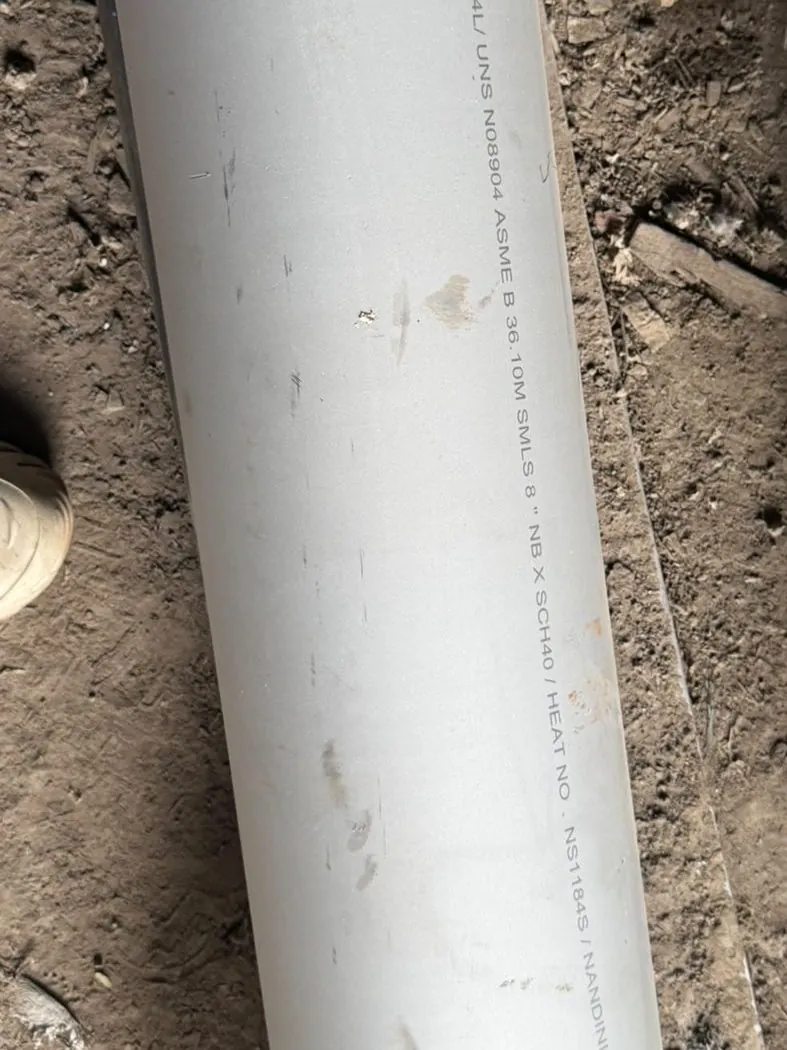
Marking follows MSS SP-25. Each fitting carries the manufacturer name or trademark, the material grade, the nominal size, the schedule or wall designation and the heat number or heat code. The heat number is the thread back to the mill test certificate, which is how traceability survives from the melt through to the installed joint.
How ASME B16.9 Fits With Other Standards
Buttweld fittings sit inside a wider set of dimensional and material standards that cover the rest of the piping run:
- ASTM A403 for wrought austenitic stainless buttweld fittings
- ASTM A234 for carbon and alloy steel buttweld fittings
- ASTM B366 for wrought nickel-alloy buttweld fittings
- ASME B16.11 for forged socket-weld and threaded fittings below the buttweld range
- ASME B16.5 for pipe flanges and flanged fittings, classes 150 to 2500
- ASTM A312 for the austenitic stainless pipe the fittings join
- ASTM A182 for the companion forged flange and valve material
Where fittings are needed in grades beyond the catalog spread, ASTM B564 covers nickel-alloy forgings for the matching flanges and valve parts.
Ordering ASME B16.9 Fittings From Nandini Steel
Nandini Steel is an ISO 9001:2015-certified stockist and supplier of pipe fittings in stainless steel, nickel alloy and alloy steel, established in 2003 and serving more than 260 clients across over 36 export countries. We hold factory-made wrought buttweld elbows, tees, reducers and caps to ASME B16.9 in common schedules, and every item is ex-stock for immediate dispatch. Buttweld fittings are available in stainless steel, Inconel, Hastelloy and alloy steel.
As a certified specialist in 904L, Alloy 28, Incoloy 800 and Hastelloy, we can supply buttweld fittings in grades many stockists do not carry. Every order ships with an EN 10204 3.1 or 3.2 mill test certificate for full traceability back to the heat.
Frequently Asked Questions
What does ASME B16.9 cover?
What is the difference between a long-radius and short-radius elbow?
How are ASME B16.9 fittings pressure rated?
When is an eccentric reducer used instead of a concentric reducer?
Which material standard applies to ASME B16.9 stainless fittings?
Do ASME B16.9 fittings come with a mill test certificate?
Need a price or availability check? Request a quote with your grade, fitting type, size and schedule, and our team will confirm ex-stock material. Email reachus@nandinisteel.com, call +91 22 43404600, or WhatsApp +91 99202 09184 for live pricing.