
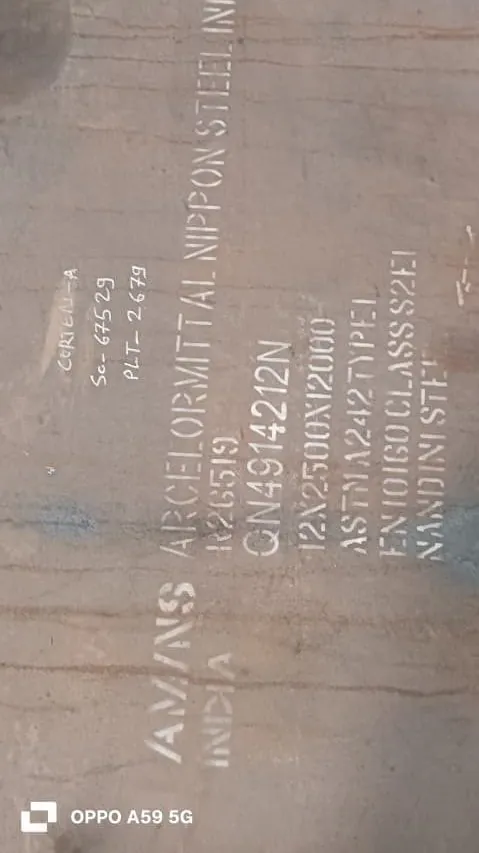
Why clad plate exists: the economics
A vessel wall has two jobs that do not need the same metal. It must hold pressure (a job that cheap carbon steel does well) and it must survive the fluid inside (a job only a corrosion-resistant alloy can do). Building the entire wall from solid 904L or Incoloy 825 means paying alloy prices for the 80 to 95 percent of the thickness that is doing nothing but holding pressure.
Clad plate splits those jobs. A 3 mm layer of CRA handles corrosion; a 30 mm layer of A516 Grade 70 pressure-vessel plate handles the load. For nickel alloys and super-austenitics, the alloy content is a large part of the plate cost, so cladding can cut material cost sharply versus a solid-alloy vessel of the same thickness, while still presenting the same wetted surface to the process.
Anatomy of a clad plate
A clad plate is defined by two layers and the bond between them.
- Cladding (the CRA layer): the corrosion barrier, typically 1.5 mm to 6 mm thick, or 5 to 20 percent of the total thickness.
- Backing (the base plate): the structural member, carbon or low-alloy steel, making up the balance of the thickness.
- Bond line: the metallurgical interface that must transfer load in shear so the two layers act as one plate.
Common cladding alloys
The cladding is chosen the same way you would choose a solid grade: by the medium, the chloride load and the temperature. The table below sets out the alloys we most often see specified as cladding, with the governing clad-plate specification.
| Cladding alloy | UNS | PREN (approx.) | Clad spec | Typical service |
|---|---|---|---|---|
| 304L | S30403 | ~18 | ASTM A264 | Mild, non-chloride process and storage |
| 316L | S31603 | ~24 | ASTM A264 | Chlorides, marine, general chemical |
| 904L | N08904 | ~34 | ASTM A264 | Dilute sulfuric and phosphoric acid, chlorides |
| Incoloy 825 | N08825 | ~31 | ASTM A265 | Sour service, reducing and oxidizing acids |
ASTM A264 covers chromium-nickel (austenitic) stainless-clad plate, so it governs 304L, 316L and 904L cladding. ASTM A265 covers nickel and nickel-base alloy-clad plate, which is the route for Incoloy 825 and other nickel alloys. ASTM A263 covers straight-chromium (ferritic/martensitic) stainless cladding. Each has an ASME SA-prefixed twin (SA-264, SA-265, SA-263) adopted into the Boiler and Pressure Vessel Code. Note that 904L owes its acid resistance to its copper, nickel and molybdenum content, not to PREN alone, and Incoloy 825 sits near PREN 31, not in the 40s.
The backing plate
For pressure equipment the backing is almost always a PVQ carbon steel, and A516 Gr 70 is the default. It is a killed, fine-grain plate with a specified minimum tensile strength of 485 MPa (70 ksi), and it can be supplied normalized for low-temperature Charpy toughness. Because the code lets the designer take credit for the backing in the strength calculation, the backing grade, its heat treatment and its impact requirements are specified exactly as they would be for an unclad vessel. See our explainer on pressure-vessel steel and PVQ plate for how A516 and A20 govern that base material.
How clad plate is made
Three production routes dominate, and the choice drives bond quality, available thickness ratios and cost.
Roll bonding
The cladding and backing slabs are surface-cleaned, stacked, sealed and hot-rolled together. The rolling pressure and temperature create a solid-state diffusion bond across the full interface. Roll bonding suits metallurgically compatible pairs such as austenitic stainless on carbon steel, gives an excellent continuous bond, and is economical for large tonnage and thinner cladding. It is the usual route for 304L and 316L clad plate.
Explosion bonding
A controlled explosive charge drives the cladding plate onto the backing at high velocity. The collision jets away surface oxides and forms a characteristic wavy, cold-welded interface. Explosion bonding (explosion welding) is the route when the two metals cannot be roll bonded, when the cladding is thick, or for reactive and nickel-rich alloys. Incoloy 825, titanium and high-nickel claddings are commonly explosion bonded. It also handles small lots and very large plates well.
Weld overlay cladding
Here the CRA is deposited as weld metal onto the backing, usually by submerged-arc or electroslag strip cladding, in one or more layers. Weld overlay is not a plate bond at all but a welded surface, typically 3 mm or thicker after the first layer is diluted by the base metal. It is favoured for nozzles, complex shapes and localized restoration, and it can be applied in a fabrication shop rather than at a rolling mill. Because the first weld pass picks up iron from the backing, the final surface chemistry is confirmed by positive material identification (PMI) on the as-deposited layer.
Standards and bond quality
A clad plate is only as good as its bond. The clad-plate specifications set a minimum bond shear strength of 140 MPa (20,000 psi) for A263, A264 and A265 material, verified on test coupons. The continuity of the bond across the whole plate is checked by straight-beam ultrasonic testing to ASTM A578 / SA-578, with acceptance levels selected for the service. For vessel work you will typically see the clad plate ordered to the clad spec plus A578 Level B or C scanning and the backing ordered to ASTM A516 / SA-516 under A20.
Chemistry of both layers appears on the EN 10204 3.1 mill test certificate, which traces the clad and backing heats to their heat numbers. As a stockist, Nandini Steel passes on the mill's 3.1 certificate with the plate; we do not issue our own.
Designing and fabricating with clad plate
ASME BPVC Section VIII, Division 1 covers clad construction (Part UCL). The designer may either treat the cladding as a corrosion allowance only, ignoring it in the strength math, or take partial credit for a bonded cladding of adequate quality. Either way the wetted CRA layer is what sets the corrosion allowance, so it is sized against the expected metal loss over the design life.
Fabrication demands discipline at every cut edge, weld and nozzle, because any breach exposes the carbon backing to the process. Welds are made with a backing-steel filler on the carbon side and a matching or over-alloyed CRA filler on the clad side, in that order, so the corrosion barrier is restored continuously. For 904L cladding the matching filler is ER385 (904L), moving to ERNiCrMo-3 for the most severe service; for Incoloy 825 cladding the filler is ERNiFeCr-1. See welding stainless and nickel alloys for the heat-input and interpass rules that keep the clad layer's corrosion resistance intact.
Clad plate vs solid CRA vs weld overlay
Choose by thickness, geometry and cost:
- Solid CRA plate: simplest to fabricate and fully alloyed through-thickness; best for thin vessels, severe service or where the cost delta is small. Our 904L plate and Incoloy 825 plate are stocked for this.
- Roll-bonded or explosion-bonded clad plate: lowest material cost for thick-walled vessels; needs careful edge and weld procedures.
- Weld overlay: best for nozzles, tube sheets and repairs, or when a mill clad plate is not available in the size needed.
Where clad plate is used
Clad plate is standard in refinery and upstream oil and gas equipment, where Incoloy 825 clad on A516 backing serves sour-service separators and hydroprocessing vessels. It appears in fertilizer and acid plants (904L or 316L clad), FGD and pollution-control scrubbers, pulp-and-paper digesters, and seawater and desalination equipment, wherever a corrosive fluid meets a pressure-bearing wall and solid alloy would be uneconomic.
FAQ
Is clad plate as corrosion-resistant as solid alloy? On the wetted face, yes. The cladding presents the same surface chemistry as the solid grade, so a 316L-clad vessel resists the medium like 316L. The difference is structural, not chemical: the backing carries the load.
What is the difference between clad plate and weld overlay? Clad plate is a rolled or explosion-bonded plate with a distinct cladding layer. Weld overlay is CRA weld metal deposited onto a backing. Overlay is better for nozzles and repairs; bonded clad plate is more economical for large flat areas.
What minimum bond strength must clad plate meet? ASTM A263, A264 and A265 require a minimum bond shear strength of 140 MPa (20,000 psi), with bond continuity confirmed by ultrasonic testing to ASTM A578.
Can A516 Gr 70 be used as the backing? Yes. A516 Gr 70 is the default PVQ backing for clad pressure-vessel plate and can be normalized for low-temperature toughness. See our A516 Grade 70 plate page for grades and options.
Which cladding do I need for chlorides versus acids? Chlorides point to 316L, then 904L as the chloride and temperature load rises; dilute sulfuric and phosphoric acids point to 904L; sour service and mixed acids point to Incoloy 825. Our PREN pitting-resistance ladder sets out the ranking.