
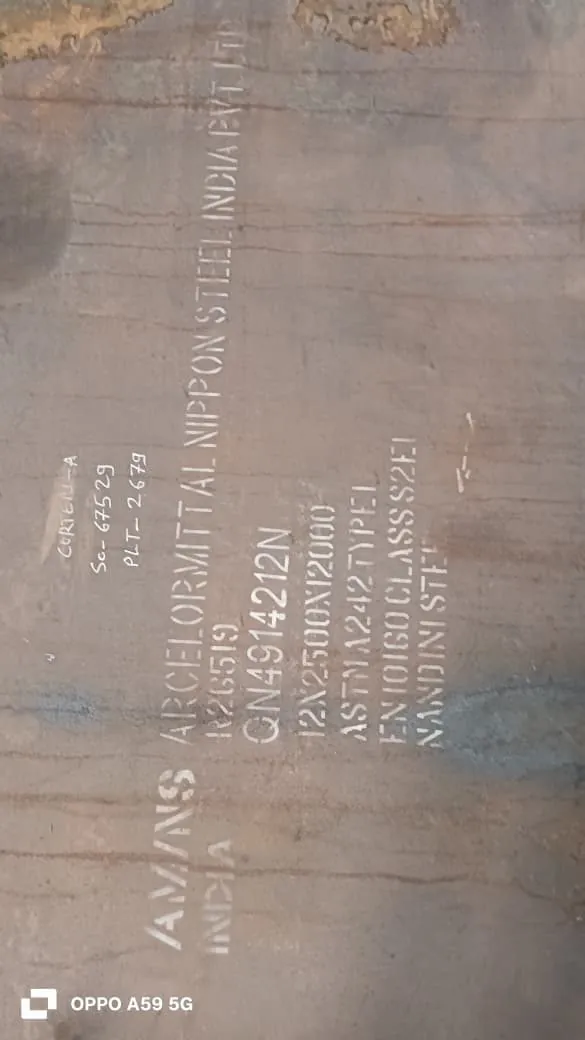
Abrasion-resistant plate at a glance
Quenched & tempered (Q&T) low-alloy steel is a boron-alloyed wear steel, hardened by heat treatment. It isn't an austenitic corrosion-resistant alloy.
- Graded by Brinell hardness (HBW), not by PREN or an ASTM grade, hardness is the defining, order-able property.
- Rockstar 400 ~400 HBW and Rockstar 500 ~500 HBW are the two hardness tiers Nandini stocks.
Abrasive wear resistance is the property that matters here, covering sliding, gouging and impact abrasion. Corrosion resistance isn't the point.
It's supplied as plate, the primary form, and held ex-stock for immediate dispatch. The Brinell hardness result shows up on the EN 10204 3.1 mill test certificate.
AR400 vs AR500: how to choose the hardness tier
The selection axis is simple: harder plate holds up better against abrasion, but it fights you more when you try to cut, bend or weld it. Go with AR400 (Rockstar 400) when you want the best balance of wear life, weldability and formability. Step up to AR500 (Rockstar 500) once sliding-abrasion severity gets bad enough to justify a harder, less-forgiving plate. Full per-grade data lives on the Rockstar 400 wear plate and Rockstar 500 (~500 HBW) plate grade pages.
| Grade | Nominal hardness (HBW) | Relative wear life | Toughness / formability | Typical service |
|---|---|---|---|---|
| Rockstar 400 (AR400) | ~400 HBW | Baseline (good) | Higher, more weldable & bendable | General wear: buckets, truck bodies, chutes, liners |
| Rockstar 500 (AR500) | ~500 HBW | Higher (longer life in sliding abrasion) | Lower, tighter bend radii, more preheat care | Severe wear: crusher liners, screen plates, high-abrasion wear parts |
Engineering teams default to AR500 "to be safe," and that habit usually costs more than it saves. Thicker plate earns its keep only where abrasion is genuinely severe. In parts that take impacts or get fabricated often, AR400's toughness and weldability tend to outlast a cracked AR500 component. Figure out whether the dominant wear mode is sliding or impact first. Then match the plate tier to it, not the other way around.
Grades we stock
Abrasion-resistant plate is a stocked wear range alongside our full catalog of flat & long steel products. The two hardness tiers below lead to their own dedicated grade pages.
Rockstar 400
Rockstar 400 is Nandini's ~400 HBW Q&T abrasion-resistant plate, the workhorse of the wear tier. By hardness it's equivalent to Hardox 400, AR400F and XAR 400. Long wear life, solid weldability, good cold-forming, that combination is why it's become the default choice for buckets, dump-body liners, chutes and hoppers. For composition, mechanicals and sizes, check the Rockstar 400 wear plate page.
Rockstar 500
Rockstar 500 is the roughly 500 HBW tier built for severe sliding and gouging abrasion, matching Hardox 500, AR500F and XAR 500 in hardness. That extra hardness stretches wear life in crusher liners, screen plates and aggregate-handling parts. The trade-off: tighter bend radii and welding that demands more care. Full data sits on the Rockstar 500 (~500 HBW) plate page.
Typical chemical composition
Abrasion-resistant plate gets defined by hardness, not by a fixed ASTM chemistry, so these manufacturer-nominal ranges are typical values rather than a spec. For the actual heat analysis, check the mill test certificate.
| Element (%) | Rockstar 400 (AR400) | Rockstar 500 (AR500) |
|---|---|---|
| Carbon (C) | ≤ 0.23 | ≤ 0.30 |
| Manganese (Mn) | ≤ 1.70 | ≤ 1.70 |
| Silicon (Si) | ≤ 0.70 | ≤ 0.70 |
| Chromium (Cr) | ≤ 1.00 | ≤ 1.00 |
| Nickel (Ni) | ≤ 1.00 | ≤ 1.00 |
| Molybdenum (Mo) | ≤ 0.50 | ≤ 0.50 |
| Boron (B) | ≤ 0.005 | ≤ 0.005 |
Mechanical & hardness properties
Hardness is checked per ASTM A370 / EN ISO 6506 (Brinell). The tensile and yield figures below are typical values given for guidance; the certified numbers are what you'll find on each heat's MTC.
| Property | Rockstar 400 (AR400) | Rockstar 500 (AR500) |
|---|---|---|
| Surface hardness (HBW) | ~360–440 | ~460–540 |
| Nominal hardness | 400 HBW | 500 HBW |
| Yield strength (indicative) | ~1000 MPa | ~1250 MPa |
| Tensile strength (indicative) | ~1250 MPa | ~1550 MPa |
| Hardness test method | ASTM A370 / EN ISO 6506 | ASTM A370 / EN ISO 6506 |
Physical properties
| Property | Value |
|---|---|
| Density | 7.85 g/cm³ |
Density drives plate weight. Use the plate weight calculator to estimate mass from thickness, width and length.
Equivalents
Abrasion-resistant plate doesn't carry a single UNS number. Equivalence gets set by hardness tier instead, matched against the usual brand and spec designations.
| Nandini grade | Hardness tier | Common equivalents |
|---|---|---|
| Rockstar 400 | ~400 HBW | Hardox 400 · AR400F · XAR 400 |
| Rockstar 500 | ~500 HBW | Hardox 500 · AR500F · XAR 500 · Quard 500 |
Available forms, sizes & thickness ranges
Abrasion-resistant steel comes mainly as plate. The figures below are indicative commercial ranges for AR400/AR500 wear plate. All stock sits ex-stock for immediate dispatch, so confirm exact thicknesses and cut sizes held against your requirement by RFQ.
| Form | Thickness (indicative) | Width / length |
|---|---|---|
| Plate | ~3 mm to 80 mm | Standard mill plate widths and lengths; cut-to-size available |
Applicable standards & testing
Abrasion-resistant plate gets defined by its properties, not by any ASTM grade. There's no such thing as an "ASTM AR400" specification. Orders and acceptance hinge on measured surface hardness. That hardness gets verified through Brinell testing to ASTM A370 or EN ISO 6506, and the result lands on the EN 10204 3.1 mill test certificate that comes with every order. Nandini supplies genuine mill plate with full traceability.
- Hardness: Brinell (HBW) per ASTM A370 / EN ISO 6506.
- Certification: EN 10204 3.1 mill test certificate with the measured hardness result. EN 10204 3.2 is available on request.
- Flatness & dimensions: checked to standard plate tolerances.
Applications
- Mining & earthmoving, excavator buckets, dump-truck bodies, loader edges and wear-exposed structures.
- Aggregate, crushing & cement, crusher liners, screen plates, feeder and chute linings handling abrasive rock.
- Bulk material handling, hoppers, chutes, skirtboards and liner plates in abrasive bulk-solids flow.
Fabrication notes
Harder plate narrows the fabrication window. Cut it with plasma, laser or oxy-fuel; at higher thicknesses, abrasive-service plate usually gets profile-cut rather than sheared. Weld with low-hydrogen consumables, and preheat according to thickness and grade, AR500 generally needs more preheat care than AR400. For cold bending, respect the minimum bend radius. It's tighter, a larger multiple of thickness, for AR500 than for AR400. Bend it too tight and you risk cracking the hardened plate.
FAQ
What is AR400 / AR500 steel?
Is AR plate the same as Hardox?
Can abrasion-resistant plate be welded and bent?
Do you provide a mill test certificate for wear plate?
Request a quote
Nandini Steel holds ISO 9001:2015 certification and works as a stockist and supplier, supplying Rockstar 400 and Rockstar 500 abrasion-resistant plate ex-stock from Mumbai. Every order comes with EN 10204 3.1/3.2 mill test certificates and hardness-verified traceability. All products are ready for immediate dispatch. Get in touch for live pricing.
- Phone: +91 22 43404600 · +91 9920209184
- WhatsApp: +91 99202 09184
- Email: reachus@nandinisteel.com
- Address: 25, Dreamland Building, 601, 6th Floor, Mama Parmanand Marg, Charni Road, Opera House, Girgaon, Mumbai, Maharashtra 400004, India
- GSTIN: 27ADJPA7240C1Z0
In business since 2003, with over 20 years supplying stainless, nickel-alloy, alloy-steel and PVQ products. The company has delivered 307+ projects for 260+ clients and exports to more than 36 countries.