


A 316 Stainless Steel Plate is an austenitic chromium-nickel-molybdenum alloy built for environments where standard grades give up early. Chloride exposure, marine air, chemical splash- none of that breaks down the passive layer the way it does on lower grades. The addition of molybdenum sets 316 stainless steel apart from other grades, and this is reflected directly in its pitting resistance numbers. Nandini Steel supplies 316 stainless steel plate in multiple sizes, thicknesses and finishes for chemical processing, marine fabrication, pharmaceutical equipment and food handling units.

What Is 316 SS Plate, and Why Is It Used?
316 SS Plate carries 2 to 3% molybdenum on top of the standard 16 to 18% chromium and 10 to 14% nickel base. That molybdenum stabilises the passive film against chloride attack, something 304 cannot match at the same exposure levels. Engineers choose this grade for tanks, reactors, and marine hardware where salt or brine sits against the metal for extended periods.
316 Stainless Steel Plate Specifications
The table below covers parameters procurement teams check before placing an order, drawn from ASTM A240 316 Stainless Steel Plate requirements.
| Parameter | 316 (UNS S31600) Plate |
| Grade | 316 (also 316L S31603 and 316H S31609 per A240) |
| UNS | S31600 |
| ASTM | ASTM A240 (standard specification for chromium and chromium-nickel stainless steel plate, sheet, and strip) |
| ASME | ASME SA240 (pressure vessel code adoption of A240) |
| EN / DIN | EN 1.4401; X5CrNiMo17-12-2 |
| Typical Composition (wt %) | C ≤ 0.08; Mn ≤ 2.00; P ≤ 0.045; S ≤ 0.030; Si ≤ 0.75; Cr 16.0–18.0; Ni 10.0–14.0; Mo 2.0–3.0; N ≤ 0.10; Fe balance |
| Thickness | ~0.5–100 mm (plate); sheet typically 0.1–6 mm. Common discrete sizes: 3, 4, 5, 6, 8, 10, 12, 16, 20, 25, 30, 40, 50, 60, 80, 100 mm |
| Width | Up to 2000–2500 mm standard; some mills up to 4200 mm |
| Length | 2000–12000 mm (standard 3000 mm, 6000 mm; custom cut-to-size) |
| Surface Finish | No. 1 (hot-rolled, annealed & pickled); 2B (cold-rolled, heat treated, pickled, skin-passed); 2D (cold-rolled, heat treated, pickled); BA (bright annealed); No. 4 (brushed); No. 8 (mirror); HL; polished as required |
| Heat Treatment | Solution anneal: 1010–1120 °C (1850–2048 °F); for 316/316L, often 1040–1175 °C (1900–2150 °F) followed by rapid cooling (air or water quench depending on section) |
| Product Condition | Supplied solution-annealed and descaled/pickled cold-rolled sheets/plates in 2B/BA/2D/2E/2H finishes; hot-rolled plates in No. 1 or mill-pickled condition |
| Mechanical Properties (Min, Room Temp) | Tensile ≥ 515 MPa (75 ksi); Yield ≥ 205 MPa (30 ksi); Elongation ≥ 40% in 50 mm; Hardness ≤ 217 HB (typical) |
| Dimensional Tolerances | Thickness, width, length, and flatness per ASTM A480/A480M (as referenced by A240) and/or mill standards; tighter tolerances by agreement (precision leveled, machined edges) |
ASTM A240 316 Stainless Steel Plate Sizes
| Size (mm) | Size (in) | Typical Thickness Range (mm) |
| 1000 × 2000 | 39.4 × 78.7 | 0.5 – 100 |
| 1219 × 2438 (1220 × 2440) | 48 × 96 (4′ × 8′) | 0.5 – 100 |
| 1250 × 2500 | 49.2 × 98.4 | 0.5 – 100 |
| 1500 × 3000 | 59.1 × 118.1 | 3 – 100 |
| 2000 × 4000 | 78.7 × 157.5 | 6 – 100 |
| 2000 × 6000 | 78.7 × 236.2 | 10 – 100 (special) |
316 Stainless Steel Plate Manufacturing Process
The production begins with the selection of raw materials. Then they are melted, casted and hot or cold rolled depending on the target thickness. The lost corrosion-resistant microstructure during rolling is restored by heat treatment. Pickling strips scale and sets the surface texture. Cutting to size, inspection, and packaging close out the sequence. The exact route shifts based on thickness, finish, and the specification the order needs to meet.
SS 316 Plate Corrosion Resistance
Corrosion resistance holds up across acids, salts, and industrial atmospheres; this is why it costs more than 304. The increased pitting threshold of molybdenum above that of common austenitic grades limits chloride-induced pitting. Reduced crevice corrosion under gaskets and bolted joints. It can hit marine structures, chemical tanks and reactors. Actual performance depends on temperature, chloride concentration, and exposure duration.
316 Stainless Steel Plate Surface Finishes
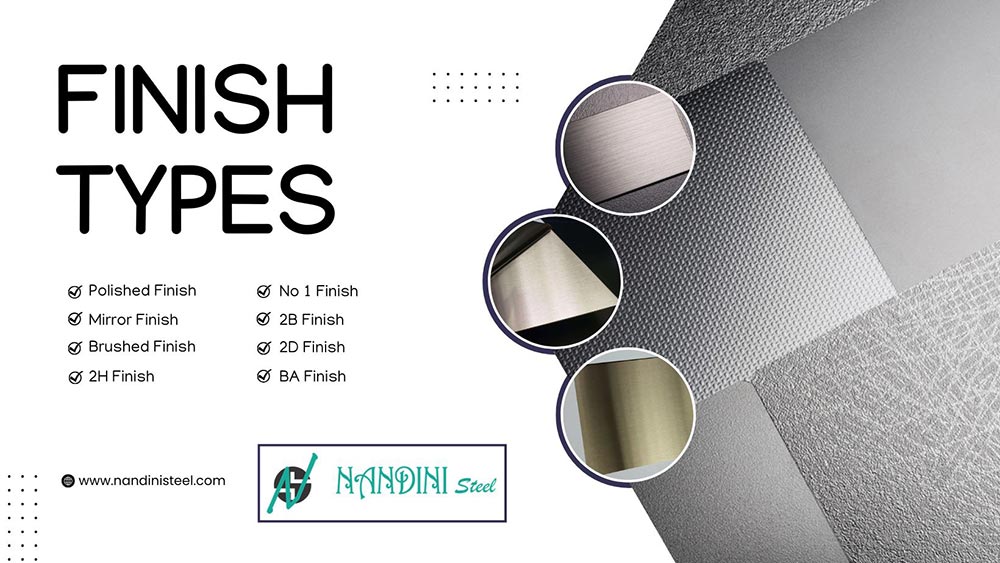
The finish selection changes how the plate looks, how it welds, and where it gets used. 2B gives a smooth, matte, mill-standard surface for general fabrication. BA delivers a bright finish for hygienic work. No. 4 brushed and mirror finishes are used for architectural cladding and food-contact equipment. Hairline suits appliance panels. Hot-rolled, annealed, and pickled plates stay unpolished, meant for structural fabrication where appearance doesn’t matter.
316 Stainless Steel Plate Types

SS 316 Chequered Plate

SS 316 Polished Plate

SS 316 Hot Rolled Plate

SS 316 CR Plates

Stainless Steel 316 Clad Plate

Stainless Steel 316 Rolling Plate

Matt PVC SS 316 Plate

2B SS 316 Plates
316 Stainless Steel Plate Chemical Composition
The chemical composition of ASTM A240 Type 316 plate, along with its proportion, is shown in the table below.
| Element | C | Mn | P | S | Si | Cr | Ni | Mo | Ti | Fe |
| Composition (%) | 0.08 max | 2.00 max | 0.045 max | 0.030 max | 0.75 max | 16.0 to 18.0 | 10.0 to 14.0 | 2.00 to 3.00 | 5 x C min, 0.70 max | Balance |
316 Stainless Steel Plate Mechanical Properties
| Property | Tensile Strength (min) | Yield Strength, 0.2% Offset (min) | Elongation (min) |
| Metric | 515 MPa (75 ksi) | 205 MPa (30 ksi) | 35% |
316 Stainless Steel Plate Equivalent Grades
| Country / Standard | Designation |
| USA (ASTM/AISI) | AISI 316 / ASTM A240 Type 316 |
| USA (UNS) | UNS S31600 |
| USA (SAE) | SAE 316 |
| Europe (EN / W.Nr) | 1.4401 / X5CrNiMo17-12-2 |
| UK (BS) | 316S31 |
| France (AFNOR) | Z6CND17-11 |
| Japan (JIS) | SUS 316 |
| China (GB) | 06Cr17Ni12Mo2 |
| Russia (GOST) | 08Kh17N13M2T or 03Kh17N14M3 |
| India (IS) | IS 6911 Gr X04Cr17Ni12Mo2 |
| Sweden (SIS) | SIS 2347 |
| Trade Name | 18/10/2 stainless steel |
Applications of 316 Stainless Steel Plates
316 Stainless Steel Plate performs across several sectors, each drawing on a different property of the alloy.

Chemical Processing
Tanks, reactors, and process equipment handle acids and aggressive chemical mixes without rapid material loss. Heat exchangers benefit from the same resistance, since fluid contact stays constant.
Marine and Offshore
Marine equipment, coastal structures, and offshore components are constantly exposed to salt spray. Chloride resistance keeps pitting and crevice attack manageable over years of service.
Food Processing
Processing equipment, storage vessels, and food-handling equipment need a surface that doesn’t react with acidic or salty products, holding up under repeated washdown cycles.
Pharmaceutical
Process equipment, storage systems and hygienic environments need a smooth, non-reactive surface that can endure repeated cleaning and sterilisation.
Oil and Gas
Equipment exposed to corrosive service, including sour gas and produced water, needs the extra chloride resistance this grade provides over standard grades.
Architectural and Construction
Cladding, facades and decorative components use this grade where outdoor exposure and appearance both matter, with finish options that support both requirements.
316 SS Plate vs 304 Stainless Steel Plate
| Aspect | 304 (UNS S30400) | 316 (UNS S31600) | Practical Implication |
| Chemical Composition (Typical) | Cr 18–20%, Ni 8–10.5%, C ≤ 0.08, Mn ≤ 2%, Si ≤ 0.75%, Mo ≈ 0% | Cr 16–18%, Ni 10–14%, C ≤ 0.08, Mn ≤ 2%, Si ≤ 0.75%, Mo 2–3% | 316 trades a little Cr for higher Ni and adds Mo to stabilize the passive film against chlorides |
| Molybdenum Content | ~0% (not specified) | 2.0–3.0% | Mo is the single largest factor improving chloride pitting resistance |
| Chloride Resistance | Moderate; pitting can initiate around ~200 ppm Cl⁻ at ambient temperature in aggressive conditions | Good; typically resists ~1,000–2,000 ppm Cl⁻ at ambient temperature; much better in salt spray and seawater splash zones | 316 holds up in coastal and chemical settings where 304 fails early |
| Pitting Resistance (PREN) | PREN ≈ 18–20 | PREN ≈ 23–26 (some calculations ~24–28 depending on N) | Higher PREN means better resistance to localized attack in chloride media |
| Cost Considerations | Lower alloy cost; widely available | Typically 20–40% higher than 304 (driven by Mo and Ni) | Grade selection becomes a cost-versus-service-life decision |
| Typical Applications | Indoor architectural, kitchen equipment, food processing (non-salty), tanks and piping for mild chemicals, general fabrication | Marine hardware, coastal structures, chemical and pharmaceutical processing, desalination, high-chloride food environments (brine, pickling), medical implants and equipment | Chloride exposure determines which grade fits |
316 Stainless Steel Plate vs 316L Plate
Carbon content separates 316 SS Plate and 316L SS Plate, which affects how each behaves after welding.
| Aspect | 316 (UNS S31600) | 316L (UNS S31603) | Practical Implication |
| Carbon Content | ≤ 0.08% max | ≤ 0.03% max (low carbon) | Lower C in 316L limits chromium-carbide precipitation during welding/heat exposure |
| Welding Considerations | Can be welded, but higher C increases sensitization risk in thick sections or multi-pass welds unless post-weld solution annealed | Excellent weldability; low C reduces carbide precipitation, allowing use in the as-welded condition for most thicknesses | 316L avoids the extra annealing step that 316 often needs after welding |
| Intergranular Corrosion (IGC) | Higher risk in the HAZ after welding or exposure to 425–850 °C (800–1560 °F) if not annealed | Much lower IGC risk; 316L is specifically designed to resist sensitization in the as-welded state | 316L suits welded assemblies going straight into corrosive service |
| Fabrication | Similar formability and machinability; may require post-weld anneal for critical corrosion service | Similar formability; often selected to avoid post-weld heat treatment, especially for heavy sections (>6 mm) | Fabrication shops pick 316L to cut a processing step |
| Mechanical Properties (Typical, Annealed) | Tensile ≥ 515 MPa; Yield ≥ 205 MPa; Elongation ≥ 40% (slightly higher strength possible due to higher C) | Tensile ≥ 485–515 MPa; Yield ≥ 170–205 MPa; Elongation ≥ 40% (slightly lower yield/tensile in some specs) | 316 offers a small strength edge where welding isn’t involved |
| Typical Applications | General chemical, marine, and food-processing equipment where welding is limited or post-weld annealing is feasible | Welded tanks, piping, heat exchangers, pressure vessels, marine hardware, and architectural components where as-welded corrosion resistance is required | The choice comes down to how much welding the final assembly needs |
Quality Testing and Inspection of 316 SS Plates
Every batch goes through a defined inspection sequence before dispatch, covering composition, mechanical behaviour and surface condition.
- Chemical composition analysis confirms that chromium, nickel, molybdenum, and carbon levels fall within the A240 range.
- Tensile testing verifies that the plate reaches the 515 MPa minimum required for the grade.
- Yield strength testing checks that the material meets the 205 MPa minimum at room temperature.
- Hardness testing confirms the plate stays under the 217 HB ceiling.
- Dimensional inspection measures thickness, width, length, and flatness against A480 tolerances.
- Surface inspection checks for scale, pitting, or finish defects across the plate.
- PMI, or positive material identification, confirms alloy grade using portable X-ray equipment.
- Ultrasonic testing detects internal laminations in thicker plates, where applicable.
- Third-party inspection allows independent verification when a specification needs it.
- A Mill Test Certificate accompanies every shipment, traceable to the heat number.
Request a quote or check stock availability by contacting our Mumbai team directly.
316 Stainless Steel Plate Weight Chart
To find the weight of a 316 SS plate (in kg), multiply its thickness, width, and length (all in mm) by 0.000008.
Weight (kg) = Thickness × Width × Length × 0.000008
| Thickness | Weight per sq ft |
| 3/16 in. (approx. 5 mm) | 8.58 lb |
| 1/4 in. (approx. 6 mm) | 11.16 lb |
| 3/8 in. (approx. 10 mm) | 16.50 lb |
| 1/2 in. (approx. 12 mm) | 21.63 lb |
Distributor of the Following Manufacturers
We are an approved supplier of stainless steel sheet products, distributing high-quality material sourced directly from the following leading mills.

Aperam

Outokumpu

Nippon Steel


JFE Steel Corporation
Stainless Steel 316 Plate Finish Types
We supply SS sheets in Mumbai, Delhi, Chennai, Kolkata, Bengaluru, Hyderabad, Pune, Ahmedabad and many other cities. Ex-stock dispatch within 3 to 5 working days.
| Mumbai (Maharashtra) | Delhi | Bengaluru (Karnataka) | Chennai (Tamil Nadu) |
| Kolkata (West Bengal) | Hyderabad (Telangana) | Ahmedabad (Gujarat) | Pune (Maharashtra) |
| Jaipur (Rajasthan) | Surat (Gujarat) | Chandigarh | Lucknow (Uttar Pradesh) |
| Indore (Madhya Pradesh) | Coimbatore (Tamil Nadu) | Kochi (Kerala) | Visakhapatnam (Andhra Pradesh) |
| Nagpur (Maharashtra) | Patna (Bihar) | Bhopal (Madhya Pradesh) | Vadodara (Gujarat) |
| Mysuru (Karnataka) | Thane (Maharashtra) | Rajkot (Gujarat) | Vijayawada (Andhra Pradesh) |
| Agra (Uttar Pradesh) | Nashik (Maharashtra) | Guwahati (Assam) | Kanpur (Uttar Pradesh) |
| Faridabad (Haryana) | Gurugram (Haryana) | Noida (Uttar Pradesh) | Shimla (Himachal Pradesh) |
| Raipur (Chhattisgarh) | Udaipur (Rajasthan) | Bhubaneswar (Odisha) | Dehradun (Uttarakhand) |
| Ranchi (Jharkhand) | Jamshedpur (Jharkhand) | Chandrapur (Maharashtra) | Dhanbad (Jharkhand) |
| Aligarh (Uttar Pradesh) | Aurangabad (Maharashtra) | Tiruchirappalli (Tamil Nadu) | Srinagar (Jammu & Kashmir) |
| Ludhiana (Punjab) | Warangal (Telangana) | Bikaner (Rajasthan) | Panaji (Goa) |
| Guntur |
Global Supply
| Region | Countries | |||||
| Middle East | Oman, Kuwait, Turkey, Yemen, Syria, Jordan, Cyprus, Saudi Arabia, Iran, Iraq, UAE, Qatar, Bahrain | |||||
| Africa | South Africa, Libya, Egypt, Sudan, Gabon, Nigeria, Algeria, Angola, Equatorial Guinea, The Republic Of Congo | |||||
| North America | Costa Rica, Puerto Rico, Trinidad And Tobago, Jamaica, Bahamas, USA, Canada, Mexico, Panama | |||||
| Europe | Netherlands, Belgium, Greece, Portugal, Hungary, Denmark, Russia, Norway, Germany, France, Italy, UK, Spain, Ukraine, Croatia, Slovenia, Malta, Albania, Austria, Switzerland, Slovakia, Finland, Ireland, Czech Republic | |||||
| Asia | India, Japan, Sri Lanka, Maldives, Bangladesh, Myanmar, Taiwan, Cambodia, Singapore, Malaysia, Indonesia, Thailand, Vietnam, South Korea | |||||
| South America | Venezuela, Colombia, Ecuador, Guyana, Paraguay, Uruguay, Argentina, Bolivia, Brazil, Chile | |||||
Frequently Asked Questions
What Is the ASTM Standard for 316 Stainless Steel Plate?
ASTM A240 covers 316 stainless steel plate, sheet, and strip. It sets composition limits, mechanical property minimums, and general requirements for the material.
What Is the UNS Number of a 316 SS Plate?
The UNS number for standard 316 is S31600. 316L carries S31603, and 316H is designated S31609.
Is ASTM A240 316 Stainless Steel Plate Resistant to Chloride Corrosion?
Yes. The 2 to 3 percent molybdenum content improves resistance to chloride pitting and crevice corrosion compared to 304, but performance still depends on temperature and concentration.
What Are Stainless Steel 316 Plates Used For?
These plates go into chemical tanks, marine equipment, pharmaceutical systems, food handling units, oil and gas components, and architectural cladding.
What Is the Difference Between 304 and 316 Stainless Steel Plate?
316 SS plate contains 2 to 3% molybdenum, which 304 SS plate lacks. That addition gives 316 stronger resistance to chloride pitting, at a cost premium of 20 to 40% over 304.
What Sizes and Thicknesses Are Available in 316 Stainless Steel Plate?
Standard sizes range from 1000 × 2000 mm up to 2000 × 6000 mm, with thicknesses between 0.5 mm and 100 mm depending on size and finish.
