


Abrasion Resistant Steel Plates are high-hardness steel products designed to withstand friction, impact, and continuous material movement. Mines, crushers, and conveyor systems can subject conventional steel surfaces to severe abrasive wear. These plates hold up far longer under that same load. Nandini Steel supplies Abrasion Resistant Plates/Sheets for mining, construction, material handling, cement and recycling operations where surfaces face constant grinding, sliding, or impact.
What Is Abrasion-Resistant Steel?
Abrasion-resistant steel is steel hardened through controlled heat treatment so its surface resists cutting, gouging, and wearing away under repeated contact with abrasive material. Hardness does the actual work; it slows the rate at which a surface loses material to friction. Plates in service can experience different forms of wear, including abrasion, sliding contact, and impact, often in combination. The right grade extends component life by years over standard steel. Grade selection depends on how severe the wear is and what load the plate takes.
How AR Steel Works
Six factors decide how a plate performs, not hardness alone.
Hardness
Hardness provides a useful indicator of resistance to cutting and gouging and is commonly considered when comparing abrasion-resistant grades.
Wear Resistance
Wear resistance is the practical outcome of hardness, chemistry, and microstructure working together, not a fixed number tied to hardness alone.
Impact Resistance
Impact resistance leans more on toughness than raw hardness. A very hard plate can still crack under a hard strike if toughness is low.
Toughness
Toughness is the ability to flex and absorb shock without fracturing. Higher hardness grades often give up some toughness in exchange.
Plate Thickness
Thickness changes how a plate handles bending stress. Thin sections flex more; thick sections resist deformation but add weight and fabrication cost.
Operating Conditions
Temperature, moisture, and the type of abrasive material change how a plate wears in real service, not just in a lab test. Higher hardness does not automatically make a grade the right fit; the application determines the best match.
Types and Grades of Abrasion Resistant Steel Plates
Nandini Steel supplies multiple hardness classes, each matched to a different wear severity.
Rockstar 400 Abrasion Resistant Plate
Abrasion Resistant Rockstar 400 Sheets & Plates are in the 360 to 440 HBW range and handle general abrasive wear from sliding and material flow. It is suitable for chutes, hoppers, and bucket liners, and it can be formed and welded without the heavy preheat control that higher grades require.
Rockstar 500 Abrasion Resistant Plate
Rockstar 500 Sheets and Plates have a higher hardness in the range of 477 to 534 HBW and it is designed for more severe abrasive wear than Rockstar 400 Crusher liners, and high-wear mining components use this grade. Welding needs closer attention to preheat and heat input.
Heavy-Duty Abrasion-Resistant Plates vs. Wear-Resistant Steel Plates
The two terms can overlap, but they may refer to different material categories and selection criteria. The table below shows where each stands in practice.
Abrasion Resistant (AR) Steel Plate Specifications
| Parameter | AR200 / AR235 | AR400 / 400F | AR450 / 450F | AR500 | AR600 |
| Hardness (HBW) | ~235 typical (not tested) | 360–440 (nominal 400) | 430–480 (nominal 450) | 477–534 (nominal 500) | 550–620 (nominal 600) |
| Thickness | 3/16″ – 3/4″ (4.8–19 mm) | 3/16″ – 4″ (4.8–100 mm) | 3/16″ – 2″ (4.8–50 mm) | 3/16″ – 2″ (4.8–50 mm) | 3/16″ – 3/4″ (4.8–19 mm) |
| Width | 48″ – 120″ (1220–3050 mm) | 48″ – 120″ (1220–3050 mm); up to 3000 mm | 48″ – 96″ (1220–2440 mm); up to 2500 mm | 48″ – 96″ (1220–2440 mm); up to 2500 mm | 48″ – 96″ (1220–2440 mm) |
| Length | 96″ – 480″ (2440–12190 mm) | 96″ – 480″ (2440–12190 mm) | 96″ – 480″ (2440–12190 mm) | 96″ – 480″ (2440–12190 mm) | 96″ – 480″ (2440–12190 mm) |
| Surface Condition | As-rolled (mill scale) | Quenched & tempered; shot-blasted or primer-coated available | Quenched & tempered; shot-blasted or primer-coated available | Quenched & tempered; shot-blasted or primer-coated available | Quenched & tempered |
| Heat Treatment | As-rolled (no Q&T) | Quenched & tempered (Q&T) | Quenched & tempered (Q&T) | Quenched & tempered (Q&T) | Quenched & tempered (Q&T) |
| Applicable Standards | ASTM A829 (generic AR) | ASTM A514 / A829; EN 10025-6 (S450J2 / S500J2 equivalent) | ASTM A514 / A829; EN 10025-6 | ASTM A514 / A829; EN 10025-6 | ASTM A514 / A829 (limited availability) |
| Dimensional Tolerances | ASTM A6/A568 (thickness ±, flatness per ASTM A6) | ASTM A6 (thickness tolerance by width/thickness); flatness per ASTM A568 | ASTM A6 (thickness tolerance by width/thickness); flatness per ASTM A568 | ASTM A6 (thickness tolerance by width/thickness); flatness per ASTM A568 | ASTM A6 (thickness tolerance by width/thickness) |
Abrasion Resistant Steel Plate Sizes
| Grade | Thickness (mm) | Thickness (in) | Width (mm) | Width (in) | Length (mm) | Length (in) |
| AR200 / AR235 | 4.8 – 19 | 3/16 – 3/4 | 1220 – 3050 | 48 – 120 | 2440 – 12190 | 96 – 480 |
| AR400 | 2.5 – 60 (cut lengths 2.5–6.4; heavy plates 5–60) | 0.10 – 2.36 (commonly 3/16″ – 4″) | 1200 – 2500 (typ. 1500, 2000, 2500) | 48 – 98 (typ. 60, 72, 96) | 3000 – 12000 (up to ~14630) | 118 – 480 (up to 576″) |
| AR450 | 3 – 50 (some mills 3–60) | 0.12 – 2.0 (commonly 3/16″ – 2″) | 1200 – 2500 (typ. 1500, 2000, 2500) | 48 – 98 | 3000 – 12000 | 118 – 480 |
| AR500 | 3 – 50 (some up to 60) | 0.12 – 2.0 (commonly 3/16″ – 2″) | 1200 – 2500 (typ. 1500, 2000, 2500) | 48 – 98 | 3000 – 12000 | 118 – 480 |
| AR600 | 4.8 – 19 (limited) | 3/16 – 3/4 | 1220 – 2440 | 48 – 96 | 2440 – 12190 | 96 – 480 |
Other Types of Abrasion Resistant Sheets & Plates
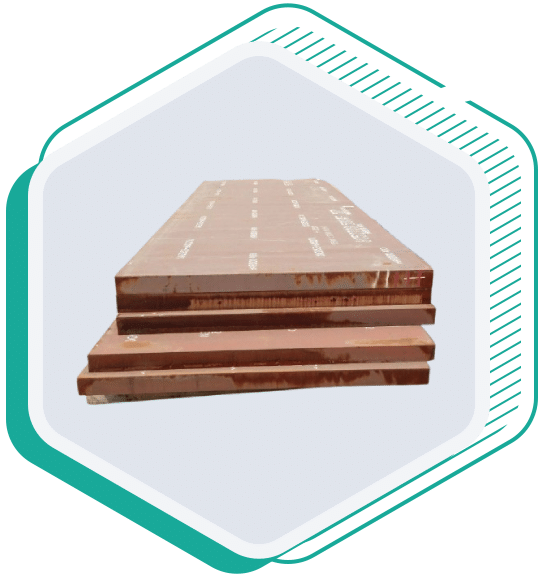
Abrasion Resistant Steel Plate
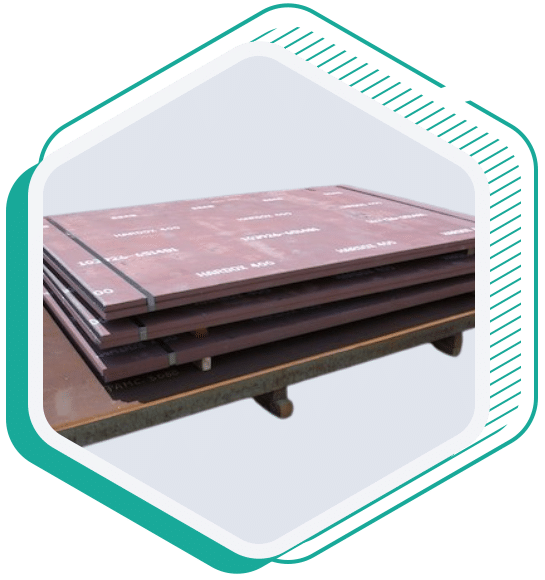
Abrasion Resistant Steel Sheet
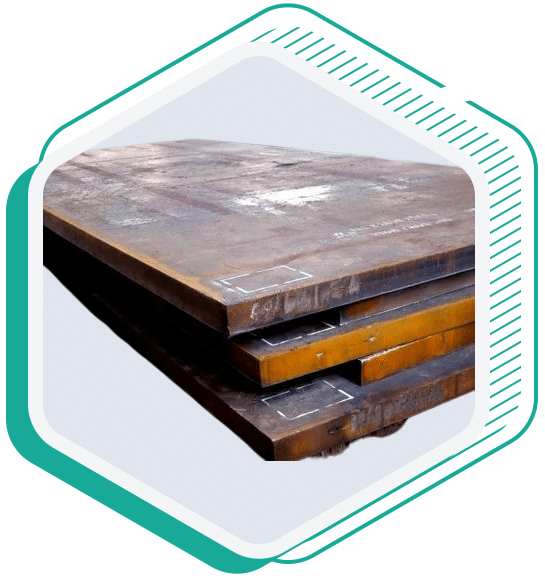
Abrasion Resistant Wear Plate
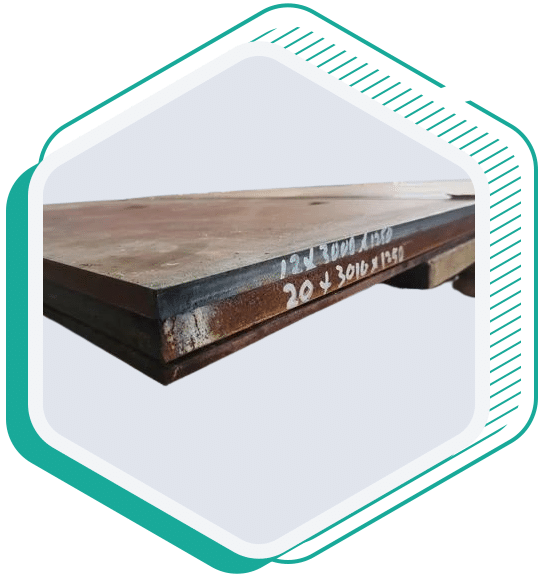
Abrasion Resistant Sheet Metal
Quality Testing and Inspection
Every batch runs through checks that confirm the plate meets its stated grade before dispatch.
- Hardness testing confirms the plate falls within the stated HBW range for its grade.
- Chemical composition analysis verifies alloy content against the mill specification.
- Tensile testing checks yield strength and elongation where the application calls for it.
- Impact testing measures toughness at specified temperatures for heavy impact duty.
- Dimensional inspection checks thickness, width, length, and flatness against tolerance limits.
- Surface inspection looks for cracks, laminations, or scale defects on the plate face.
- Ultrasonic testing screens for internal defects when the order specification requires it.
- A mill test certificate accompanies each shipment with batch-level chemical and mechanical results.
- Third-party inspection is available on request for buyers needing independent verification.
Applications of Abrasion Resistant Steel Plates/Sheets
Mining
Ore chutes and crusher liners are constantly impacted and sliding-abrasioned by the raw material; therefore, plates here need to have hardness, plus adequate toughness to withstand repeated blows.
Construction
Every day, the edges of buckets and the hulls of dump trucks scrape against soil, gravel and rubble, and untreated steel wears down fast.
Cement Plant
Kiln feed chutes and clinker handling equipment are subject to hot abrasive dusts which quickly wear ordinary steel. Toughened liners are required at all transfer points.
Material Movement
Conveyor chutes and transfer points are continuously exposed to bulk material flow and contact sliding wears surfaces down over time.
Recycling
Mixed scrap has sharp edges and non-uniform density. Shredders and sorting equipment lead to combined cutting wear and impact loading.
Agriculture
Repeated contact with soil and abrasive dust is common to tillage tools and grain handling equipment, and hardened edges retain longer form.
Abrasion Resistant Sheets Plates Specification
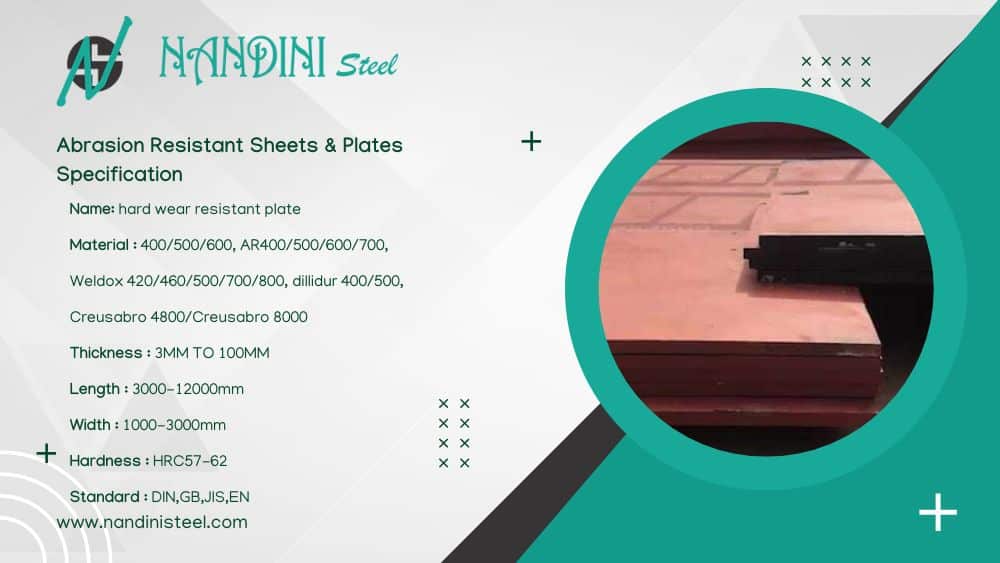
Name: hard wear resistant plate
Material : 400/500/600, AR400/500/600/700, Weldox 420/460/500/700/800, dillidur 400/500, Creusabro 4800/Creusabro 8000
Thickness : 3MM TO 100MM
Length : 3000-12000mm
Width : 1000-3000mm
Hardness : HRC57-62
Standard : DIN,GB,JIS,EN
Abrasion Resistant Sheet Plate Thickness Chart
| Thickness | Width | Length |
|
4 |
2000 |
6000 |
|
5 |
2000 |
6000 |
|
6 |
2000 |
6000 |
|
6 |
2500 |
6000 |
|
8 |
2000 |
6000 |
|
8 |
2500 |
6000 |
|
10 |
2000 |
6000 |
|
12 |
2000 |
6000 |
|
15 |
2000 |
6000 |
|
16 |
2000 |
6000 |
|
20 |
2000 |
6000 |
|
25 |
2000 |
6000 |
|
32 |
2000 |
6000 |
|
40 |
2000 |
6000 |
|
50 |
2000 |
6000 |
|
60 |
1800 |
3400 |
Abrasion Resistant Sheet Plate Stockist Distributor of Following Manufacturers

ThyssenKrupp Make Abrasion Resistant Sheet Plate

Aperam Make Abrasion Resistant Sheet Plate

Outokumpu Make Abrasion Resistant Sheet Plate

Nippon Steel & Sumitomo Metal Make Abrasion Resistant Sheet Plate

Posco Make Abrasion Resistant Sheet Plate

Jindal Make Abrasion Resistant Sheet Plate

JFE Steel Corporation Make Abrasion Resistant Sheet Plate

Essar Make Abrasion Resistant Sheet Plate
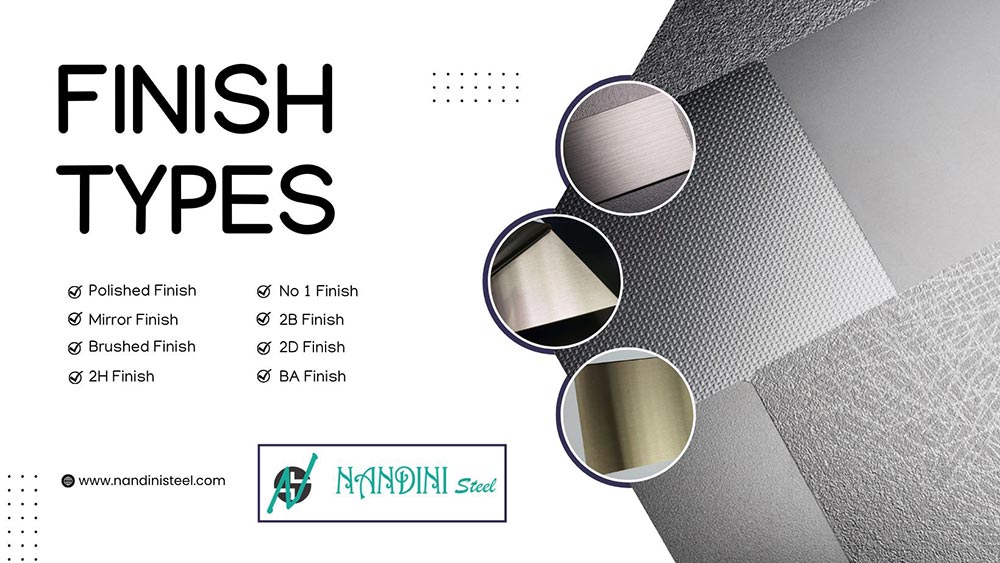
Abrasion Resistant Sheet Plate Finish Types
| Mumbai (Maharashtra) | Delhi | Bengaluru (Karnataka) | Chennai (Tamil Nadu) |
| Kolkata (West Bengal) | Hyderabad (Telangana) | Ahmedabad (Gujarat) | Pune (Maharashtra) |
| Jaipur (Rajasthan) | Surat (Gujarat) | Chandigarh | Lucknow (Uttar Pradesh) |
| Indore (Madhya Pradesh) | Coimbatore (Tamil Nadu) | Kochi (Kerala) | Visakhapatnam (Andhra Pradesh) |
| Nagpur (Maharashtra) | Patna (Bihar) | Bhopal (Madhya Pradesh) | Vadodara (Gujarat) |
| Mysuru (Karnataka) | Thane (Maharashtra) | Rajkot (Gujarat) | Vijayawada (Andhra Pradesh) |
| Agra (Uttar Pradesh) | Nashik (Maharashtra) | Guwahati (Assam) | Kanpur (Uttar Pradesh) |
| Faridabad (Haryana) | Gurugram (Haryana) | Noida (Uttar Pradesh) | Shimla (Himachal Pradesh) |
| Raipur (Chhattisgarh) | Udaipur (Rajasthan) | Kolkata (West Bengal) | Bhubaneswar (Odisha) |
| Dehradun (Uttarakhand) | Ranchi (Jharkhand) | Jamshedpur (Jharkhand) | Chandrapur (Maharashtra) |
| Dhanbad (Jharkhand) | Aligarh (Uttar Pradesh) | Bhubaneswar (Odisha) | Aurangabad (Maharashtra) |
| Tiruchirappalli (Tamil Nadu) | Srinagar (Jammu & Kashmir) | Ludhiana (Punjab) | Warangal (Telangana) |
| Kolkata (West Bengal) | Bikaner (Rajasthan) | Panaji (Goa) | Guntur |
Oman, Kuwait, Turkey, Yemen, Syria, Jordan, Cyprus, Saudi Arabia, Iran, Iraq, UAE, Qatar, Bahrain
South Africa, Libya, Egypt, Sudan, Equatorial Guinea, The Republic Of Congo, Gabon, Nigeria, Algeria, Angola
Costa Rica, Puerto Rica, Trinidad And Tobago, Jamaica, Bahamas, Denmark, USA, Canada, Mexico, Panama
Netherland, Belgium, Greece, Czech Republic, Portugal, Hungary, Russia, Norway, Germany, France, Italy, UK, Spain, Ukraine, Croatia, Slovenia, Malta, Albania, Austria, Switzerland, Slovakia, Finland, Ireland
India, Japan, Sri Lanka, Maldives, Bangladesh, Mayanmar, Taiwan, Cambodia, Singapore, Malaysia, Indonesia, Thailand, Vietnam, South Korea
Venezuela, Colombia, Ecuador, Guyana, Paraguay, Uruguay, Argentina, Bolivia, Brazil, Chile
Frequently Asked Questions
Rockstar 500 has a hardness of 477 to 534 HBW and is great for more aggressive abrasive wear. The Rockstar 400 is meant for general wear applications.
Hardness is measured on the Brinell scale and is indicated as HBW. We will assign a grade range. The area of the plate under test is considered.
Yes, AR plates can be welded. Higher hardness grades need controlled preheat and heat input to avoid cracking, while lower grades weld with fewer precautions.
Yes, these plates can be cut and drilled, though higher hardness grades wear tooling faster and often need plasma or laser cutting instead.
Service life depends on the grade selected, the type of wear faced, plate thickness, and how closely the application matches the grade’s intended duty.


