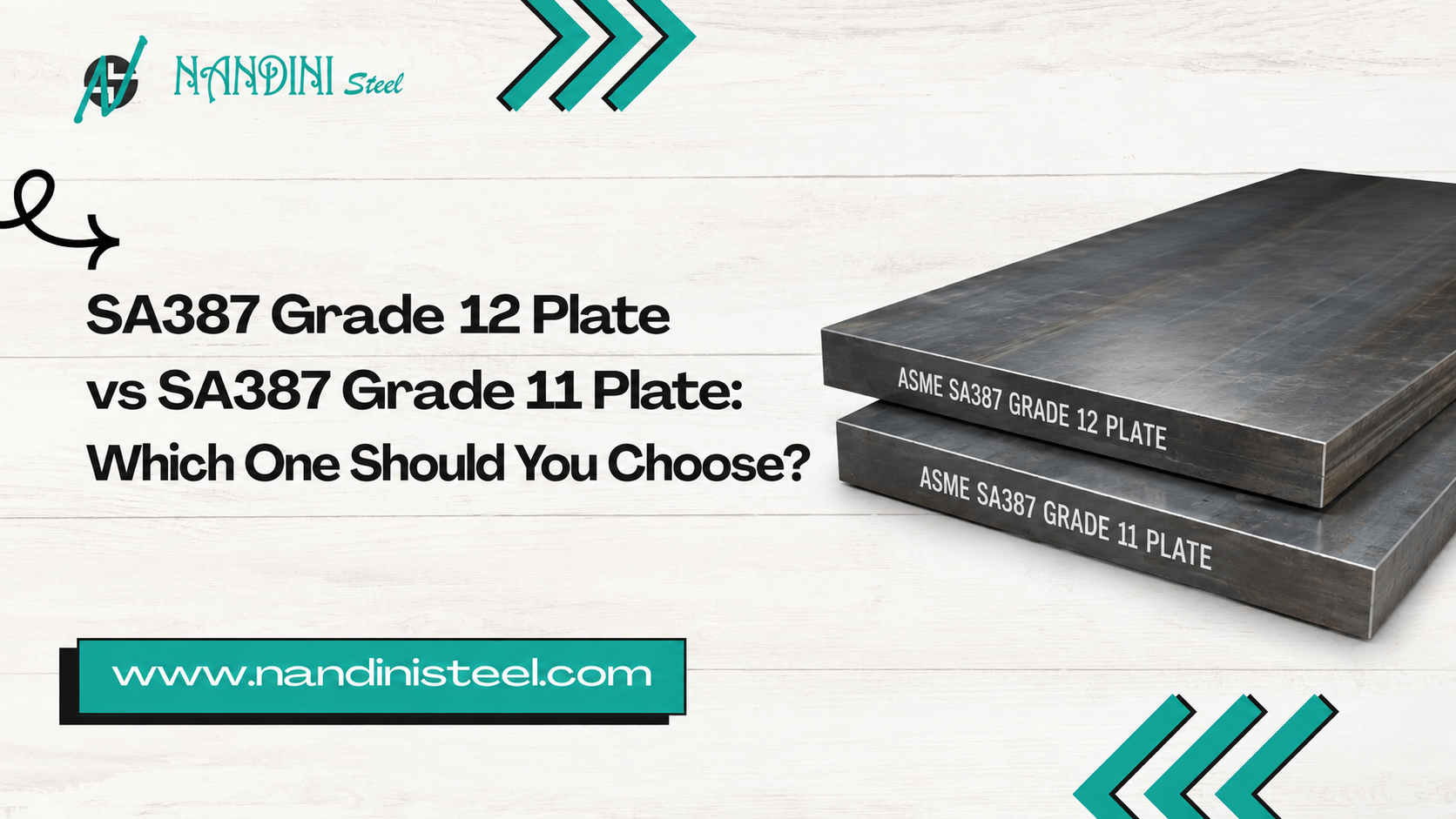
A pressure vessel running at 480°C does not forgive a wrong material choice. Neither does a refinery reactor cycling between startup and shutdown twice a month. SA387 alloy steel plates exist precisely for this kind of service, and two grades from this family, Grade 11 and Grade 12, get compared constantly by engineers sourcing material for boilers, heat exchangers, and process vessels.
Both grades belong to the chromium-molybdenum family of low-alloy steels. Both resist creep at elevated temperatures. Yet the chemistry difference between them changes how each plate performs once the equipment goes into actual service, and that difference affects fabrication cost, maintenance intervals, and total project economics over a 15 to 20 year asset life.
Procurement teams sourcing SA387 grade 12 class plate often start with a Grade 11 specification sheet already in hand, comparing the two before finalizing a purchase order. This guide walks through the practical differences that matter for that decision, not just the chemistry tables already published on specification sheets.
Understanding SA387 Grade 11 and SA387 Grade 12 Plates
SA387 covers pressure vessel plates made from chromium-molybdenum alloy steel, manufactured under ASME and ASTM standards for service at elevated temperatures. Refineries, power plants, and petrochemical units specify this family because carbon steel alone cannot hold strength or resist hydrogen attack once temperatures climb past 370°C.
Grade 11 carries roughly 1.25% chromium and 0.5% molybdenum. This composition gives it solid performance in moderate-temperature pressure vessel applications, typically up to around 480°C, where hydrogen service and creep resistance both matter but extreme oxidation resistance is not the primary concern.
Grade 12 contains about 1% chromium and 0.5% molybdenum, a leaner chromium content than Grade 11 despite sitting in the same temperature-resistant family. That distinction surprises buyers who assume higher grade numbers always mean higher chromium. In practice, Grade 12 fills a specific niche between Grade 11 and the higher-chromium grades like Grade 22, used where moderate creep strength is needed without the added cost of higher alloy content.
Both grades ship as Class 1 or Class 2, with Class 2 plates normalized and tempered to deliver higher tensile and yield strength than Class 1. Most pressure vessel fabricators specify Class 2 when design margins are tight.
Chemical Composition Differences Between SA387 Grade 11 and Grade 12
Chromium and molybdenum work together in both grades, but the ratio changes the outcome. Chromium forms a protective oxide layer on the steel surface, slowing oxidation at high temperatures. Molybdenum strengthens the steel matrix at elevated temperature and resists the softening that occurs during prolonged heat exposure.
Grade 11’s higher chromium content, around 1.25% against Grade 12’s roughly 1%, gives it a marginal edge in oxidation resistance at the upper end of its service range. Molybdenum content stays similar across both grades, near 0.5%, so creep resistance does not separate them as sharply as buyers sometimes expect.
The composition differences between these two grades are smaller than the gap between either of them and Grade 22 or Grade 91. Engineers choosing between Grade 11 and Grade 12 are fine-tuning a selection within a narrow band, not picking between fundamentally different material families.
Mechanical Properties and High-Temperature Performance
Tensile strength for both grades in Class 2 condition runs in a similar range, typically 515 to 690 MPa, with yield strength around 310 MPa minimum. Toughness, measured through Charpy impact testing, stays comparable between the two grades at standard test temperatures.
Where the two grades start to diverge is creep behavior under sustained load above 450°C. Grade 11 historically holds a slight advantage in long-term creep rupture strength at the higher end of its rated range, a factor that shows up in ASME Section II Part D allowable stress tables rather than in basic tensile test numbers.
Operating temperature should drive the decision more than any single mechanical property. A vessel cycling between 350°C and 420°C sees little practical difference between the two grades. Push design temperatures toward 480°C and above, and the allowable stress tables start favoring Grade 11 by a measurable margin, which directly affects how thick the plate needs to be for a given pressure rating.
Corrosion Resistance and Service Life Considerations
Neither grade was designed for aggressive corrosive media the way stainless steel or nickel alloys are. Both rely on their chromium-molybdenum chemistry primarily for high-temperature strength and hydrogen attack resistance, with general corrosion resistance as a secondary benefit.
Grade 11’s higher chromium content does translate into marginally better resistance to oxidizing atmospheres at elevated temperature, which matters in fired heater applications and certain refinery process streams. Service life in these conditions depends heavily on actual operating temperature, cycling frequency, and the corrosiveness of the process fluid, not on chemistry alone.
Grade 12 holds its own in services where hydrogen attack resistance matters more than oxidation resistance, since its molybdenum content provides similar protection against hydrogen-induced damage at a lower alloy cost. For vessels processing hydrogen-rich streams below 450°C, Grade 12 often provides similar service life to Grade 11 at a better material cost.
Applications Where SA387 Grade 11 Is Commonly Used
Refinery hydroprocessing units specify Grade 11 plate for reactors and heat exchangers operating in the 400°C to 480°C range, where hydrogen partial pressure and elevated temperature combine to demand reliable creep resistance. Power generation boilers also use Grade 11 for components exposed to sustained high-temperature steam service.
Petrochemical plants building distillation towers and process vessels that run continuously at moderate-to-high temperatures often default to Grade 11 because of its established track record and the depth of allowable stress data published across decades of ASME code editions. Fabricators familiar with welding Grade 11 also find it predictable across long production runs.
Applications Where SA387 Grade 12 Is Preferred
Pressure vessels in catalytic reforming units, where hydrogen service combines with moderate temperatures around 400°C to 450°C, frequently specify Grade 12 to balance cost against performance. Grade 12 is also used in boiler drums and headers in industrial steam generation, where the design temperature is below the temperature at which the chromium advantage of grade 11 becomes relevant.
Process equipment manufacturers select Grade 12 Class 2 specifically when the design requires higher strength than Class 1 offers but the operating envelope does not push into territory where Grade 11’s marginal oxidation resistance edge justifies the added alloy cost. This makes Grade 12 a frequent choice for new-build vessels with tighter capital budgets and well-defined, moderate operating temperatures.
Cost vs Performance: Is Grade 12 Worth the Additional Investment?
Grade 12 typically carries a lower material cost than Grade 11 due to its reduced chromium content, reversing the assumption that higher grade numbers cost more. The real cost comparison, though, has to account for plate thickness, since lower allowable stress at high temperature can force a thicker plate to meet the same pressure rating.
A vessel operating near 480°C might need a Grade 12 plate 10% to 15% thicker than the Grade 11 equivalent to hit the same design margin, erasing much of the per-ton price advantage once fabrication and welding costs are added. Below 420°C, that thickness penalty narrows or disappears, and Grade 12 becomes the more economical choice outright.
Lifecycle cost matters more than the purchase order line item. A vessel that needs unplanned shutdown for inspection or repair five years into a 20-year design life costs far more in lost production than the material price difference ever would. Matching the grade to the actual operating envelope, rather than defaulting to whichever grade looks cheaper on the mill invoice, protects that lifecycle value.
Factors to Consider Before Choosing Between Grade 11 and Grade 12
Operating temperature is the most important factor. Anything consistently above 450°C points toward Grade 11; service staying below that threshold opens the door to Grade 12 without a meaningful performance tradeoff.
Process environment matters next, particularly hydrogen partial pressure and any oxidizing components in the stream. Before finalizing, check the design requirements from the vessel’s stress analysis (required plate thickness, weld procedure qualifications, etc.) for both grades.
Regulatory and code requirements, particularly ASME Section VIII and the applicable Section II Part D stress tables, set the allowable limits for each grade at the design temperature. Long-term performance expectations, including planned turnaround intervals and inspection schedules, should factor into the decision alongside straightforward budget constraints.
Common Selection Mistakes and How to Avoid Them
Choosing a grade purely on per-ton price is the most frequent and costly mistake in this comparison. A lower material cost that forces thicker plate, more welding, and tighter inspection schedules rarely saves money once the full fabrication and maintenance picture is considered.
Another common error is assuming higher grade numbers always mean better performance across every property. Grade 12’s lower chromium content compared to Grade 11 contradicts that assumption directly, and engineers who skip the actual stress table comparison sometimes specify the wrong grade based on number sequence alone.
Skipping a detailed review of actual operating temperature, including transient conditions during startup and shutdown, leads to undersized margins. A vessel rarely runs at one fixed temperature; its design needs to account for the full operating range, not just the steady-state number on the process datasheet.
Conclusion
SA387 Grade 11 and Grade 12 plates share a common family but diverge in ways that matter once a vessel goes into service. Grade 11’s higher chromium content suits the upper end of elevated-temperature applications, while Grade 12 delivers comparable performance at lower cost for moderate-temperature, hydrogen-service equipment.
The right alloy steel plate for any project depends on actual operating temperature, process chemistry, and design stress requirements rather than price alone. Review your vessel’s full operating envelope, including startup and shutdown transients, before finalizing whether sa387 grade 12 class 2 or Grade 11 fits your application.
Contact Nandini Steel‘s technical team to confirm grade selection against your specific design temperature and pressure rating.