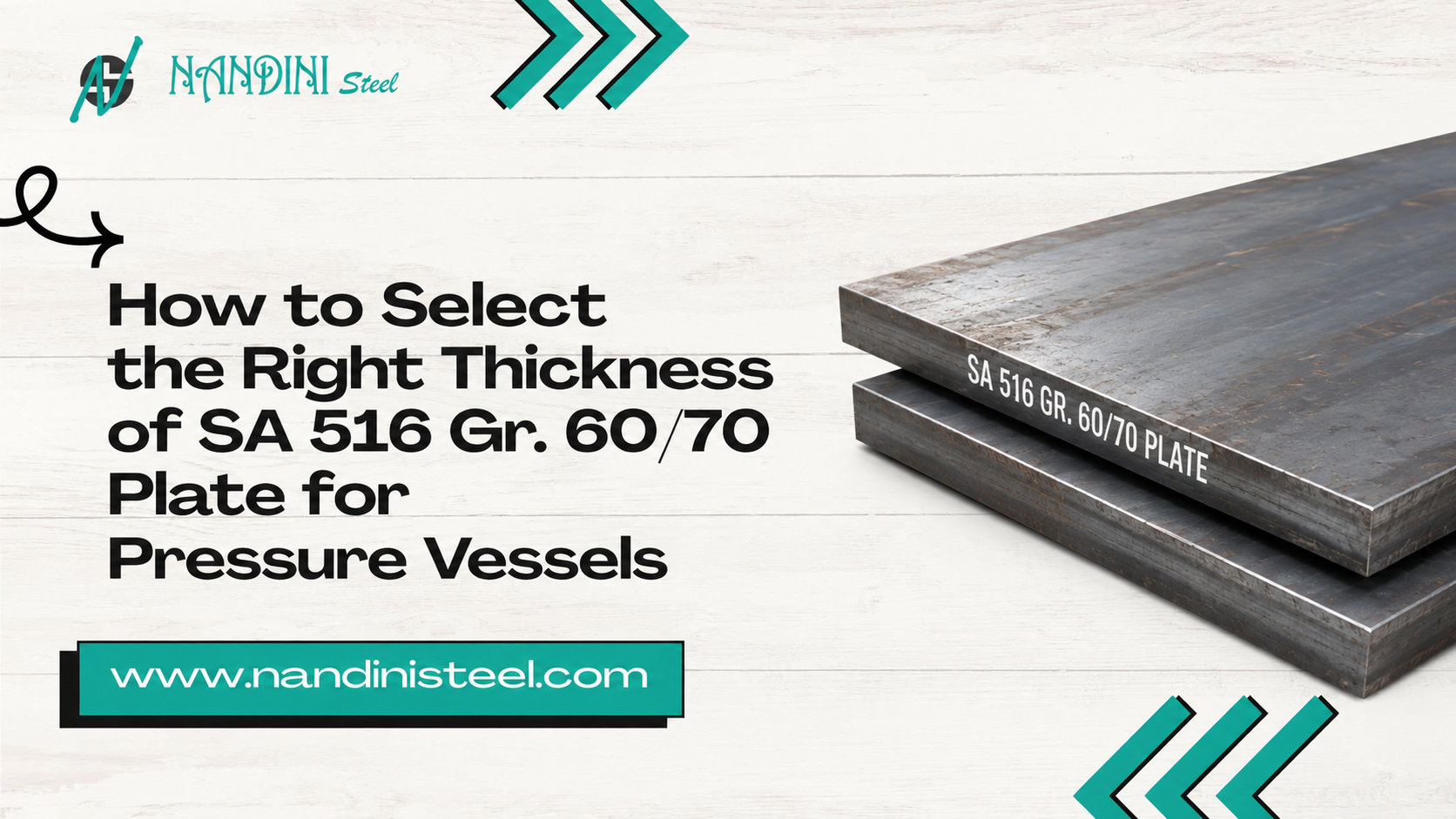
Plate thickness is at the center of every pressure vessel design decision. Get it right and the vessel performs safely across its intended service life. Get it wrong and the consequences range from premature failure to catastrophic rupture. Engineers working with SA 516 Gr. 60/70 Plate face this calculation on every project, because the right number depends on a combination of operating conditions, material properties, applicable codes, and fabrication constraints. Thickness must be calculated, not assumed. The SA 516 Gr. 60/70 Plate Furnace Normalized grade adds another variable into that calculation, since normalizing affects mechanical behavior in ways that influence how the final section performs under pressure, temperature, and cyclic stress.
Why Plate Thickness Matters in Pressure Vessel Design
Pressure vessels exist to contain fluids or gases under conditions that would otherwise be dangerous. The plate forms the primary containment barrier. Thickness determines how much hoop stress and longitudinal stress the shell can sustain before the material yields or fractures. Safety margins exist specifically to account for manufacturing tolerances, material variability, and service degradation over years of operation. A vessel designed with inadequate thickness enters service already closer to its failure point than the engineer calculated. Service life projections in heavy industrial applications routinely run 20 to 30 years, and the plate selected on day one must still perform reliably on day ten thousand. Thickness is a calculated minimum that carries safety implications beyond the initial build.
Factors That Influence SA 516 Gr. 60/70 Plate Thickness Selection
Several variables feed directly into the thickness calculation, and each one must be assessed individually before settling on a final figure.
- Operating pressure sets the baseline load that the shell wall must resist. Higher design pressures demand thicker sections to keep circumferential stress within the allowable limits defined by ASME Section VIII.
- Design temperature affects the allowable stress value used in calculations. SA 516 Gr. 70 loses allowable stress at elevated temperatures, which can push required thickness upward even when operating pressure stays constant.
- Vessel diameter scales the hoop stress directly. A 3,000 mm diameter shell at the same pressure as a 1,000 mm shell requires a proportionally thicker wall to carry the same stress safely.
- Corrosion allowance adds material beyond the calculated minimum to compensate for wall loss over the operating life. This addition varies by fluid chemistry and expected service duration.
- Industry codes and standards such as ASME BPVC Section VIII Div. 1 or Div. 2 prescribe the calculation method and the minimum thicknesses permitted for specific applications.
- Expected service life determines how aggressively the corrosion allowance must be applied. Vessels designed for 30-year service in corrosive media need more reserve material than those operating in clean environments for 10 years.
Understanding the Difference Between Grade 60 and Grade 70 in Thickness Selection
Grade 70 has a minimum tensile strength of 485 MPa compared to 415 MPa for Grade 60. The higher strength allows a higher allowable stress in the ASME calculations which can reduce the calculated minimum thickness for a given pressure and diameter. A fabricator working with Grade 70 may achieve the same pressure rating with a slightly thinner plate than Grade 60 would require, influencing material weight, welding costs, and transportation. Grade 60 still finds preference where impact performance at sub-zero temperatures takes priority, or where the operating temperature is low enough that the strength advantage narrows. Furnace-normalized SA 516 Gr. 60/70 Plate improves toughness across both grades, which matters where brittle fracture risk must be controlled.
How Operating Conditions Affect Required Plate Thickness
High-pressure applications operating above 10 MPa push thickness requirements substantially beyond what lower-pressure vessels demand. Allowable stress values decrease as temperature rises, meaning a vessel at 350 degrees Celsius requires thicker walls than an identical vessel at ambient temperature, even with the same internal pressure. Cyclic loading adds fatigue to the failure mechanisms. Vessels that experience repeated pressurisation and depressurisation cycles accumulate fatigue damage over time, and thicker sections carry lower stress amplitudes for the same pressure cycle, extending fatigue life. Hydrogen sulfide environments, chloride-containing media, and acidic process fluids all attack the base metal, and each calls for a tailored assessment of the additional thickness the vessel needs.
The Role of Corrosion Allowance in Thickness Calculations
Corrosion allowance is the additional thickness added to the calculated pressure-design minimum to account for material loss during service. It does not contribute to the pressure containment capability. The point of it is to make sure that after years of the walls getting thinner, the remaining metal is still greater than the minimum required for safe operation. Corrosion allowances of 3 mm to 6 mm are common for oil and gas applications that include sour service or wet hydrogen sulfide. Conservative allowances are normally used in refining crude fractions with varying sulfur contents to provide flexibility as the feedstock composition varies. Chemical plants working with halogenated compounds specify corrosion allowances based on laboratory testing of material compatibility, since generalised values may underestimate actual attack rates.
Common Thickness Ranges Used in Pressure Vessel Fabrication
Pressure vessel shells typically use plate thicknesses between 6 mm and 100 mm. Small-diameter, low-pressure vessels below 1 MPa often use plates in the 6 mm to 12 mm range. Mid-range vessels at 3 MPa to 7 MPa and diameters between 1,000 mm and 2,000 mm commonly fall in the 16 mm to 40 mm range. High-pressure reactors above 10 MPa frequently require a 50 mm to 80 mm plate, and some hydrocracker vessels use sections above 100 mm. The precise value derives from the engineering calculation rather than a rule of thumb. ASME Section VIII Division 1 provides the governing formula, and the inputs control the output.
Challenges of Using Excessively Thin or Overly Thick Plates
Insufficient thickness creates a safety risk that fabrication quality control cannot compensate for. A plate below the code minimum may pass hydrostatic testing at commissioning, then fail after wall thinning brings it below the minimum during operation. Fatigue cracks in under-thickness shells propagate faster. Excessive thickness drives up material cost, increases welding passes, extends post-weld heat treatment times, and adds weight that raises transportation and foundation costs. The goal is a calculated optimum: enough material to satisfy the design code and the appropriate corrosion allowance, without adding metal that inflates cost and weight without engineering benefit.
Key Considerations Before Finalising Plate Thickness
Both design pressure and operating temperature should be confirmed before calculations are made, since nominal ratings on purchase orders sometimes differ from actual service conditions. The temperature profiles should take into account local hot spots due to internal heaters or reaction zones. Close tolerances on dimensions after rolling and welding require sufficient base material, thus limiting the practical minimum thickness due to fabrication requirements. Inspection requirements under radiography or ultrasonic testing also depend on thickness and joint category. Where multiple codes apply, the most conservative governs. Future operating conditions deserve consideration in long-life vessels, since building in modest additional thickness during initial fabrication costs far less than a retrofit or replacement years later.
Industries Where Thickness Selection Is Critical
Oil and gas separators, scrubbers, and slug catchers operate in environments combining pressure, hydrogen sulfide, and chloride-laden produced water, each factor independently driving thickness upward. Petrochemical processing vessels handling ethylene or propylene at elevated pressures must meet strict fatigue life requirements because process upsets produce damaging pressure cycles. Power generation applications in high-pressure steam circuits operate at temperatures where creep becomes a design concern alongside pressure containment. Refineries specify heavy-wall reactors for hydroprocessing units operating above 10 MPa hydrogen partial pressure, where Nelson curve compliance and hydrogen embrittlement resistance influence the design. Chemical plants handling strong acids face corrosion rates that consume several millimetres of wall annually.
Conclusion
Selecting the right thickness for SA 516 Gr. 60/70 Plate in pressure vessel applications comes down to a calculated response to actual service conditions. Operating pressure, design temperature, vessel diameter, corrosion allowance, applicable code, and expected service life all feed into the engineering calculation that produces the correct answer. Deciding whether SA 516 Gr. 60/70 Plate Furnace Normalized is appropriate follows the same logic: match the material properties to the service demands and confirm compliance with the governing standard. Both under-thickness and over-thickness carry real consequences. Nandini Steel stocks SA 516 Gr. 60/70 Plate with full mill test certifications to ASTM and ASME standards. Contact Nandini Steel to confirm plate availability, thickness range, and certification requirements for your next pressure vessel project.