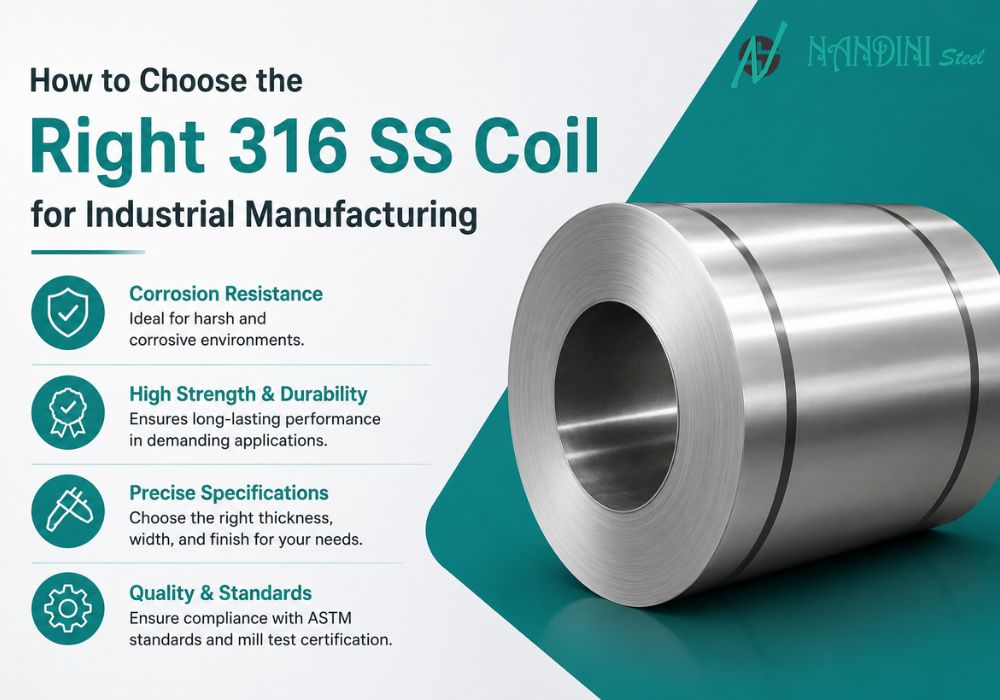
A 316 stainless steel coil performs better than 304 in chloride-rich and high-temperature environments, where corrosion resistance becomes more demanding. Choosing the correct coil is not a single decision. It depends on the application, the dimensions needed, the finish specified, and the operating conditions the material will face once installed. Get any one of these wrong and fabrication gets harder, corrosion resistance drops, and rework costs pile up. This guide walks through the practical factors that matter when sourcing a 316 stainless steel coil for industrial manufacturing, covering application requirements, specifications, material standards, and fabrication performance.
Understand the Requirements of Your Industrial Application
Start with where the coil will actually be used. A tank exposed to marine air needs a different level of chloride resistance than a coil used indoors for equipment casings. Chemical exposure, moisture, and temperature swings accelerate corrosion and reduce service life when the material is not suited to the operating environment. In processing plants, coils face acids, salts, and cleaning agents on a routine basis, and 316 grade handles these conditions because of its molybdenum content. Mechanical load matters too. A coil used for structural framing carries stress differently than one bent into thin cladding sheets. Match the coil to the environment first, then move to sizing and finish.
Choose the Right Specifications and Surface Finish
Thickness and width decide how a coil behaves once it enters fabrication. Nandini Steel supplies stainless steel coils from 0.3 mm to 120 mm thick, in widths between 1000 mm and 3500 mm, and standard coil lengths of 2000 mm, 2500 mm, 3000 mm, or 6000 mm. Tolerance affects how consistently a coil feeds through rollers and presses, so tighter tolerances reduce waste on precision jobs. Selecting the correct finish is another important part of the sourcing process. 2B gives a smooth, matte surface suited to general fabrication. BA offers a brighter, reflective look for architectural work. No. 8 mirror finish goes into food and pharma equipment where hygiene and appearance both count. Picking the wrong finish means extra polishing costs later.
Check Material Quality and Industry Standards
A coil that isn’t certified is a liability on paper, even if it looks fine on the shop floor. Material should meet ASTM A240 / ASME SB575 or equivalent DIN, JIS, and EN standards, and every batch needs a mill test certificate covering chemical composition and mechanical properties. For 316 grade, chromium sits between 16% and 18%, nickel between 10% and 14%, and molybdenum between 2% and 3%. Tensile strength runs at 515 MPa minimum, yield strength at 205 MPa minimum, and elongation at 40% minimum. These values define how the material performs under load, heat, and corrosive conditions. They tell a fabricator exactly how the coil will respond under load, heat, and chemical exposure before a single cut is made. Skipping the MTC check is how mismatched material ends up in a weld seam.
Consider Fabrication and Performance Requirements
Formability decides how far a coil can bend or be stamped before it cracks or work-hardens beyond repair. 316 stainless steel coil takes bending and deep drawing without much trouble, which is why it shows up in tanks, pipe fittings, and pressure vessels. Weldability matters just as much. Low carbon content in most 316 batches keeps carbide precipitation down during welding, so seams hold strength without needing heavy post-weld treatment. Corrosion resistance after fabrication is particularly important because bending and welding introduce localized stresses. Bent or welded sections face concentrated stress points, and this is exactly where inferior material starts pitting first. Durability over years of service, not just initial strength, is what separates a coil that performs from one that fails early.
Why Choose Nandini Steel for 316 Stainless Steel Coil?
Sourcing decisions come down to whether the supplier can back up the paperwork with consistent material. Nandini Steel is ISO 9001:2015 certified. Coils are stocked across thicknesses from 0.3 mm to 120 mm and finishes, including 2B, 2D, BA, and No. 8, with every batch tested for chemical composition, mechanical properties, and corrosion resistance before dispatch. Packaging is built to prevent surface damage in transit, and orders across India and international markets move on committed timelines. Nandini Steel is a stainless steel and alloy products supplier based in Mumbai.
Conclusion
Selecting a 316 stainless steel coil comes down to matching the material to the application, confirming thickness, width, and finish against the job at hand, and verifying certification before the order is placed. Fabrication performance, from bending to welding, depends on getting these details right at the sourcing stage, not after the coil reaches the shop floor. A supplier that tests every batch and documents composition properly removes most of the guesswork. For engineers and procurement teams working on demanding applications, that combination of correct specification and verified quality is what keeps manufacturing timelines on track.