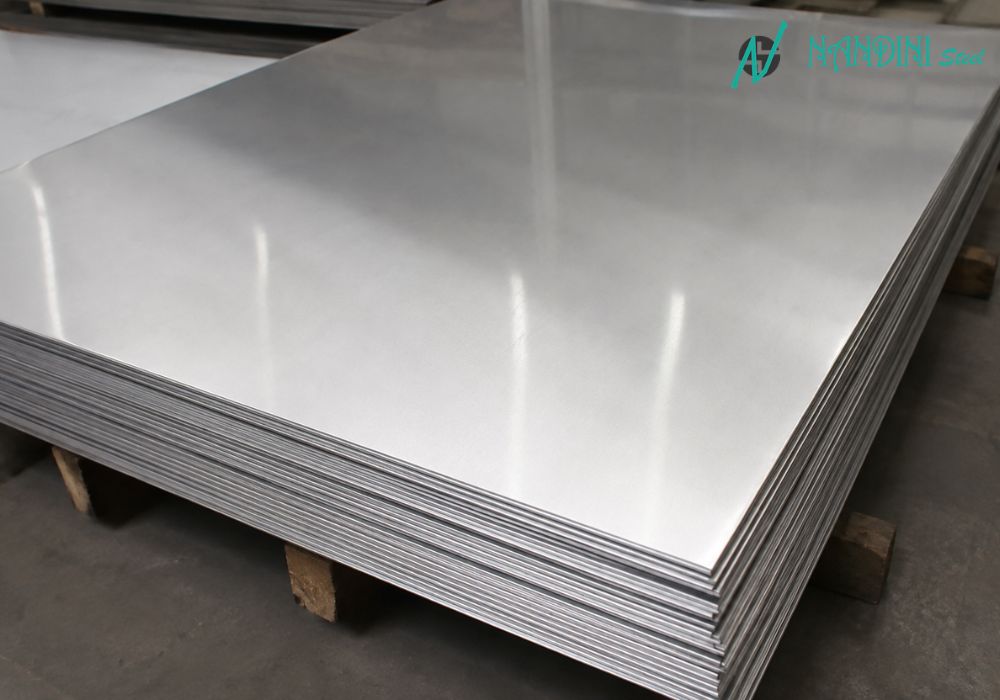
304L stainless steel sheets are a preferred material for fabrication projects that involve extensive welding. The “L” denotes a low carbon content, limited to 0.03%, and this difference from standard 304 makes the grade more dependable after welding. Carbon in stainless steel reacts with chromium at high heat and forms chromium carbides along the grain boundaries. When this occurs near a weld, the metal can lose corrosion resistance exactly where performance matters most. 304L largely prevents that issue, which is why fabricators rely on it for tanks, piping, structural frames, and process equipment that must perform reliably in service, not just leave the shop looking complete.
How SS 304L Sheets Improve Fabrication Efficiency
304L cuts clean on shears, lasers, and plasma without much edge distortion. It bends and forms without cracking at the outer radius, which matters on tighter bends where standard carbon steel would work-harden and split. The material holds dimensional accuracy through multiple forming passes, so parts that go through cutting, punching, and rolling in sequence come out close to spec without constant rework. Machinability is reasonable too, not as free-cutting as 303 but workable with the right tooling and feed rates.
Sheet thickness is consistent across a coil or batch, so nesting parts on a laser table does not result in unexpected kerf width or edge burn. Springback during press brake operations is predictable once the die and tonnage are set for the gauge in use, reducing the trial bends. This consistency allows manufacturers to use the same 304L stock for both small brackets and large fabricated vessels without changing fabrication processes. A single batch of 304L stainless steel sheets can move from shearing to bending and then to welding without requiring significant process adjustments.
Why 304L Sheets Deliver Better Welding Performance
The low carbon content is the key factor, as it reduces chromium carbide formation in the weld heat-affected zone, helping keep the chromium in place and the surface protected from corrosion. Welds come out cleaner, with less sensitization and a lower chance of intergranular corrosion resulting months later in service. Most fabricators don’t need post-weld heat treatment after every weld, which cuts a step out of the process. 304L takes TIG, MIG, and standard arc welding without special preheating, and filler wire matched to the base metal keeps the joint properties close to the parent sheet. Heat input still needs to be controlled on thinner gauges to limit distortion, but that’s a fixture and technique issue, not a material limitation. Multi-pass welds on thicker sections stay stable because repeated heat cycling doesn’t push carbide formation the way it would on standard 304. That’s a big part of why it’s specified over standard 304 wherever welding is heavy, particularly on shop floors running continuous multi-pass work on pressure vessels and structural frames.
Industries That Benefit Most from 304L SS Sheets
Food processing lines use this grade for tanks, chutes, and conveyor frames because the welded joints have to stay corrosion-free under repeated washdowns. Pharmaceutical equipment makers specify it for similar reasons, plus the material meets the cleanliness standards those industries audit against. Chemical processing plants use 304L for vessels and piping exposed to mild to moderate corrosive media, where a compromised weld zone would mean a shortened tank life. Storage tank fabricators lean on it for the same weld integrity reasons. General fabrication shops keep 304L on hand as a default stainless stock because it welds predictably across brackets, frames, ducting, and pressure parts alike. Architectural fabricators use it for structural and decorative welded elements that need to hold their finish outdoors for years without staining at the seams.
Why Choose Nandini Steel for SS 304L Sheets?
Nandini Steel supplies 304L sheets against mill certification, in multiple thicknesses and finishes, for fabrication shops that can’t afford inconsistent material between batches. Sizes and finishes are kept in stock for regular dispatch, so procurement teams aren’t stuck waiting on production runs for standard specifications. The full product range and current specifications for 304L stainless steel sheets are listed for engineers and buyers who need exact dimensional and chemical data before placing an order. Technical support is available for teams working out material selection against a specific welding procedure or fabrication sequence.
Conclusion
304L stays the default choice for welded fabrication because the low carbon content solves the exact problem that shows up after welding standard grades: carbide precipitation and the corrosion risk that follows it. It cuts, bends, and forms with predictable results, and it welds clean across TIG, MIG, and arc processes without extra post-weld treatment in most applications. These advantages are why food processing, pharmaceutical, chemical, and architectural fabricators continue to specify 304L for welded applications. Buyers sourcing 304L stainless steel sheet stock for a welded project should work with a supplier that can confirm certification and consistent specifications batch-to-batch.