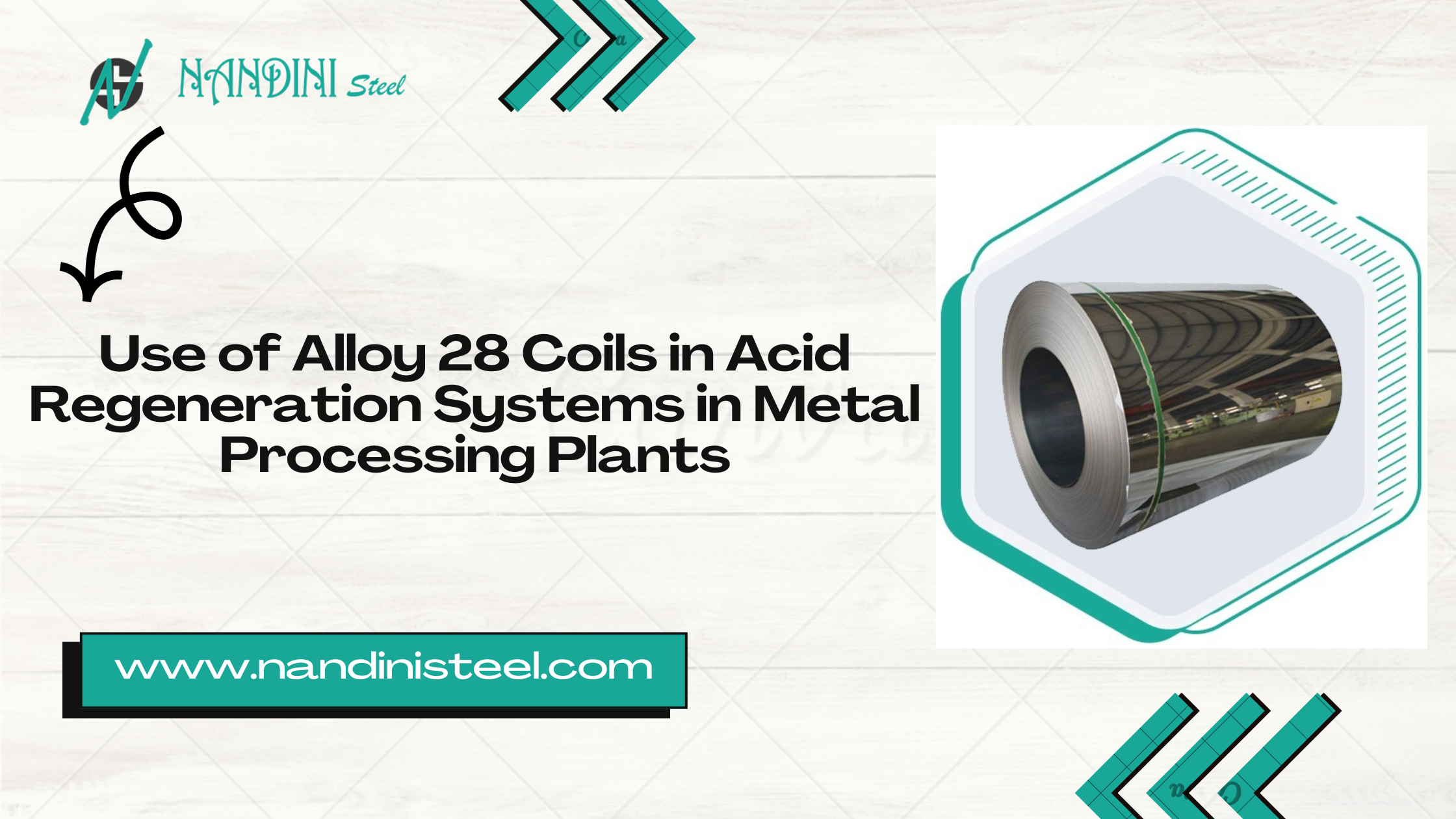
Alloy 28 coils are commonly used in metal processing plants’ acid regeneration systems due to their resistance to HCl, H₂SO₄, and high-temperature corrosive conditions. Acid regeneration machines continuously chemically expose steel pickling lines, towers, absorbers, and heat exchangers, requiring material integrity for long-term performance, process efficiency, and operational reliability in harsh industrial environments. Standard stainless steel grades fail here. 304 sensitizes; 316L pits under concentrated acid at temperature. The economics of acid regeneration demand a material that stands up long-term without constant replacement. That’s where Alloy 28 coil finds its clearest industrial application.
What Makes Alloy 28 Suited to Acid Environments
Alloy 28 designated UNS N08028, also known commercially as Sanicro 28 is a high-nickel, high-chromium, molybdenum-bearing austenitic alloy. Nickel at 29.5–32.5%, chromium at 26–28%, molybdenum at 3–4%, and copper at 0.6–1.4% combine to deliver acid resistance that standard austenitic grades can’t approach. The elevated nickel resists stress corrosion cracking in chloride environments; the molybdenum specifically improves resistance to pitting and crevice attack in reducing acid conditions. Copper additions enhance performance in dilute and moderately concentrated sulfuric acid, the exact concentration range common in spent acid from pickling lines.
ASTM B709 (strip/sheet specification for UNS N08028) governs dimensional and mechanical requirements for the coil and strip form. In acid regeneration service, the alloy resists H₂SO₄ across a wide concentration spectrum, handles HCl in the ranges present after pickling operations, and performs in phosphoric acid environments where chrome-moly or standard stainless grades would corrode rapidly.
Role of Alloy 28 Coils in Acid Regeneration Systems
Acid regeneration systems recover spent pickle acid for reuse a closed-loop process that’s both economical and environmentally required in modern metal processing plants. The coil form of Alloy 28 is particularly valuable here because it can be readily fabricated into tubes, cylindrical liners, ducting sections, and heat exchange elements that form the internal structure of regeneration equipment.
In HCl regeneration towers the roaster/absorber configurations used in hot HCl stripping internal liners and gas ducts see hot, wet HCl vapor combined with iron chloride mist. That environment corrodes carbon steel rapidly and attacks standard stainless. UNS N08028 coil strip, formed into cylindrical liner sections and welded in situ, provides an acid-resistant barrier that extends equipment service life from months to years.
Acid coolers in the circuit where spent acid is cooled before re-entering the process use Alloy 28 alloy steel coil as tube material in shell-and-tube heat exchangers. The alloy handles the combination of thermal cycling and acid exposure without the stress corrosion cracking failures that compromise 316L in the same position. Absorption columns where HCl gas meets water to form regenerated pickle acid represent another critical location; internal components here need the full acid resistance that Alloy 28 provides consistently across operating cycles.
Performance Comparison with Competing Alloys
Refer to the comparative table below to see how Alloy 28 balances cost and performance against other common industrial alloys in hot acid environments:
| Alloy Grade | Corrosion Resistance in Hot/Concentrated Acid | Relative Material Cost | Ideal Application Context |
| 317L | Low; lacks sufficient nickel and molybdenum | Budget-friendly | Mild environments; basic upgrade from 316L |
| 904L | Moderate; falls short in high temperatures/concentrations | Moderate | Standard chemical processing and mild acid lines |
| Alloy 28 | High; optimized for hot, reducing acid circuits | Balanced / Mid-range | HCl and H2SO4 regeneration environments |
| Hastelloy C-276 | Extreme; handles the most severe acid conditions | Very High | Ultra-aggressive, highly concentrated chemical service |
Alloy 28 coil occupies a highly strategic cost-performance sweet spot for acid regeneration projects. While standard grades like 317L and 904L fail under high temperatures and acid concentrations, and Hastelloy C-276 proves cost-prohibitive, Alloy 28 delivers the necessary corrosion resistance at a significantly more manageable procurement price point.
Metal Processing Plant Case Scenarios
Galvanizing lines that use HCl pickling generate spent acid that requires continuous regeneration. Internal ducting in the roaster section fabricated from Alloy 28 coil strip handles the combination of elevated temperature, HCl vapor, and zinc chloride without the pitting and general corrosion that eliminates lower-alloy options.
Cold-rolling mill pickling lines that use H₂SO₄ represent a different acid challenge. Alloy 28 coil formed into heat exchanger tubes in the acid cooling circuit demonstrates sustained resistance to sulfuric acid across the operating concentration range maintaining tube wall integrity through multiple years of 24/7 operation where 316L would require annual replacement.
Continuous annealing and pickling lines (CAPL) in automotive steel production combine thermal stress with acid exposure in a sequence that challenges almost any material. An internal liner strip fabricated from a UNS N08028 coil in the acid section of a CAPL line handles this combined stress reliably.
Sourcing and Specification Checklist
When ordering Alloy 28 coil for acid regeneration service, specify ASTM B709 for strip/sheet form. Confirm thickness range matches your fabrication requirement: a typical coil strip runs from 0.5 mm to 6 mm depending on the component geometry. Request EN 10204 3.1 Mill Test Certificates (MTCs) document the material’s chemical analysis and mechanical properties from the mill, providing the traceability that process industry procurement requires. We at Nandini Steel supply Alloy 28 coil with full MTC documentation and in-stock availability across standard gauge and width combinations.
Conclusion
Alloy 28 coils deliver the acid resistance, fabrication flexibility, and cost-performance balance that acid regeneration systems in metal processing plants require. HCl and H₂SO₄ service the environments that defeat standard stainless are precisely where UNS N08028 earns its specification. Match the coil gauge to your fabrication requirement, confirm ASTM B709 compliance, and source from a supplier who provides full MTC documentation with every order.