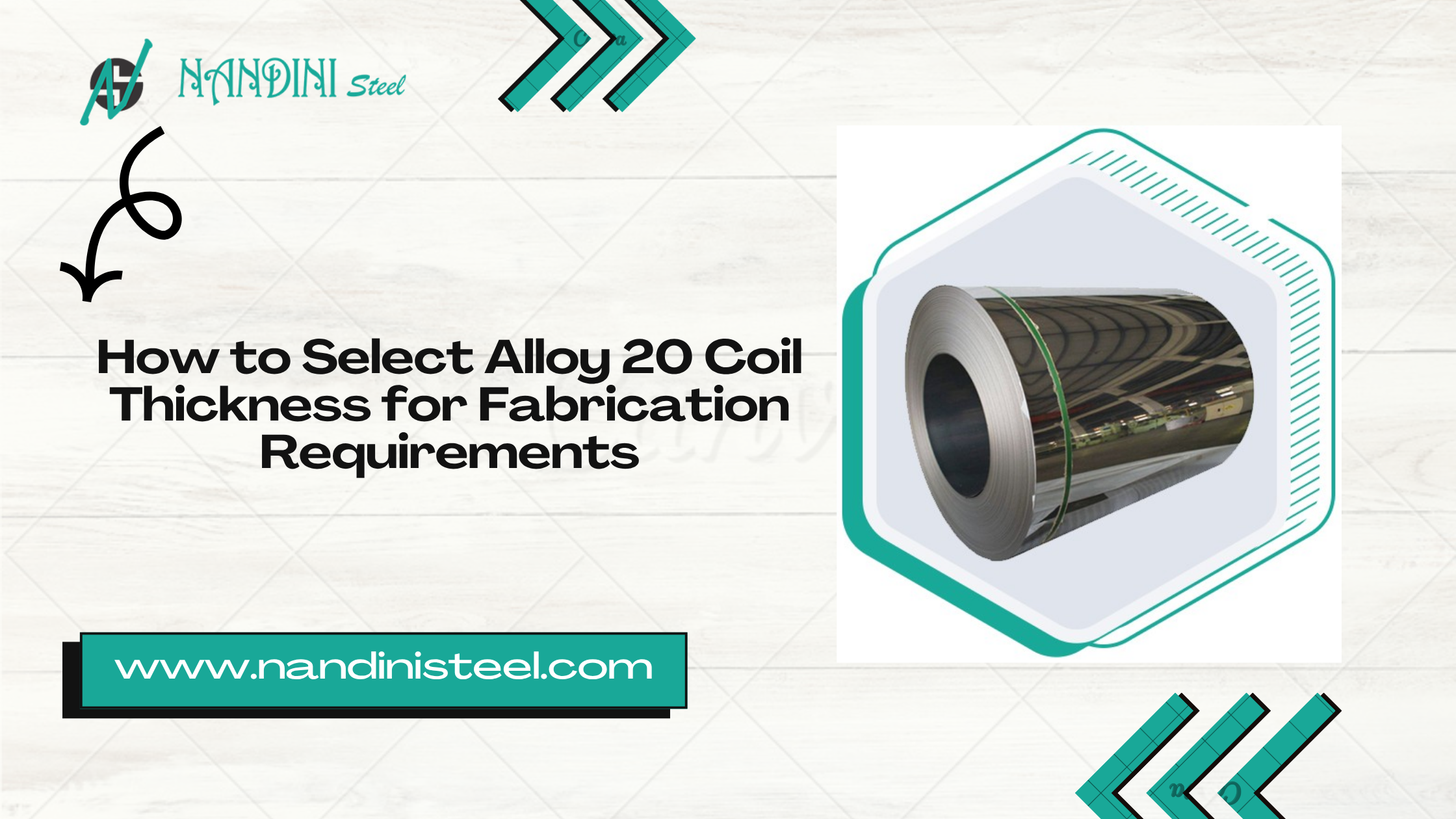
Choosing the right Alloy 20 Coil thickness is rarely as simple as matching a number to a corrosion chart. Alloy 20 Coil thickness selection depends on the fabrication method, component geometry, forming and welding requirements, structural or handling loads, dimensional stability, service environment, and the applicable material specification. If you get one of these wrong, the coil fails during forming or falls short in service.
What Determines Alloy 20 Coil Thickness?
Several factors work together before a nominal thickness gets locked in. The type of fabricated component sets the baseline: a vessel shell, a duct section, and a small bracket carry different structural expectations. Required mechanical strength and rigidity follow from load and support conditions. Forming radius and expected deformation limit how thin the material can go without cracking. Welding method, joint configuration, operating pressure, corrosion conditions, and tolerance requirements add further constraints. Thickness has to come from the engineering design and the Alloy 20 fabrication requirements of the project.
Match Coil Thickness to the Fabrication Process
The fabrication process shapes what thickness range is workable. Roll forming, press-brake forming, bending, cutting, stamping, and welding each place different demands on the material. Alloy 20 runs through conventional industrial equipment, but it work-hardens at a comparatively high rate during cold forming. Alloy 20 can generally be press-brake bent over a radius of roughly twice the material thickness, and that heavy cold reduction may call for a stabilizing anneal. Thickness and forming methods are not separate decisions; they have to be worked out together.
How Thickness Affects Alloy 20 Coil Forming and Welding
Thinner coil forms with less force and tighter radii, but it moves more during welding. Controlling distortion becomes the priority once material drops below a certain gauge, particularly on long welded seams.
Thicker material resists distortion better and holds its shape through handling. The trade-off is forming force: press brakes and rolls need more tonnage, and bend geometry has to account for greater resistance to deformation.
Welded assemblies bring thickness, joint design, and heat input into one equation. Technical references on Alloy 20 fabrication list different welding parameters for different base metal thicknesses, confirming that gauge directly shapes welding conditions. No universal current or bend radius figure applies across every thickness; each gauge carries its own parameters, drawn from the applicable procedure or specification.
Consider Alloy 20 Coil Thickness Against Service Conditions
The finished component still has to perform in service once forming and welding constraints are settled. Corrosive chemical exposure, sulfuric acid contact, chloride-containing environments, temperature, mechanical loading, and corrosion allowance all factor into the final thickness decision. Alloy 20 was developed for resistance to sulfuric acid and also offers resistance to pitting, crevice corrosion, and chloride stress-corrosion cracking, and that resistance comes from the alloy’s composition, not from extra thickness. Thickness and corrosion resistance solve different problems: one governs structural life under load; the other covers chemical attack. Treating a thicker coil as a substitute for the correct alloy grade leads to over-engineered parts that still fail if the chemistry mismatch is never addressed.
Alloy 20 Coil Thickness: What Specifications Should Buyers Check?
- UNS N08020 designation confirmed against the mill certificate
- Applicable ASTM/ASME material specification for the product form
- Nominal thickness matched to the fabrication drawing
- Thickness tolerance within acceptable range
- Coil width suited to the blanking or slitting plan
- Surface finish and delivery condition confirmed
- Test certificates are included with the shipment
- Cutting or processing needs to be communicated before dispatch
For sheet, plate, and strip forms, ASTM B463 is commonly referenced for Alloy 20, though the exact specification must match the product form and purchase order.
How to Choose the Right Alloy 20 Coil Thickness
Step 1: Define the finished component and its dimensions.
Step 2: Identify the forming and joining processes involved.
Step 3: Establish mechanical and service requirements, covering load, temperature, and chemical exposure.
Step 4: Determine the engineering thickness and tolerance from the design calculation, not an estimate.
Step 5: Confirm available Alloy 20 Coil sizes and Alloy 20 Coil specifications with the supplier.
Step 6: Verify material certification before fabrication begins.
Conclusion
Thickness requirements for Alloy 20 Coil vary by fabrication application. The right gauge depends on component geometry, forming process, mechanical design, welding method, and service environment. Skipping any one of these factors shifts risk onto the shop floor or into the field. Review your Alloy 20 Strip thickness and coil requirements against your project drawings, then check current Alloy 20 Coil stock and specifications on Nandini Steel’s product page before placing your order.