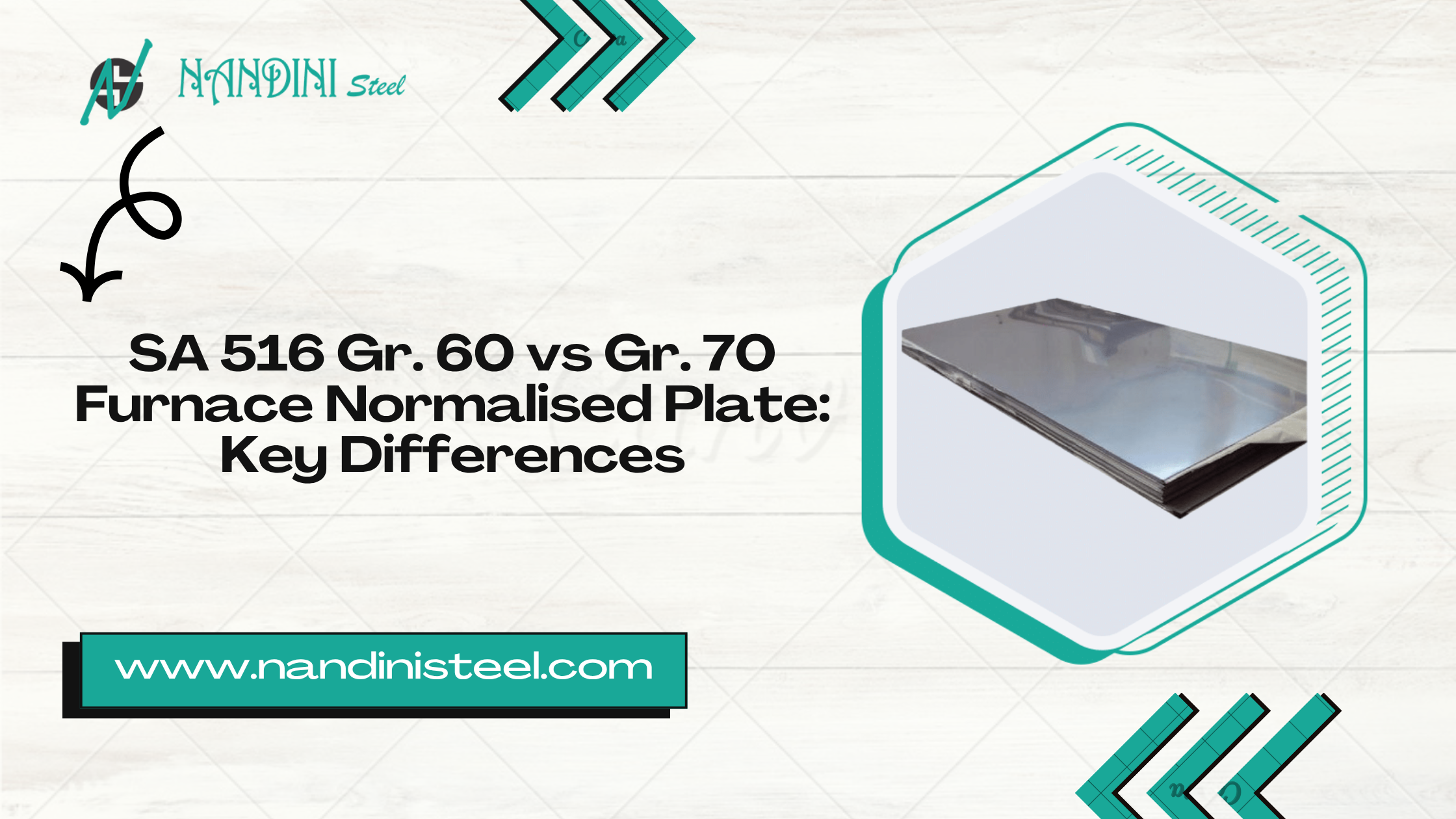
ASTM/ASME SA 516 covers pressure vessel plate across several strength grades, and Grade 60 and Grade 70 sit at different levels within that specification. Furnace normalization is a separate matter. It describes the heat treatment condition the plate is supplied in, not the property separating one grade from the other. Buyers sourcing SA 516 Gr. 60/70 plate furnace normalized, often blur these two decisions. Grade selection follows the design calculation. Heat treatment conditions follow the specification, thickness, and project documentation.
SA 516 Grade 60 vs Grade 70: Key Differences
The two grades differ mainly in tensile strength, yield strength, and elongation. Values below come from ASTM A516/ASME SA-516.
| Factor | SA 516 Grade 60 | SA 516 Grade 70 |
| Tensile strength | 415–550 MPa (60–80 ksi) | 485–620 MPa (70–90 ksi) |
| Yield strength | 220 MPa (32 ksi) min, ≤25 mm | 260 MPa (38 ksi) min, ≤25 mm |
| Elongation | 21% (200 mm) / 25% (50 mm) min | 17% (200 mm) / 21% (50 mm) min |
| Relative strength and ductility | Moderate strength, higher ductility | Higher strength, slightly lower ductility |
| Selection focus | Moderate pressure vessels, cost-sensitive designs | Higher pressure or thicker vessels needing reduced wall thickness |
Both grades fall under the same SA 516 plate specifications and are supplied fine-grained and killed, with impact testing optional depending on the order.
What Does Furnace Normalisation Mean for SA 516 Plate?
Normalising heats the plate above its upper critical temperature and lets it air-cool afterwards. This resets the coarse-grain structure that hot rolling leaves behind, giving finer, more uniform grains and better toughness. For pressure vessel work, the supplied condition matters as much as the grade. Whether normalising applies to a given order depends on the specification, thickness, and project requirements, so this should be checked against the standard rather than assumed.
Grade 60 vs Grade 70: Mechanical Performance
Grade 70’s higher yield and tensile values allow thinner sections for the same design pressure, cutting plate weight and welding volume. Grade 60 trades some strength for higher elongation and better forming behaviour. Neither grade wins outright. Tight thickness limits may call for Grade 70, while heavy cold forming may suit Grade 60. Fabrication method and code minimums decide this, not strength alone.
How to Choose Between SA 516 Grade 60 and Grade 70
The selection begins with the design calculation, since ASME Section VIII sets allowable stress by grade and thickness. Check whether fabrication involves heavy cold forming, which favours Grade 60’s extra elongation. Confirm the governing pressure vessel code and any impact testing in the project specification. Toughness requirements at low service temperatures can rule a grade in or out regardless of strength. The final choice on SA 516 Grade 60 vs Grade 70 should come from these checks, not from the higher strength number.
What Buyers Should Verify Before Ordering Furnace-Normalized SA 516 Plate
Before placing an order for furnace-normalised plates, buyers should confirm a set of details that affect compliance and delivery timelines.
- Confirm whether the order needs Grade 60 or Grade 70 based on the design calculation.
- Verify the ASTM or ASME specification edition listed in the project documentation.
- Check the required thickness and dimensions against available mill sizes.
- Confirm the supply condition, including furnace normalisation where specified.
- List the mechanical property requirements needed for the test certificate.
- Ask whether impact testing applies and at what test temperature.
- Request a material test certificate showing chemistry and test results.
- Confirm heat and lot traceability through to the delivered plate.
- Check project-specific inspection or documentation requirements before finalising the order.
Nandini Steel supplies SA 516 Gr. 60/70 plate furnaces. Normalised with mill test certification and heat-traceable documentation.
FAQs
What is the difference between SA 516 Grade 60 and Grade 70?
Grade 70 carries a minimum tensile strength of 485 MPa and a minimum yield of 260 MPa, both higher than Grade 60’s 415 MPa tensile and 220 MPa yield. Grade 60 gives up strength for more elongation.
What does furnace normalisation mean for SA 516 plates?
It refers to the heat treatment condition, not the grade. Normalising refines the grain structure through controlled heating and air cooling, improving toughness and consistency.
Is SA 516 Grade 70 always better than Grade 60?
No. Grade 70 offers higher strength, but Grade 60 offers more elongation for cold-forming work. The right choice depends on the design calculation and fabrication method.
What should buyers verify when ordering a furnace-normalised SA-516 plate?
Buyers should confirm the grade, specification edition, thickness, supply condition, and mechanical property requirements. A material test certificate with heat traceability should accompany the plate.